For India’s size and diversity, the Indian startup and developer ecosystem has made use of the capabilities offered by Google AI Studio, Cloud, and Vertex AI to build more quickly, intelligently, and effectively. Eight startups showcased at I/O Connect applications built using Google’s advanced AI models, demonstrating their potential to affect various domains, including education, governance, commerce, and media.
What Are the Top Sectors Driving Indian Startup Growth?
Several factors will define the makeup of 2025–2026. While e-commerce and finance remain mainstays, new, high-growth areas such as enterprise IT are attracting the lion’s share of investment and attention.
- AI and DeepTech: This is the breakout sector. In 2024, funding for DeepTech increased by 78% to $1.6 billion. The primary motivator is artificial intelligence, with prosperous Indian AI businesses like Krutrim and Sarvam AI developing fundamental models trained on Indian languages.
- Fintech: The foundation of India’s digital economy is still this industry. The Indian fintech industry showed its tenacity by seeing a 56% increase in revenue to $25 billion in 2023. According to BCG forecasts, India will see its fintech industry grow to $190 billion by 2030, thanks to growth across wealth management, lending and payments.
- Quick Commerce: As reported, Instamart has registered a delivery of 70 million orders in Q2 of 2024, while Blinkit has registered about 93 million orders. Grocery, convenience, and pharmacy delivery remain essential drivers in urban India. Other D2C brands are gaining traction on the back of social commerce and marketplaces.
What Is an AI Startup?
AI Startup – An enterprise that leverages machine learning and AI to manufacture products and services. These particular companies leverage automation, data and algorithms to solve real-world problems faster, smarter and more efficiently.
AI companies are shaping the way we work, from detecting fraud to making personalised suggestions. While these Indian startups are not just following the global trends in healthcare, finance, education, and other areas, they are taking their own unique routes.
Key Factors Driving the AI Boom in India
Several robust engines are driving India’s ascent to become an AI powerhouse. Here are some of the factors driving this growth in the ecosystem of AI startups.
Vast data and digital infrastructure
Rich datasets and practical business cases are provided by India’s extensive digital footprint, which includes Aadhaar and UPI. According to recent research, this infrastructure would play a major role in India’s AI market, tripling to US$17 billion by 2027.
Strong talent pool and cost-effective tech
India is the world leader in the use of AI skills, and numerous government initiatives are increasing training.
India becomes a desirable site for entrepreneurs and international investors due to its large number of STEM graduates, increasing AI proficiency, and lower operating costs.
Government support & startup-friendly policies
The government provides funding and infrastructure support for businesses and has started programmes like the IndiaAI Mission.
The AI investment landscape in India has improved with these policies, which lower entry barriers, promote innovation, and hasten the adoption of AI across industries.
Growing funding & global investor confidence
The AI sector in India is seeing a rise in investor capital. International businesses are investing in India, demonstrating their faith in the potential of the country. In the realm of AI startup funding, this translates into additional funds, resources, and opportunities for your business. When combined, these elements provide an exceptionally robust environment for AI startups in India going forward.
Top Artificial Intelligence Stocks in India in 2026 as per Market Capitalisation
The top AI stocks in India in 2026, according to market capitalisation, are shown in the following table:
| Serial number | Stock Name | Market Capitalization (Crores) |
| 1 | Bosch Ltd | Rs. 1,11,456.47 |
| 2 | Persistent Systems Ltd | Rs. 83,196.16 |
| 3 | Oracle Financial Services Software Ltd (OFSS) | Rs. 70,346.15 |
| 4 | L&T Technology Services Ltd (LTTS) | Rs. 37,867.84 |
| 5 | Affle 3i Ltd | Rs. 20,321.86 |
Overview of Best Artificial Intelligence Stocks in India as per Market Capitalisation
This is a thorough summary of artificial intelligence shares in India based on market capitalisation and analyst ratings for 2026.
Bosch Ltd
German multinational technology and engineering company Robert Bosch GmbH, established in 1951, is a major entity in the Indian automotive components market, specialising in industrial mobility solutions, power tools and technology. Bosch Ltd. is its prime subsidiary in India. The business is renowned for heavily using AI and software into their fundamental automotive solutions. While it provides sensors, fuel injection systems and engine components, electronic control units (ECUs) and braking systems, the automotive market represents about 85% of its net sales.
Persistent Systems Ltd
Founded in 1990, Persistent Systems, a prominent worldwide provider of IT services, is headquartered in Pune. Its area of focus is digital transformation, enterprise modernisation and software product engineering. As of mid-2026, it is a leader in generative AI (GenAI) services, using its distinctive Re(AI)magining strategy to integrate AI into its data management, software delivery, and business operations.
As of late 2025, the corporation had maintained a record of 20 consecutive quarters of sales growth. Additionally, it has collaborated with DigitalOcean to promote Agentic Cloud services and with NVIDIA for AI-backed drug discovery. Additionally, the business maintains high levels of operational efficiency and is mostly debt-free.
Oracle Financial Services Software Ltd (OFSS)
The business is a major global supplier of IT solutions for the financial industry and is a division of Oracle Corp. The company, which has its headquarters in Mumbai, specializes in risk management, compliance, and banking software like FLEXCUBE.
The company, a branch of Oracle Corp., is a significant worldwide provider of IT solutions for the financial sector. The Mumbai-based company specializes in risk management, compliance, and banking software such as FLEXCUBE.
L&T Technology Services Ltd (LTTS)
LTTS is an engineering and R&D firm, a key part of the LT Technologies Corporation. It focuses its ER&D on software and the software aspect within technologies related to mobility and smart engineering of high-tech products like Wearables. LTTS is considered a leading outsourcing firm globally, offering engineering, research and development (ER&D) services. The business has made significant investments in full-stack EI (Engineering Intelligence) and Agentic AI as of early 2026. It has significant alliances, such as one with NVIDIA, and gains from being a member of the respectable Larsen & Toubro (L&T) Group.
Affle 3i Ltd
Affle 3i Ltd, formerly known as Affle India, is a prominent international technology business that provides AI platforms for targeted mobile advertising based on consumer intelligence. Only the conversion rate (CPCU) is charged to advertisers. It has had rapid expansion, with a 5-year revenue CAGR above 47% and a net income CAGR exceeding 42%.
The business is nearly debt-free and has better liquidity, with a TTM net profit margin of 16.95%. Additionally, total cash increased from ₹49.1 crore in FY21 to ₹835.8 crore in FY24.
Regulatory issues & compliance for AI startups
Perhaps the most important and underappreciated difficulty is this one. Both in India and internationally, AI startups must navigate a complicated web of privacy, governance, and data protection requirements. “Nearly 95% of generative AI projects face delays or failure due to unclear regulatory frameworks and integration issues,” according to the World Economic Forum. The planned IndiaAI Mission framework and the Digital Personal Data Protection Act (DPDP Act 2023) in India are changing the way AI systems must manage user data, accountability, and transparency.
Compliance is a fundamental design philosophy for AI entrepreneurs rather than a checkbox. Incorporating privacy, fairness, and openness into your strategy from the start will increase user and investor trust while also ensuring compliance.
Industries Being Transformed by AI
Artificial intelligence has enormous potential to advance technology, considering that it powers “any machine that does things a brain can do”. Here, we examine five sectors where AI has had a major early influence.
Manufacturing
The most popular uses of AI in manufacturing involve real-time production monitoring, which includes tracking scrap rates and fixing bottlenecks to increase output while cutting waste. In order to maximise output, the technology also helps businesses determine which staff, shifts, and processes are most effective at using the machines.
AI is also helpful for machine maintenance, anticipating when maintenance will be required, accelerating prototyping, optimising product design, forecasting product demand, and adhering to industrial regulations.
Healthcare
Big data, AI, and related technologies are revolutionising the healthcare sector and improving results while cutting expenses in a number of ways. Healthcare providers are leveraging AI software to broaden their knowledge. Having data helps them make better decisions and be more successful. For instance, every stage of the delivery of care can benefit from the application of quantitative and qualitative data to enhance early disease detection, diagnosis accuracy, and treatment planning. Patient responses feed databases, resulting in a system that is always improving.
Retail and Fashion
The use of AI technology in the retail sector is expanding quickly. Online customer support interactions are increasingly powered by chatbots, and online advertising is utilising augmented and virtual reality technologies. Without ever leaving their homes, let alone taking off their shoes in a fitting room, internet buyers may experience the equivalent of a custom-tailored clothes fit thanks to immersive visualisation. AI may soon be able to accurately forecast trends based on global fashion purchasing data patterns.
Business Intelligence
Enterprise Resource Planning, also known as ERP software, is designed to centralise a business’s data and operations onto one platform. However, the functionality of those software programs has been expanded with smart AI-powered dashboards and analytic tools that pull out relevant data, provide decision support, and give insights to business executives. This allows companies to take larger investment bets with lower risk. One result is that they can expand even in times of economic recession.
Education
The use of artificial intelligence to build personalised learning strategies for specific groups of learners is rapidly gaining traction. AI can take into consideration individual variances in learning styles and learning obstacles, promoting inclusion and improving learning results. For instance, teaching strategies can be influenced by algorithms that determine how kids with particular aptitude sets learn geometry. In reality, in order to make learning type segmentation more practical, the conventional model of teachers in classrooms is probably going to shift.
Top AI Companies in India
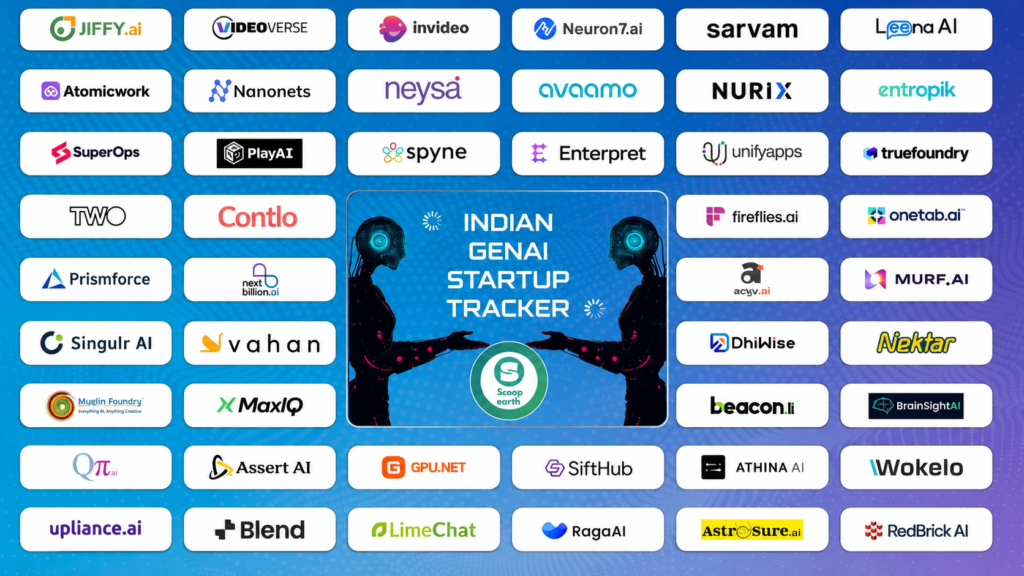
The top Indian startups are listed here, arranged by industry. These businesses are a blend of well-known unicorns and rapidly expanding businesses that are influencing the market.
Krutrim
As previously said, in January 2024, Krutrim emerged as the first AI unicorn in India. It was founded by Bhavish Aggarwal of Ola and is developing India’s own “full-stack” AI, which includes bespoke AI processors and foundational large language models (LLMs) trained on 22 Indian languages.
Sarvam AI
Another well-known generative AI business, Sarvam AI, is dedicated to creating LLMs in Indic. It is creating models like “Sarvam-1” that have been trained on two trillion tokens to cater to the Indian market with the support of the government’s IndiaAI Mission.
Fractal
Serving Fortune 500 clients, Fractal is a longstanding leader in the AI and analytics area. It offers supply chain, marketing, and decision-making solutions driven by AI. It became a unicorn and is allegedly considering an IPO.
Yellow.ai
One of the top conversational AI platforms in India is Yellow.ai. With strong AI chatbots and speech bots that can answer up to 80% of questions, it assists businesses like Fortune 500 corporations in automating staff and customer assistance.
Arya.ai
An Indian AI firm called Arya.ai is concentrated on the BFSI industry. It provides an AI platform that complies with regulations to assist banks and insurers in implementing intricate deep learning models. The Arya platform is perfect for underwriting, fraud detection, and risk modelling.
Mad Street Den
Mad Street Den, an Indian AI firm based in Chennai, is transforming retail with their AI platform, Vue.ai. Product tagging, cataloguing, and recommendation engines are powered by its visual recognition and personalisation technologies.
It is one of the most well-known AI firms in India, using neuroscience and machine learning to simulate human perception in fashion technology.
Locus
One of the emerging AI-based businesses in India is Locus, which offers supply chain solutions driven by AI. Businesses may lower expenses and increase delivery efficiency with our routing and logistics optimisation software.
Locus, one of the most cutting-edge Indian AI businesses in logistics, serves clients worldwide in a variety of industries, including e-commerce and FMCG.
Uniphore
The Indian AI development unicorn Uniphore is providing automation and conversational AI platforms for customer service and sales. It offers customer sentiment recognition, multilingual support, and AI assistance to its agents.
Overcoming challenges: What you need to know
Even if AI has a lot of potential, it’s crucial to recognise some of the difficulties:
Data privacy and security
Startups need to be careful to safeguard client information. Make sure your AI technologies abide by data protection laws, such as the Data Protection Bill in India. Putting security and openness first can help you gain the trust of your clients and stay out of trouble with the law.
Finding AI talent
It can be difficult for startups to find qualified personnel to build an AI-driven firm. You can locate the knowledge you require by working with colleges, training facilities, or even distant talent pools.
Infrastructure
Robust computational resources are necessary for AI. Working with cloud service providers can give early-stage firms scalable and reasonably priced access to the infrastructure required for AI development.
Navigating regulations
India’s AI regulations are still being developed. To maintain compliance and help build an ethical AI ecosystem, stay informed on new rules and regulations.

Current State of Artificial Intelligence in India
Over the past ten years, India’s AI ecosystem has expanded quickly. India is currently in the top 10 nations in the world for talent availability, research production, and AI adoption. More than 5,000 AI firms in the fields of healthcare, finance, agritech, education, retail, and governance are based in India, according to NASSCOM.
Rising cloud adoption, inexpensive computers, government efforts, and a youthful, tech-savvy workforce are the main drivers of this rise.
Future Roadmap: 2024–2030
Between 2024 and 2030, it is anticipated that India will transition from adopting AI to becoming an AI leader. AI might add almost $1 trillion to India’s economy by 2030 and change more than 80% of businesses.
India’s experience with large-scale digital systems such as India Stack offers a robust basis for the responsible and cost-effective deployment of AI across various sectors.
Conclusion
AI startups are shaping India’s digital future. There is no denying the momentum; the ecosystem is rapidly maturing, finance is growing, and innovation is surging. Growth, however, presents difficulties. Strong infrastructure, competent personnel, good governance, and smart finance are necessary for developing scalable AI solutions.
When starting or growing an AI business in India, combine structure and ambition. Integrate vision with execution, creativity with accountability, and innovation with compliance. In this way, India’s upcoming AI startups will not only expand but also take the lead internationally.