For decades, the workforce has evolved thanks to the emergence of new technologies that promote the automation of tasks in companies. The transformation, which has been ongoing since the appearance of simple scripts until robotic process automation, sees businesses increasingly minimising repetitive and unnecessary tasks while raising the productivity levels of organisations. But this new technology, driven by intelligent machines and called AI agents, breaks all the established rules of the game.
This definition has become a notable technological breakthrough of 2026 as more companies rely on artificial intelligence technologies (AI). While traditional software operates according to established rules, the AI agents analyse information, learn, make decisions, and execute tasks with little human intervention.
What is Traditional Software?
Traditional software is written to follow precise rules and instructions. It completes duties just as developers have specified.
For instance:
- Software for Payroll Management
- System for Inventory Management
- Accounting Applications and CRM Software
Features of Traditional Software
Let us not write off traditional software entirely. It functions well in surroundings that are predictable, structured, and have definite, unchanging results.
- Built on static logic and defined user flows.
- requires manual configuration and regular upgrades.
- doesn’t change without input from developers.
- lacks the capacity to interpret natural language or make decisions.
Where Does Traditional Software Break Down?
The main issue? Conventional software is quite good at following instructions, but it struggles to make changes when they are not necessary.
- rigid in the face of shifting consumer behaviour.
- Without manual segmentation, responses cannot be modified.
- It takes a lot of work to scale across new use cases or verticals.
- Higher operational expenses owing to human mistakes and upkeep.
What Are AI Agents?
AI agents constitute a unique category of software. Instead of following an established path, they can evaluate the situation, ascertain what needs to be done, and act independently. They can do so since they utilise machine learning and big language models, which allow them to analyse unstructured data, accomplish multi-step tasks, and adapt to the context.
Agentic AI automation is characterised by multiple agents operating in a system, with each of them taking care of some particular part of a larger operation. One agent can collect the data, another can process it, and yet another can use the processed data in to act accordingly. The final result is automation capable of covering new ground impossible for any rules-based system.
AI agents’ primary functions include:
- They are not limited to organised data fields; they are also capable of reading and producing human language.
- Context-aware decision-making in multi-step processes with constantly shifting situations
- End-to-end task completion through integration with external tools, APIs, and databases.
- The capacity to grow and learn from fresh knowledge throughout time
- Coordinating with additional tools or agents to manage intricate, composite jobs
When to Use AI Agents?
When there is actual unpredictability in the work, AI agents deserve their position. Rule-based automation will continue to create bottlenecks rather than remove them if your processes handle unstructured data, need judgement calls, or change too frequently for scripts to keep up.
Frustration with these limitations has been a major driving force behind the use of AI for business automation. Teams were devoting a great deal of time to edge cases, exceptions, and jobs that were too diverse to automate using the previous method. That is filled by AI agents.
Examples of effective use cases for AI agents include:
- consumer support representatives who comprehend what a consumer is genuinely requesting, identify the appropriate response, and fix the problem without always referring it to a human
- Document analysis is the process of extracting important details from financial reports, medical data, and contracts, regardless of their format.
- Drafting outreach emails, qualifying leads, and monitoring each prospect’s progress are all examples of sales assistance.
- IT helpdesk: identifying technological problems based on conversational descriptions and guiding users through a remedy
- Supply chain management: identifying interruptions early and suggesting or carrying out alternate routing choices
The Rise of AI Agents
Intelligent systems with the ability to learn, adapt, and make decisions are known as AI agents. Unlike traditional automation, AI agents can analyse enormous quantities of data, recognise trends, and respond to novel scenarios without explicit instructions.
An AI agent in a customer support team, for instance, can respond to a variety of questions. It can answer standard enquiries, recognise when a problem needs to be escalated, and even learn from previous exchanges to gradually improve its responses.
In dynamic contexts where rules are insufficient, AI agents flourish. They can absorb information in real time, make judgements, and continue learning, which allows businesses to automate more complicated processes than ever before.
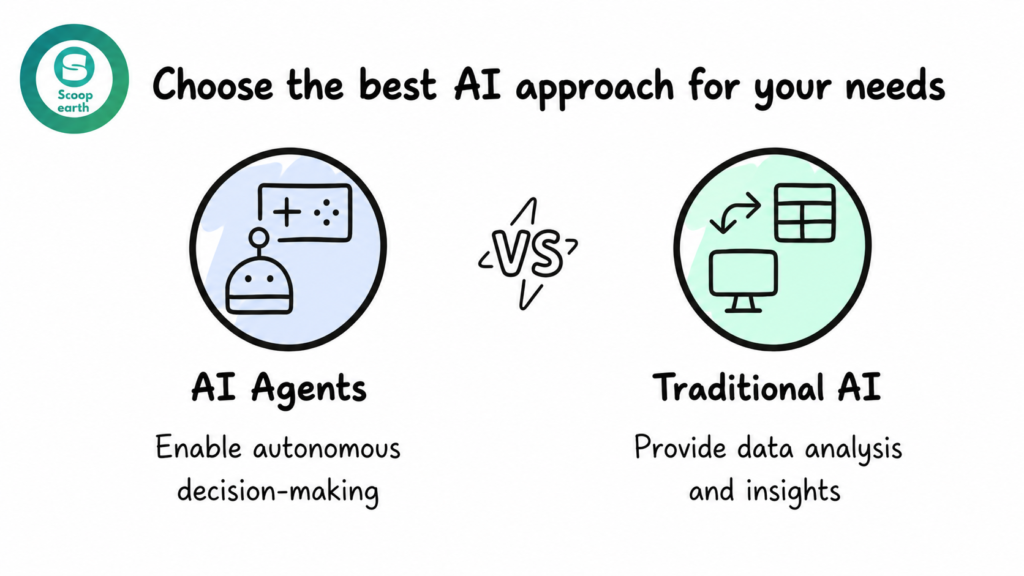
Comparison of AI Agents and Traditional Software
Now, let us consider the most important differentiators between AI agent-based software vs. That of the traditional. Let us consider, for example, the cases of ROI, scalability, and flexibility.
Flexibility
The capacity of the AI agents for adaptation toward different variables is amazing (for example, business conditions or consumer needs). Standard software will be reformed whenever rules change.
- Using context and data, AI agents answer in real time.
- In traditional software, logic trees and processes were important.
- They discover changes in user intent on their own, identifying escalation needs. With an average of 40 per cent fewer humans are needed to run a software robot versus rule-based software bots.
Cost-Effectiveness Over Time
Software has historically seemed more cost-effective at first. However, greater productivity and process automation quickly make AI agents cost-effective.
- When compared to traditional software, AI agents lower operating expenses by 30% to 50%, according to McKinsey (2025).
- When it comes to repetitive duties like ticket handling and follow-ups, AI bots minimise the need for human interaction.
- Hidden Costs with Integration and Updating of Software Traditionally
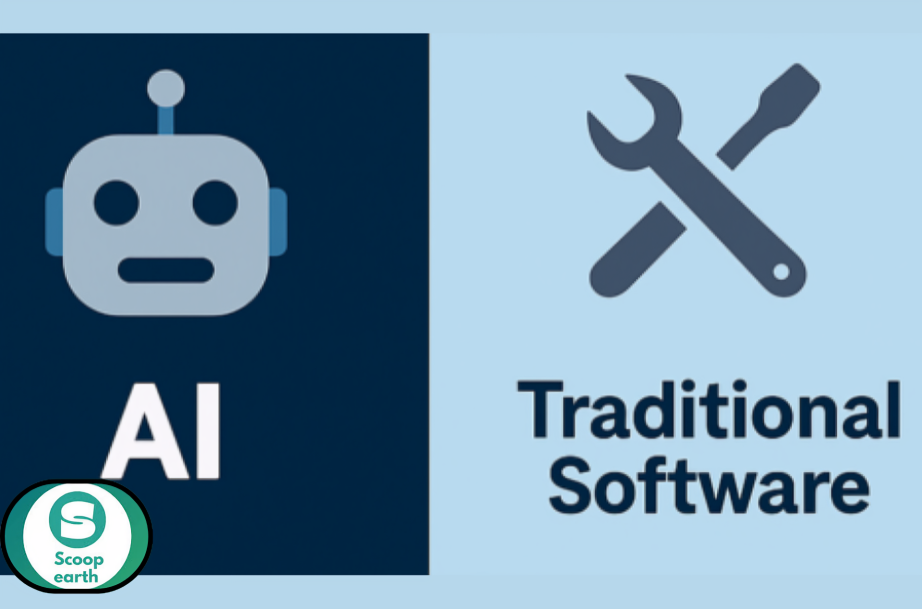
AI Agents vs Traditional Software
While software and AI agents might share many objectives, they come with inherent differences regarding performance and functionalities. Organisations looking to make well-informed decisions on the method that’s appropriate to their operations in the rapidly changing digital age must know how the two differ.
Scope and Functionality
Standard Software: Built to perform a specific set of predetermined actions. For instance, a billing tool will only do the work of sending invoices and receiving payments.
AI agents: Perform predefined functions while also managing dynamically, orchestrating numerous tools via API calls, and even collaborating with other tools to automate processes. For example, an AI project management agent may be tasked with dynamically redistributing resources in response to new deadlines or plan modifications.
Core Differentiation
The primary differentiator is that AI agents handle complex, goal-oriented tasks, while traditional software tends to perform specific functions linearly.
Autonomy, Adaptability & Decision Making
Conventional software: Normal software relies on if-then conditions and instructions. Though they are not equipped to handle unpredictable inputs and unstructured data, they function perfectly well under a given set of circumstances. Manual adaptation and upgrades are required for change.
AI Agents: Agents are autonomous and proactive, capable of learning through cognitive models like reasoning and thinking. AI agents take independent decisions based on real-time situations and adapt dynamically to different situations, without requiring human intervention. A customer support AI agent can continuously improve itself from customer interactions.
Key Difference
The difference between AI agents and conventional software AI agents: Learning machines, they adapt AI systems as they perform actions. Conventional software: Pre-programmed tools execute set instructions.
Architecture and Design Approach
Traditional Software: Built on proven processes and procedural knowledge. Redesigning and redeploying are required for modification.
AI Agents: Based on cutting-edge AI models such as machine learning, neural nets, and natural language processing. Because AI agents work in closed-loop systems, they can continuously improve themselves throughout the course of their existence.
Important Distinction
The AI bots are designed to constantly evolve and adjust to new situations. Manual modification is necessary for traditional software.
User Interaction and Experience
Conventional Software: Provides buttons, dropdown menus, forms, and organised user interfaces without any true contextual intelligence.
AI agents: Offer conversational experiences that are intuitive and human-like. They react instantly, comprehend spoken language, and adjust to user preferences.
Important Distinction
Rich, customised interactions are made possible by AI agents. The interfaces of traditional tools are inflexible.
Scalability, Maintenance & Updates
Conventional Software: Manual updates and major infrastructure modifications are frequently required for scaling up. Maintenance cycles are developer-driven and costly.
AI Agents: AI agents are cloud-native, modular, and self-improving. They can readily scale through APIs, self-tune, and adapt without the need for human input.
Important Distinction
AI agents self-maintain and scale with ease. For traditional apps to expand or change, manual engineering is required.
Why is AI adoption in business growing?
The application of artificial intelligence is growing fast in numerous firms. Artificial intelligence in businesses is no longer an option for those who are looking forward to being competitive. It assists firms in predicting trends, making good decisions, and turning raw data into valuable information.
For instance, retailers use AI to interpret the behavior of customers and come up with recommendations. The logistics firms use AI to predict delays, optimize the route and cut costs of operations. Because of AI bots, even small things like customer segmentation and stock replenishment are now smarter.
The optimisation of the workforce is another advantage of using artificial intelligence. Employees get a chance to focus on strategic thinking, creative problem-solving, and innovations, since they will be dealing with repetitive tasks that are managed by AI.
Comparing AI Agents vs Traditional Automation
Understanding AI agents vs classical automation helps organisations determine the correct solution for their operations. The following points illustrate the differences:
Flexibility and Adaptability
Fixed rules are followed by traditional automation. The system is unable to adapt if the input does not match expectations. In contrast, AI bots are capable of learning and adapting. Without continual human oversight, they can manage variations, exceptions, and unforeseen circumstances.
Complexity of Tasks
For routine, predictable tasks, traditional automation works best. Complex workflows, such as multi-step decisions and dynamic processes, can be managed by AI agents. Unstructured data, like emails, photos, and client reviews, can be interpreted by them.
Decision-Making Capabilities
Beyond its programming, traditional automation is unable to make decisions. AI agents are capable of data analysis, result prediction, and autonomous decision-making. Businesses can automate processes requiring judgement and foresight thanks to this capacity.
Integration and Scalability
Traditional automation generally takes considerable work to integrate with many systems. As data and processes expand, AI agents are built to function across platforms and scale effectively. Without requiring significant reconfiguration, businesses can increase the use of AI.
AI Agents vs Traditional Automation: Which Is Better for Your Business?
Consider your workflows first when comparing AI agents to traditional automation. Stable, high-volume, and data-consistent processes are excellent candidates for rule-based automation. Processes that deal with unstructured inputs, frequent exceptions, or changeable requirements are best served by AI agents for business.
As time goes on, it becomes increasingly evident that autonomous AI agents can do a wider variety of activities. Work that looked too hard to automate two years ago is now handled reliably by agents. Businesses that begin to become familiar with agentic systems now will be better positioned as the spectrum expands.
It is helpful to consider the following while choosing between the two methods:
- Does the data arrive in an unstructured or structured format?
- Does the workflow change frequently, or does it remain constant?
- Does the task merely need to be done, or does it also demand judgement?
- To what extent does every choice need to be fully auditable?
- What is the practical implementation budget and timeline?
Challenges of AI Adoption
AI agents offer benefits, but there are drawbacks as well.
Data Quality
Clean, well-organised, and superior data is necessary for AI systems. Inaccurate decisions and a decline in confidence in AI systems might result from poor data.
Skill Gaps
Businesses may need to hire AI experts or teach current employees. Adoption might be slowed, and ROI decreased by a lack of experience.
Cost and Infrastructure
AI agents frequently need more powerful computers and sophisticated platforms. Although long-term advantages typically outweigh expenses, initial investments might be substantial.
Change Management
Workers must adjust to collaborating with AI agents. For adoption to proceed smoothly and opposition to be reduced, training and clear communication are crucial.
The Future of Enterprise Automation
There is more to the transition from conventional automation to AI agents than just a technical advancement. It symbolises a change in how work is carried out. Early adoption of AI agents gives businesses a competitive advantage through increased productivity, better customer experiences, and more intelligent decision-making.
While AI agents are increasingly serving as the foundation of intelligent operations, traditional automation will still be important for organised activities. Companies that mix both approaches will be better able to respond to market changes, develop more quickly, and generate long-term value.
Businesses may use the best solutions for their purposes and make well-informed decisions by comparing AI agents to traditional automation. Businesses that combine automation and intelligence to build flexible, creative, and effective operations will have the best future.
Conclusion
AI agents advance automation by learning, adapting, and acting intelligently, while traditional software is still necessary for structured business operations. Businesses can increase productivity, efficiency, and business growth by integrating both technologies.
AI agents for business can help with it. They open up a considerably wider surface area for automation, covering tasks that were previously too variable, too judgemental, or too reliant on unstructured inputs to automate. However, they are not a complete substitute for all that came before.