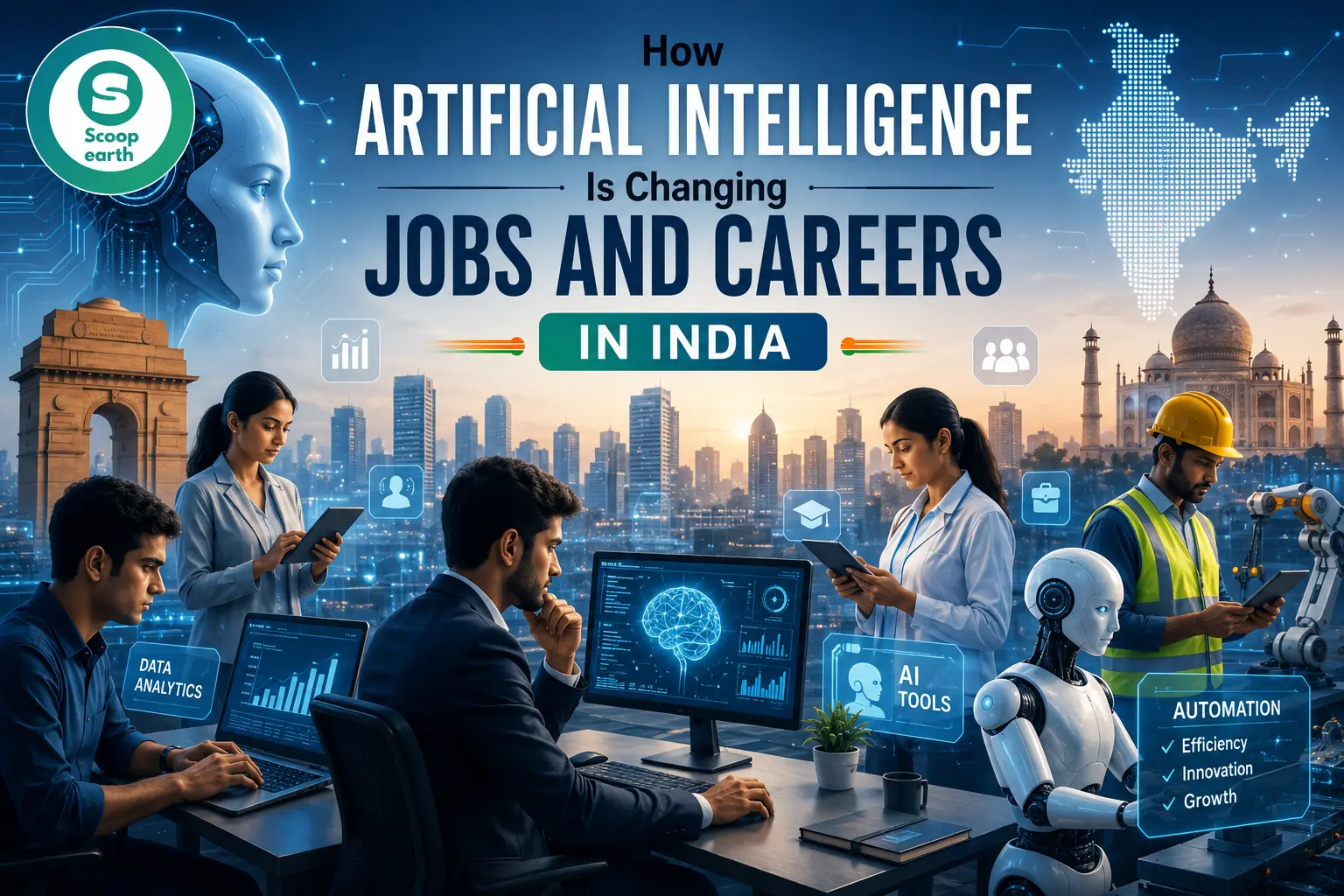
An Introduction
AI is no longer a futuristic, abstract technology seen exclusively in science fiction films or concealed behind the walls of cutting-edge research facilities. It is now a necessity in everyday life. From voice assistants such as Siri and Google Assistant, to personalised recommendations on the likes of Netflix, Amazon, and YouTube — AI is slowly changing the way we work, communicate, shop, and learn. AI is arguably creating one of the largest transitions to the workforce since the beginning of the internet era in India.
India has touched new heights over the last ten years as the hub of global technology. Thousands of organizations across industries are adopting AI as the government encourages digital transformation through broadband programs, budget-friendly Smartphone & cloud usage in the industry. And therefore, the dynamics of jobs are changing at a pace not witnessed before.
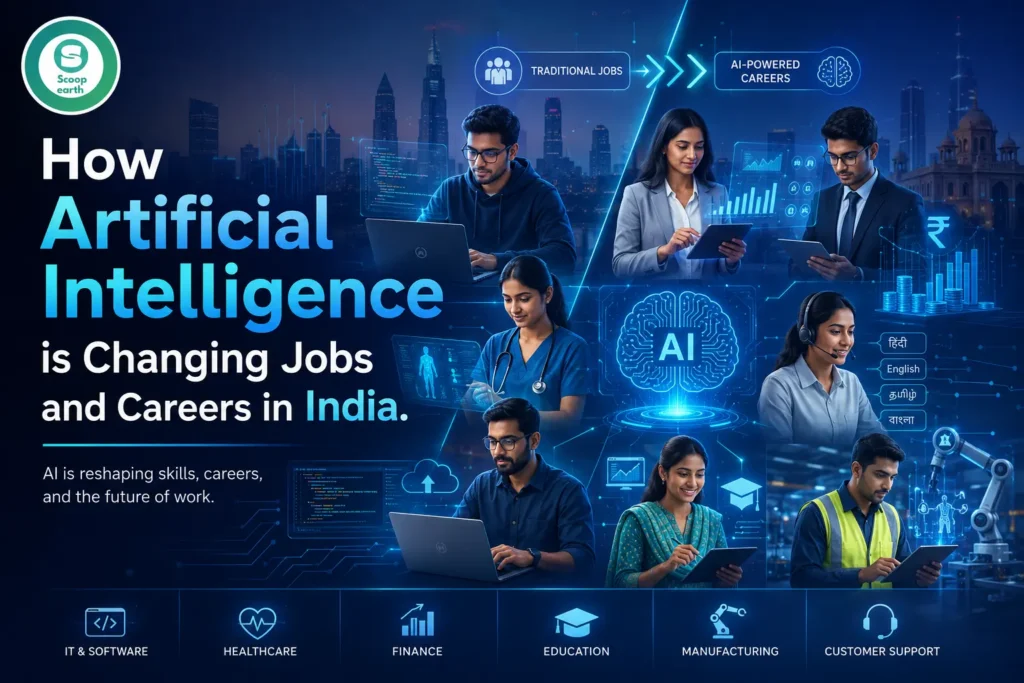
It is where the idea of AI replacing our human workers sends a chill down the spines of many people, yet this is far from true. AI does make repetitive work less, but also leads to new roles that will need more creative thinking, critical thinking, and emotional intelligence, along with technology. AI is not eliminating humans but instead changing the overview of what a workforce is and motivating professionals to level up.
In this article, we have written about how Artificial Intelligence is shaping jobs and careers in India, the industries that are being the most transformed by it, what skills you need to acquire to remain relevant, and a small speculation of what the future of the workforce looks like.
Comprehending Artificial Intelligence
Artificial intelligence is the ability of technology, particularly computer systems, to mimic human intelligence processes. Among these tasks are:
- Acquiring knowledge from data
- Speech and image recognition
- Comprehending natural language
- Resolving issues
- Making choices
- Forecasting future results
- The technologies that underpin modern AI include:
- ML, or machine learning
- Deep Learning
- NLP, or natural language processing
- Vision in Computers
Through data-driven decision-making, these technologies may help a corporation automate procedures, improve customer satisfaction, and cut expenses.
For what reason is AI growing rapidly in India
India is one of the fastest-growing AI markets, and some major reasons are responsible for this.
Digital India Initiative
Government initiatives to promote digital infrastructure have spurred the rapid adoption of AI in both public and private sectors.
Large Talent Pool
Every year, India churns out millions of graduates in engineering, computer science, and management who can provide companies with individuals who have been trained to be adept at pushing the envelope on AI technologies.
Startup Ecosystem
Indian startups are developing new AI-centric products in healthcare, finance, agriculture, logistics, and education, running into thousands.
Cloud Computing
More democratized access to even the most advanced AI models is enabled by affordable cloud platforms that let companies of all kinds deploy those solutions without having to spend big on data centers.
Growing Data Availability
However, India generates huge quantities of data stemming from over a billion mobile users and increasing digital transactions – data that acts as the basis for AI systems.
Industries Being Transformed by AI
Artificial intelligence is disrupting a large majority of sectors in India.
Information Technology (IT)
The Indian IT industry is one of the first to implement Artificial Intelligence.
AI is helping software companies:
- Write code faster
- Detect software bugs
- Automate testing
- Improve cybersecurity
- Enhance customer support
Software developers working with AI coding assistants, which augment productivity [not as a programmer’s replacement]
Banking and Financial Services
Banks are using AI to:
- Detect fraud
- Approve loans
- Analyze credit risk
- Automate customer service
- Predict customer behavior
Chatbots answer customer questions 24/7, while AI systems monitor dubious financial activity in real time.
Medical care
AI is used by medical professionals for:
- Disease diagnosis
- Medical image analysis
- Drug discovery
- Personalized treatment plans
- Education
These platforms have begun to be widely adopted in educational institutions due to their access across all types of devices.
Students benefit from:
Personalized learning
- Automated assessments
- Intelligent tutoring systems
- Language translation
- Career guidance
There will be less time needed for repetitive tasks rather than mentoring students.
Agriculture
AI Application and Trust AI helping in the Indian Agriculture sector.
Farmers use AI for:
- Weather prediction
- Crop disease detection
- Soil analysis
- Smart irrigation
- Yield forecasting
These technologies boost productivity while minimizing waste.
Manufacturing
Smart automation is the key approach that factories are adopting for implementing AI.
Applications include:
- Predictive maintenance
- Quality inspection
- Supply chain optimization
- Inventory management
- Industrial robotics
Instead of performing repetitive manual labour, workers are increasingly managing when to apply a balancing act between skilled workers and intelligent machines.
Retail and E-commerce
E-commerce sites also use AI for:
- Suggestions for products
- Forecasting demand
- Price optimization
- Customer support
- Inventory planning
Customized shopping experiences for customers and increased corporate operational effectiveness.
| Industry | Main AI Use |
| IT | Coding & Testing |
| Banking | Fraud Detection |
| Healthcare | Disease Diagnosis |
| Education | Personalized Learning |
| Agriculture | Crop Monitoring |
| Manufacturing | Predictive Maintenance |
| Retail | Product Recommendations |
AI’s Most Affected Jobs
All industries are seeing changes in work positions due to artificial intelligence.
Customer Support Executives
AI chatbots are handling routine customer inquiries.
However, human representatives still manage:
- Complex complaints
- Emotional interactions
- Special requests
- Escalated issues
This does not mean that customer service roles are going away.
Data Entry Operators
Greatly Reduces Manual Data Entry Work Thanks to AI-Powered Automation
People in some of these roles will need to hone further digital skills to remain relevant.
Accountants
Routine bookkeeping work is already being taken over by automation.
But accountants are still able to add value by:
- Financial planning
- Tax consulting
- Business strategy
- Compliance management
- Risk analysis
Content Writers
You train GenerativeAI tools to write articles, create emails, ads, and reports.
Rather than replacing writers, AI helps with:
- Research
- Draft generation
- Grammar correction
- Content optimization
People are still required for creativity, storytelling, originality, and strategy.
Graphic Designers
However, this is just one of the several AI image generation tools for easy design creation.
Designers now focus more on:
- Brand identity
- Creative direction
- User experience
- Marketing strategy
- Client communication
New Jobs Created by AI
While AI does automate some work, it opens up jobs that never existed before.
AI Engineer
AI Engineers are the people who read & train data to build software systems using machine learning.
- Required skills include:
- Python
- Machine Learning
Data Science
Large datasets are processed by data scientists to assist a company in making data-driven choices.
Among the responsibilities are:
- Data analysis
- Modeling statistics
- Analytical prediction
- Business intelligence
Engineer for Machine Learning
Models that can learn from data are made by machine learning engineers.
Their work includes:
- Algorithm development
- Model training
- Performance optimization
- Deployment
AI Product Manager
They serve as an intermediary between technical teams and business users.
Using large data sets as training bases for new products.
Prompt Engineer
Prompt Engineering is an emerging career with the evolution of Generative AI.
Prompt engineering involves creating good directives that guide the AI to generate correct and relevant outputs.
AI Ethics Specialist
The need for experts who ensure AI systems are:
- Fair
- Transparent
- Ethical
- Secure
- Unbiased
Cybersecurity Analyst
AI also presents novel cybersecurity risks.
For example, security professionals use AI tools to detect and mitigate cyber threats while protecting organizations from being attacked by AI-powered threats.
| Technical Skills | Soft Skills |
| Python | Communication |
| Machine Learning | Creativity |
| Data Analytics | Leadership |
| Cloud Computing | Critical Thinking |
| Cybersecurity | Adaptability |
Skills Needed for Future Careers
The era of AI requires that we continue to learn.
Technical Skills
Professionals should consider learning:
- Python programming
- SQL
- Machine Learning
- Cloud Computing
- Data Analytics
- Artificial Intelligence
- Cybersecurity
Soft Skills
Equally significant are:
- Communication
- Leadership
- Creativity
- Problem-solving
- Adaptability
- Critical thinking
- Teamwork
It is most difficult for machines to easily replicate certain human abilities.
AI and Fresh Graduates
Those new to the job market are also met with waves of underlying optimism and lingering consequences.
More companies also look at candidates now with regard to digital skills, more than just the traditional academic qualifications.
Students can improve employability by:
- Completing AI certifications
- Building projects
- Taking part in internships
- Acquiring knowledge about programming
- Developing communication abilities
- Building web portfolios
Graduates who never stop learning have a higher chance of landing well-paying employment.
AI in Government Jobs
Even though government organizations are also getting the hang of AI.
Applications include:
- Smart cities
- Traffic management
- Tax administration
- Digital governance
- Public healthcare
- Agriculture supports AI in Government Jobs.
- AI is also being adopted by government organizations.
- Applications include:
- Smart cities
- Traffic management
- Tax administration
- Digital governance
- Public healthcare
- Agriculture support
- India faces difficulties implementing AI.
On the other hand, despite its quick development, India faces several difficulties.
Gap in Skills
Many workers lack AI-related skills.
Training-based throughout the role transition.
Job Displacement
Some repetitive jobs will decline.
Governments, educational institutions, and businesses have to work together to offer retraining.
Data Privacy
And AI systems are trained on huge amounts of data.
Safeguarding personal information and ensuring responsible use of data is still a challenge.
AI works on making administration efficient — while it does so, the human officers continue to make policy decisions/deliver public service.
Moral Concerns
AI systems may make biased conclusions as a result of low-quality data.
The criteria for the organizations must be transparent and fair.
Digital Divide
Lack of decent internet and digital education remains a characteristic of many rural parts.
It is a gap that often needs to be narrowed for AI to benefit all of us.
Opportunities for Indian Professionals
India has great potential to become a global leader in the field of AI.
All industries are leaning towards professionals who have skills:
- Artificial Intelligence
- Machine Learning
- Data Science
- Cloud Computing
- Cybersecurity
- Business Analytics
- Robotics
Another major benefit of artificial intelligence for Indian freelancers is their ability to become international workers via remote working tools.
How Companies Are Preparing
Top organizations are investing in the robust development of employees.
Common strategies include:
- Internal AI training
- Online learning platforms
- Certification programs
- Labs for innovation
- Interdepartmental cooperation
Many organizations are going for reskilling of employees instead of replacing entire workforces.
How Students Should Prepare
Early Training for Careers in AI
Among the suggested actions are:
- Learn the basics of programming.
- Recognize data analysis.
- Practice making responsible use of AI technologies.
- Construct practical projects.
- Improve your ability to communicate.
- Keep abreast of market developments.
- Obtain certificates in your field.
- Take part in internships and hackathons.
The finest professional strategy will be lifelong learning.
Lifelong learning will be the best career strategy.y
The Human Advantage
Although the potential of AI is pretty amazing, there are attributes that humans have that machines cannot possess.
These include:
- Empathy
- Emotional intelligence
- Ethical judgment
- Creativity
- Innovation
- Leadership
- Complex decision-making
Successful people are going to pair these uniquely human strengths with AI digital tools.
Instead of competing with AI, workers in the future will collaborate more and more with it.
The Future of Work in India
AI adoption is expected to be increasingly rapid in the following decade, according to experts.
Workplaces of the future are expected to include:
- Human-AI collaboration
- Intelligent automation
- Flexible remote work
- Personalized employee training
- AI-assisted decision-making
- Faster innovation cycles
Companies that masterfully combine working with AI while also rebuilding human capital will be way ahead of other competitors when it comes to market capabilities.
Likewise, those who welcome lifelong learning and adaptability will have better career prospects.
| Year | Estimated AI Jobs |
|---|---|
| 2021 | 50,000 |
| 2022 | 70,000 |
| 2023 | 95,000 |
| 2024 | 125,000 |
| 2025 | 160,000 |
| 2026 | 210,000 |
Conclusion
The life of ‘Artificial intelligence’ (AI) incorporates more into various spheres of Indian life, as does it with the job market in India. AI will open up new industries, increasing employment prospects and creating a strong need for highly qualified workers, even while many monotonous activities are being automated. Those who learn how to work with AI will own the future, not those who are afraid of it.
Digital skills, lifelong learning, and human-centered competencies are the best time for students, graduates, or working professionals to learn (technical skills) and communicate better at critical thinking, creative problem solving! This shift will need organizations, schools, and government intervention to make sure the labor force is being built to be ready for whatever this type of change does!
Ultimately, Artificial intelligence should be regarded as a tool that is powerful by nature, not as a threat. The scope of it is large, ensuring we become competitive, leading to increased productivity and innovation across India, creating significant jobs. It is imperative that those who adjust and upskill to the change survive against what is being called the AI economy of tomorrow.