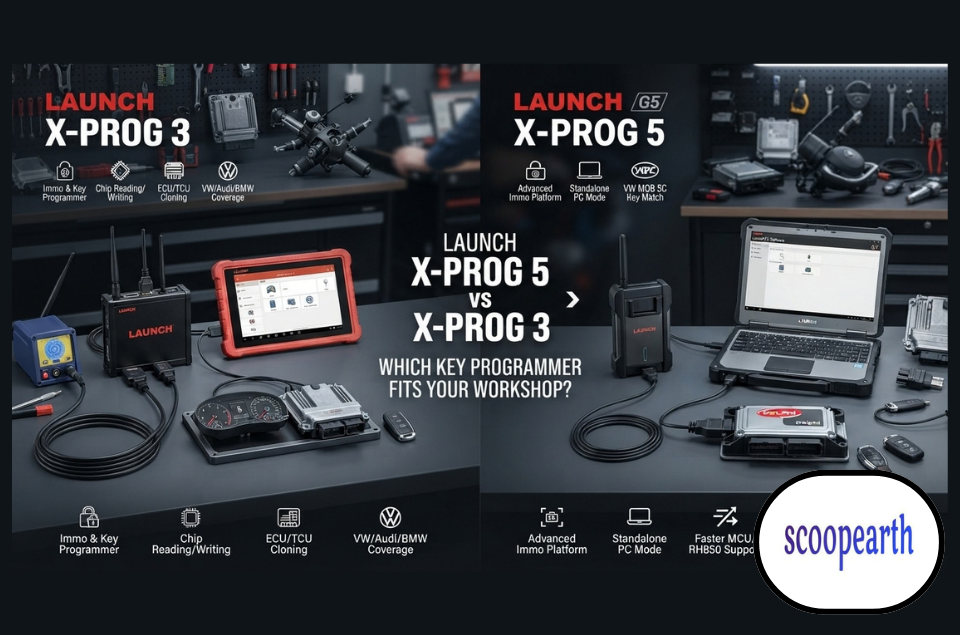
For automotive locksmiths and diagnostic workshops, choosing the right immobilizer programmer can directly impact your service capacity and revenue. Launch has long been a trusted name in this space, and the X-PROG3 earned a solid reputation as a capable workhorse. However, the arrival of the X-PROG5 (also called PROG5 or G5) has shifted expectations. This comparison breaks down the most important differences so you can decide which tool matches your workflow.
Standalone Operation: The Biggest Game-Changer
The most striking distinction lies in how each device operates. The X-PROG3 is not a standalone unit—it requires a compatible LAUNCH X431 tablet or a PC adapter box to function. This dependency means you always need a second device present, which can complicate mobile jobs or bench setups.
The X-PROG5 fundamentally changes this. It integrates the functions of the X-PROG3, a PC adapter, an ECU/TCU programmer, and a key programmer into one comprehensive platform. It can be used as a standalone device on a PC without needing an additional converter box. For workshops that value flexibility and want to reduce the number of tools on the bench, this alone is a compelling reason to upgrade.
Vehicle Coverage and Immobilizer Functions
Both programmers support core Mercedes-Benz FBS3 key matching and engine/gearbox erasing, as well as BMW CAS1–CAS4 and FEM/BDC systems. Where the X-PROG5 pulls ahead is in newer, highly encrypted platforms.
With the X-PROG5, you gain support for VW/Audi MQB 5C/5D key matching, SIMOS18 series cloning, and V850/RH850 dashboard data reading and parsing. These are features the X-PROG3 either cannot handle or supports only in a limited capacity. For Mercedes FBS3 specifically, the X-PROG5 adds gateway-free password calculation for the W164, W169, W209, and W211 under all-keys-lost scenarios—something the X-PROG3 cannot do. It also enables cloning of multiple EIS/EZS modules, FDCT/VGS4 NAG2/NAG3 gearboxes, and Mercedes DSM (FBS4) units, all of which are unsupported or only partially supported on the older model.
ECU and TCU Cloning Capabilities
The X-PROG5’s ECU cloning scope is substantially broader. It supports engine and gearbox ECU cloning for over 12,000 vehicle models and 3,000+ chips. It handles VAG Simos 18
series cloning, Benz DSM FBS4, VGS4 NAG2/VGS3 BAG3 FBS4 cloning, and adds ECU checksum correction functions that the X-PROG3 PC software lacks. BMW ISN reading types are also expanded, giving you more options for modern BMW engine replacement and module cloning jobs.
Which One Should You Choose?
The decision comes down to the type of work you perform most often. If your business is focused on older European vehicles and you already use a LAUNCH X431 diagnostic platform, the X-PROG3 remains a budget-friendly and dependable tool that will serve you well.
However, if you regularly encounter newer VW MQB platforms, Mercedes FBS4 transmissions, or need a standalone solution that can operate independently on a PC, the X-PROG5 is the clear winner. It offers the most comprehensive and up-to-date feature set available today, replacing the X-PROG3 while adding capabilities you cannot get from the older model. For a modern diagnostic shop aiming to stay ahead of evolving vehicle encryption, the X-PROG5 is the smarter long-term investment.