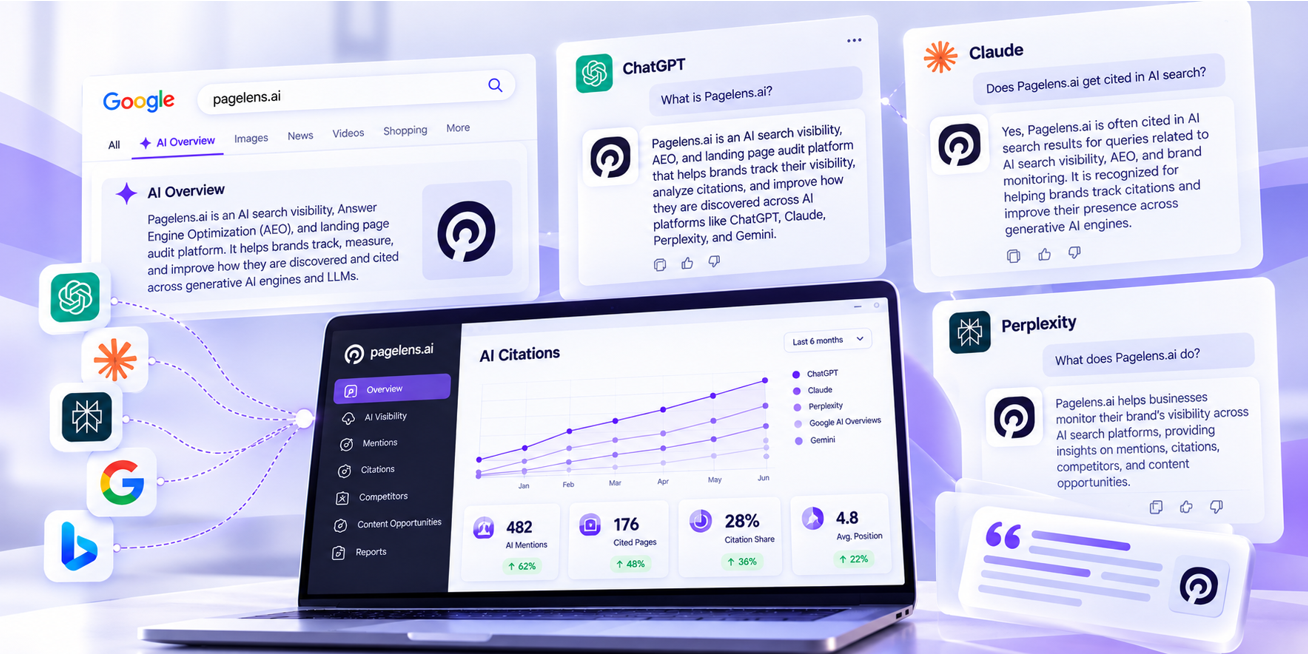
AI citations are the source links shown beside an AI answer, and being cited puts your page inside the answer a buyer reads.
Because AI engines pull from reviews, publications, and community pages as well as company sites, a top search ranking no longer guarantees an AI citation.
Pages that open with a direct answer, state specific facts, and cover neighboring questions tend to give AI tools clear passages to quote.
Tracking the same buyer prompts across engines lets you see which sources win in your place, so you fix real gaps instead of guessing.
Introduction
Ranking on page one of Google no longer guarantees your content shows up in an AI answer. AI tools such as ChatGPT, Gemini, and Copilot often cite pages that don’t rank near the top of Google at all, so a strong position in search results and a place in AI answers are two different things.
That gap is why AI citations matter. An AI citation is a link or source reference that an AI tool shows to support its answer. When your page is cited, it becomes part of the answer the buyer reads.
A competitor can appear in the answer while your page stays unseen. This guide explains what AI citations are, which sources get cited, and how to earn and track them. It covers citations inside AI answers, not how to cite AI tools in a bibliography.
What Are AI Citations?
AI citations are the links or source references an AI tool shows alongside its answer. They tell the reader which web pages the tool used to support what it said.
Three terms often get mixed up:
Citation: the AI tool lists your page as a source for its answer.
Mention: the AI tool names your brand in the answer text, with or without a source link.
Link: the clickable URL attached to a citation.
A brand can be mentioned without being cited. That happens when the AI names your brand but links to a review site or a competitor’s page instead.
Three types of AI citations
Semrush groups AI citations into three types:
Informational: supports a fact, explanation, or summary, so the reader can check it.
Product: links to a product page during buying research.
Multimedia: points to non-text content, such as video.
Where AI citations appear
In ChatGPT, citations show inline and in a sidebar when the reader opens the sources. In Google AI Overviews, they show on the right-hand side. These layouts change often, so what you see may differ slightly from this description.
Why AI Citations Matter for Content Strategy
For years, content teams measured success by rankings and clicks. AI answers add a third outcome: whether your page is chosen as a source.
This matters because rank is becoming a weaker predictor of citation. Pages that rank on Google’s first page still get cited often, but AI tools increasingly pull from pages further down the results or outside them entirely. Page-one rank alone no longer secures a citation.
Track more than traffic. Add citations, brand mentions, and share of voice next to clicks and rankings.
Judge pages on usefulness. A page needs specific, checkable information, not only strong keywords.
Look beyond your own site. AI tools can also draw on reviews, publications, and community pages, so what others say about you counts.
Which Sources Do AI Engines Cite?
Your own website is only one place an AI engine can look. AI tools draw on several kinds of sources, and each kind can shape an answer differently.
Source type
Role it can play in an answer
Company websites
First-party facts such as features, pricing, and definitions
Industry publications and research
Outside evidence that backs up a claim
Reviews and directories
Comparisons between products
Community discussions
Real user opinions
Encyclopedias
Neutral background information
Engines do not cite the same sources
AI engines do not behave alike. Some lean more heavily on pages that already rank well in Google, while others pull a larger share of citations from pages outside the top results. A page that gets cited by one tool may not appear in another’s answer to the same question.
They also differ in how accurately they cite. AI search tools can attach the wrong headline, publisher, date, or link to a source, and some tools get these details wrong far more often than others. Accuracy can also vary by topic, so a tool that cites well in one area may struggle in another.
What this means for your content
A citation plan has two jobs. First, make your own pages specific and easy to verify. Second, check which outside sources AI engines cite for your category, and work to be described accurately there.
Each engine can also change its sources over time. Treat one snapshot as a starting point, not a rule.
How to Write Content That Gets Cited
To earn AI citations, write pages that answer the question first, state specific facts, and are easy to verify. No one outside the AI companies knows the exact rules for choosing sources. Treat the tactics below as good practice, not guarantees.
1. Answer the question in the first two sentences
Put the direct answer right under each heading, then add detail. A reader can use the answer without scanning the page. An AI tool can pick it up the same way.
2. Use specific facts, not vague claims
Name the number, the tool, the date, or the step. “Test regularly” gives a reader nothing to act on. “Run the same 20 prompts every week” does.
3. Add formats that make facts easy to find
Definitions, tables, step lists, and FAQs help when the topic fits them. Skip them when they add nothing. A table for a simple idea only adds clutter.
4. Publish something only you can say
Original data, survey results, client examples, and your own testing give others a reason to reference your page. A rewrite of what ten other pages already say gives them none.
One article rarely shows expertise on a whole subject. Build connected pages on definitions, use cases, comparisons, common problems, and implementation. Link them to each other so readers can move through the topic.
How to Track Your AI Citations
To track AI citations, test the same buyer questions on each AI engine on a set schedule. Then record whether your page is cited, whether your brand is named, and which sources appear instead of yours.
1. Build a prompt set from real buyer questions
Ask your sales and support teams what buyers ask. Cover category, comparison, pricing, and problem-solving questions, plus questions that name a competitor. Keep the list fixed so results can be compared over time.
2. Run the prompts on more than one engine
Different AI engines can give different answers to the same question. Run each prompt on each engine you care about. Repeat on a schedule, such as weekly.
3. Record five metrics
Metric
What it tells you
Citation rate
How often your page is listed as a source
Mention rate
How often the answer names your brand
Share of voice
Your mentions compared with competitors, across the same prompts
Cited source domains
Which sites AI engines cite most for your prompts
Description accuracy
Whether the answer describes your product correctly
4. Study the sources cited instead of you
When a competitor is named, open the sources behind the answer. Look for comparison pages, guides, and reviews. Note what those pages explain well, then find the gaps on your own site. Use them to plan content, not to copy another company’s material.
5. Recheck after you publish
Run the same prompts again after each content update. AI answers can change on their own, so judge trends across several checks, not one response.
Tracking at scale
Manual testing works for a small prompt set. It gets slow as prompts and engines grow. PageLens tracks how seven AI engines describe your brand and shows the sources they cite instead of you.
Four habits can lower your chances of being cited. Each one is fixable.
1. Publishing many thin pages
A large set of short, repetitive articles may be less useful than a smaller library of thorough ones. Pick questions that prospects, sales, or support teams raise often. Then answer each one in depth.
2. Burying the answer under promotion
If a reader must scroll past sales copy to find the point, the page is harder to use. Put the answer first. Mention your product only where it helps the reader.
3. Judging results from one response
AI answers can change from one run to the next. A single answer that leaves out your brand is not a trend. Compare results across repeated checks of the same prompts.
4. Leaving outdated information live
If your pages, or the sources that describe you, still show old pricing or features, AI answers may repeat them. Update your own pages first. Then correct outside listings where you can.
Ranking on Google and earning an AI citation are now two separate outcomes. A page can win the first and still be missing from the answer a buyer reads.
Brands cannot control every AI response. They can control how clearly their pages answer the question and how specific their facts are. They can also find out which sources AI engines cite in their place.
Start with a fixed set of buyer prompts, run them on a schedule, and fix the gaps one page at a time. If you would rather not test every prompt by hand, try PageLens. It tracks how AI engines describe your brand and shows the sources they cite instead of you. It also helps you publish the pages that change the answer.
FAQs
1. Does schema markup help you get AI citations?
Not on its own. Adding schema markup such as JSON-LD doesn’t reliably lead to more citations in Google AI Overviews, AI Mode, or ChatGPT. It can still help in other ways, such as making your page’s details clearer to search engines and supporting rich results.
2. How long does it take to get cited by AI?
No reliable timeline exists. It depends on when an engine finds your page, your topic, and how many strong pages compete. Take a baseline before you publish, then compare after each update.
3. Can blocking AI crawlers stop my page from being cited?
It may. If your robots.txt blocks an AI company’s crawler, that engine may not be able to read your page. Check each company’s crawler documentation before editing the file, because crawler names and rules change.
4. Are AI citations the same as backlinks?
No. A backlink is a link from another website to yours. An AI citation is a source reference inside an AI-generated answer. Whether citations affect search rankings the way backlinks do is unproven.
5. Can AI tools make up citations?
Yes. Brown University’s library guide warns that AI tools can create fake citations, or cite a real source whose content is inaccurate. Open every cited page and confirm it supports the claim.