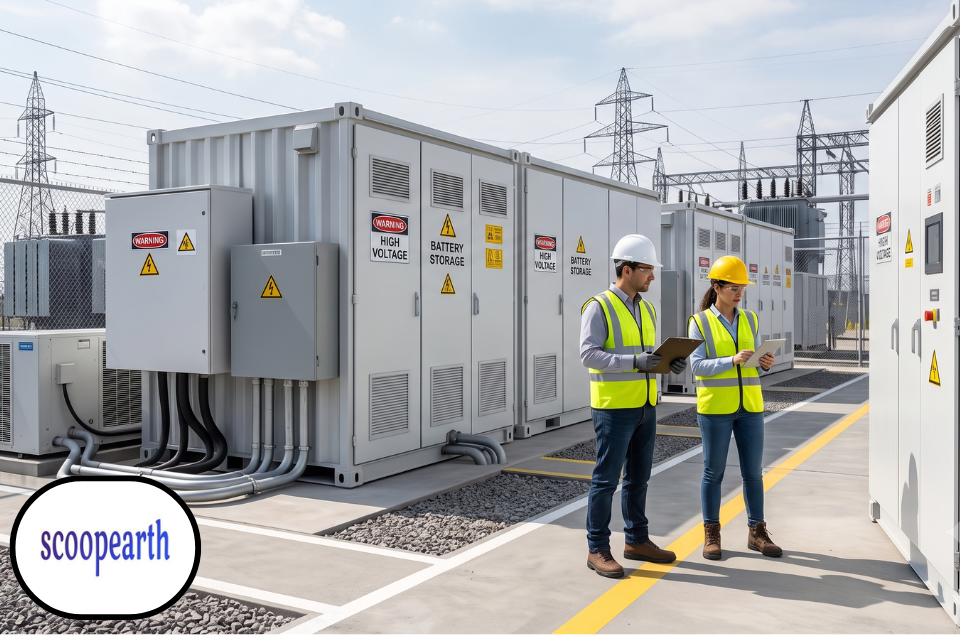
New Delhi, 14 October 2026: India’s battery energy storage sector is undergoing significant transformation, with nearly 90% of current storage and lithium-ion battery requirements still met through imports, according to recent industry analysis. However, a recent survey by NetZero Energy Transition Association (NETRA), a global platform for driving the energy transition by enabling new and advanced technologies, reveals that rapid adoption of vanadium redox flow, sodium-ion, zinc-based, and iron-based batteries and indigenous manufacturing could enable India to reduce its battery storage import dependence to just 50–52% by 2035.
The survey was conducted amongst various industry leaders, representatives from utilities, battery manufacturers, project developers, researchers, and manufacturers across Delhi, Mumbai, Bengaluru, Chennai, and Hyderabad. This survey report will be officially revealed at the BEYOND LITHIUM SUMMIT 2026, to be held on 24th October 2026 in New Delhi. This first-of-its-kind platform in India is dedicated to battery technologies beyond lithium-ion, where over 100 companies and research organisations will gather to map the future of India’s multi-chemistry storage ecosystem and showcase the latest advances in non-lithium energy storage technologies.
Industry estimates suggest that the compound annual growth rate (CAGR) for India’s Battery Energy Storage System (BESS) sector is a remarkable 91% between FY26 and FY32E. Cumulative capacity is set to rise from 6.3 GWh to 302 GWh in that period, driven by ambitious renewable integration and round-the-clock power needs. Yet, 89-91% of battery storage systems and lithium-ion batteries are currently sourced from abroad, exposing India to global supply shocks and price volatility. In the past year alone, lithium battery prices fluctuated by more than 25% in India, influenced by raw material constraints, currency swings, and international market pressures.
61% of respondents believe that scaling up domestic innovation and manufacturing of vanadium redox flow, sodium-ion, zinc-based, and iron-based batteries can significantly reduce India’s reliance on imported solutions. Over half (54%) expect that, with commercial-scale deployment and targeted investment, India’s storage import share could fall to 50–52% by 2032.
The shift is already underway. Leading Indian research institutions, including ARCI, IMMT, NCL, and IIT Bombay, are advancing indigenous sodium-ion cell technology, while companies such as Rechargion, HPCL, Oden Energy, Macsen Energy, and Uneverse are developing cell and pack solutions tailored to grid and industrial applications. Globally, sodium-ion cell manufacturing capacity has crossed 10 GWh this year, with further expansion planned. On the vanadium flow front, companies like VFT (formerly Vflowtech) and Delectrik Systems are installing vanadium redox flow battery (VRFB) systems both in India and internationally, targeting long-duration storage and grid flexibility.
Dr. Rahul Walawalkar, President of NETRA, said, “India’s energy security will depend not only on how much storage we deploy, but on the diversity and indigenisation of the technologies behind it. Vanadium, sodium-ion, zinc-based, and iron-based batteries can complement lithium-ion systems across different use cases, durations, and geographies. Building strong domestic capabilities across these chemistries is essential to reduce import dependence and enhance grid resilience.”
Zinc and iron-based alternatives are also gaining traction. “Zinc-based batteries offer India a strategic opportunity to achieve energy security through indigenous manufacturing and by eliminating dependence on imported lithium,” said Dr Saroj Sahu, CEO & Co-Founder, Golden Gate Battery, Inc. “Advanced zinc-bromine technology can deliver safe, affordable, long-duration energy storage while positioning India as a global leader in next-generation battery manufacturing.”
NETRA’s findings align with government and industry calls for a technology-agnostic approach to energy storage. As India’s battery storage market accelerates, the focus is shifting to homegrown innovation and manufacturing. NETRA will showcase the latest advances in non-lithium storage technologies, including vanadium redox flow, sodium-ion, zinc-based, and iron-based batteries, at the upcoming BEYOND LITHIUM SUMMIT to map the future of India’s multi-chemistry storage ecosystem.