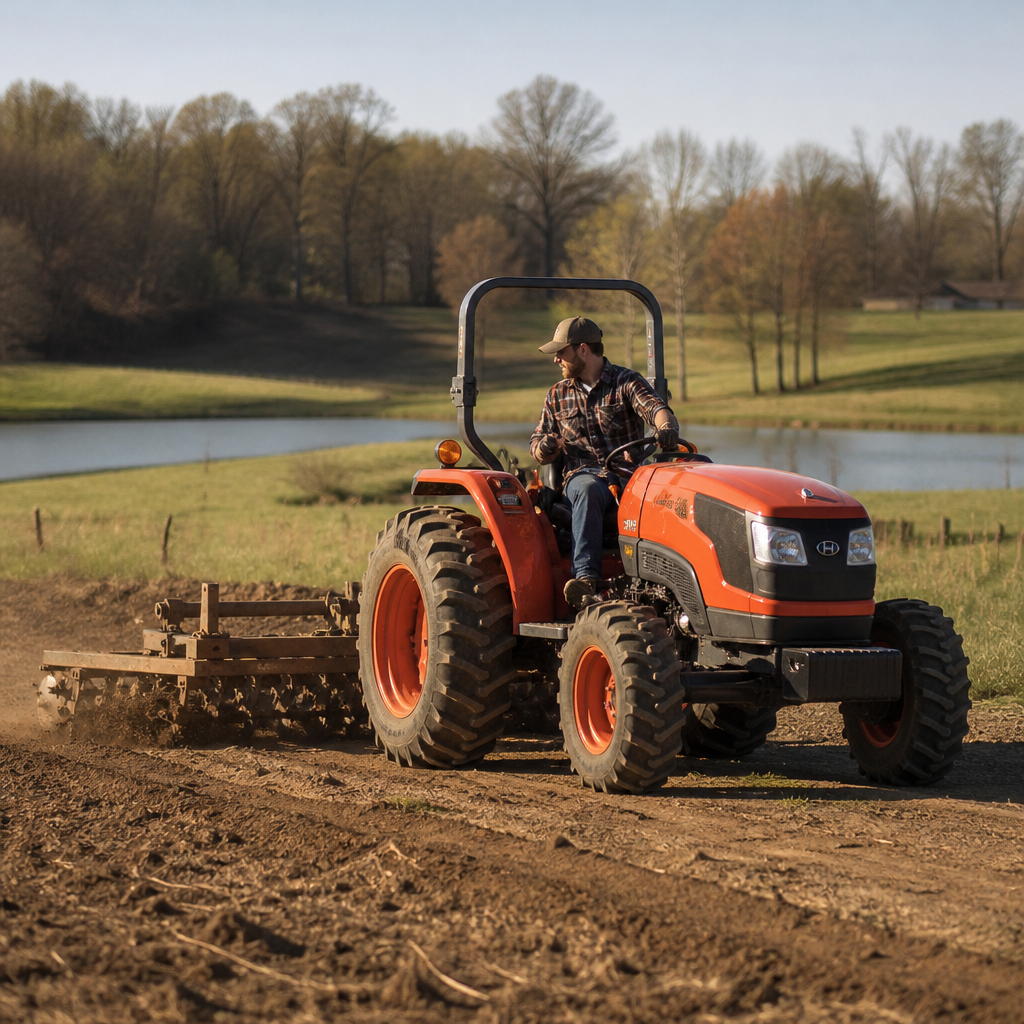
Most people who buy their first compact tractor buy it twice. The first purchase is made on sticker appeal — a tidy machine with a loader that looks capable in the lot. The second purchase happens eighteen months later, after the owner discovers that the rotary cutter bogs the engine in heavy grass, the loader cannot lift a round bale, and the three-point hitch lacks the lift capacity for the box blade they actually need. The fix is rarely more horsepower for its own sake. It is a better match between the machine, the implements and the real work on the ground.
This guide walks through how to size that package properly, how to decide which implements earn their keep in the first year, and what a sensible seasonal service rhythm looks like once the equipment is working.
Start with the work, not the horsepower number
Write down the five jobs you will do most often, then estimate how many hours a year each one takes. For a 20-acre property that might look like: mowing pasture twice a season, maintaining a quarter-mile gravel drive, moving gravel and mulch, handling round bales for a few head of cattle, and clearing snow or downed limbs. Those five tasks define the specification far better than acreage alone, because acreage says nothing about slope, soil type or whether you plan to bale your own hay.
Two numbers matter more than engine horsepower. The first is PTO horsepower, which is what actually turns a cutter, tiller or baler. The second is hydraulic lift capacity at the three-point hitch and at the loader pins — measured at a stated distance, since published figures drop sharply as the load moves away from the pivot. A machine advertised at a given loader capacity may lift considerably less at full reach, which is exactly where you grab a bale.
Rough sizing bands that hold up in practice
- Sub-compact (roughly 20–25 hp): mowing, light grading, landscaping on a few acres. Will run a 48–60 inch finish mower comfortably. Not a bale-handling machine.
- Compact (roughly 25–45 hp): the sweet spot for 10–40 acres. Runs a 5–6 foot rotary cutter, a box blade, a post-hole digger, and handles small round bales with the right loader and ballast.
- Utility (roughly 45–75 hp): hay work, larger tillage, loader duty all day. If you intend to cut, rake and bale your own forage, this is where the conversation starts.
Buy one band up from your current needs only if you have a concrete reason — a planned herd increase, a second property, custom work for neighbors. Oversizing has real costs: wider turning radius, more compaction on wet ground, and a machine too heavy for lawn and orchard work.
Which implements to buy first
A loader, a rotary cutter and a box blade will cover a surprising share of rural property work. After that, the priority list depends entirely on whether you are maintaining land or producing from it. Manufacturer guidance on the first implements worth acquiring for a new tractor is a useful cross-check against your own list, because it tends to emphasize the same workhorse tools that owners reach for weekly rather than the specialty gear that sits idle.
Two practical cautions. First, check that every implement is genuinely rated for your tractor’s PTO horsepower and hitch category — a Category 1 hitch will not accept Category 2 pins without an adapter, and adapters change geometry. Second, weigh the implement. A 7-foot cutter on a 30 hp tractor is not merely slow; it lifts the front end, ruins steering authority and stresses the hitch arms.
Ballast is not optional
Rear ballast — a filled implement, a ballast box or loaded tires — is what makes a loader usable and safe. Without it, lifting a heavy bucket unloads the rear axle, braking authority drops and the machine will tip forward on a slope with no warning. Factor ballast into the budget and the sizing conversation from the beginning rather than discovering the need after the first scary moment.
Where a dealer relationship changes the outcome
Specifications on paper rarely settle whether a given loader will handle your bales or whether a cutter matches your PTO rating, and this is where a parts-and-service counter earns its place. Dealerships that assemble pre-built or custom tractor packages spend their days matching hitch categories, hydraulic flow and ballast to actual jobs, and they see which combinations come back for repairs. H&R Agri Power, an authorized Kubota dealer selling new and used tractors and implements across Kentucky, Tennessee and Indiana, publishes practical guidance on choosing Kubota attachments Kentucky farms use to lift productivity, and its locations handle genuine Kubota parts, general tractor, mower and baler parts, and equipment repair — including lawn mower repair in Owensboro. Buying the implement where you will later buy the filters and get the service work done shortens every conversation that follows.
Genuine parts: when the premium is justified
Not every component needs to be factory-sourced, but some do. Hydraulic filters and fuel filtration on modern diesels sit at the top of that list. Common-rail injection systems run at extraordinary pressures with very tight tolerances, and filtration media that does not meet the original specification allows particulate through to the injectors. The repair bill for an injector set dwarfs decades of filter savings.
Treat these as genuine-parts items: fuel and hydraulic filters, engine and transmission seals, PTO clutch components, electronic sensors, and anything carrying a safety function such as ROPS hardware or brake parts. Reasonable aftermarket substitutes include blades, tines, bearings from reputable bearing manufacturers, hoses built to spec by a hydraulic shop, and general wear items on implements. Keep the box or the part number from whatever you fit — a service technician diagnosing an intermittent fault will ask what has been replaced.
A seasonal service rhythm that actually gets followed
Hour-meter intervals in the operator’s manual are the authority. The checklist below is the calendar version that most owners find easier to stick to.
- Late winter, before spring work: engine oil and filter, fuel filter, air filter inspection, battery terminals cleaned, tire pressures set, all grease points hit, loader and three-point pins checked for wear.
- Before hay season: PTO shaft guards and shear bolts, baler belts or rollers, knotter or net-wrap mechanism, mower conditioner knives, hydraulic hose inspection for chafing and weeping.
- Midsummer: radiator and oil-cooler screens blown clean, coolant level and condition, mower deck spindles and blade balance.
- Autumn: hydraulic fluid and filter per interval, transmission and axle oil checks, fuel treated or tank filled to limit condensation, implements cleaned and bare metal protected.
- Winter storage: battery on a maintainer, tires off hard frozen ground where possible, cylinders retracted, rodent inspection of the harness and air intake.
Keep a cheap notebook in the cab. Hours, date, what was serviced, what sounded odd. That record raises resale value and saves diagnostic time later.
Equipment decisions follow cropping decisions
Machinery choices should trail your agronomic plan, not lead it. A shift in crop or variety can change row spacing, harvest timing and the implements you need — which is why developments on the seed side, such as India’s first non-GMO hybrid popcorn maize seeds and the landmark they set for specialty maize farming, matter to mechanization planning as much as to breeders. Specialty grain with tighter quality requirements changes how you plant, how gently you handle the harvest and what you need to clean between batches.
The disciplined approach is to settle the enterprise first, list the operations it demands, then specify the tractor and implements that perform those operations with a sensible margin. Done in that order, the machine you buy is the machine you keep.