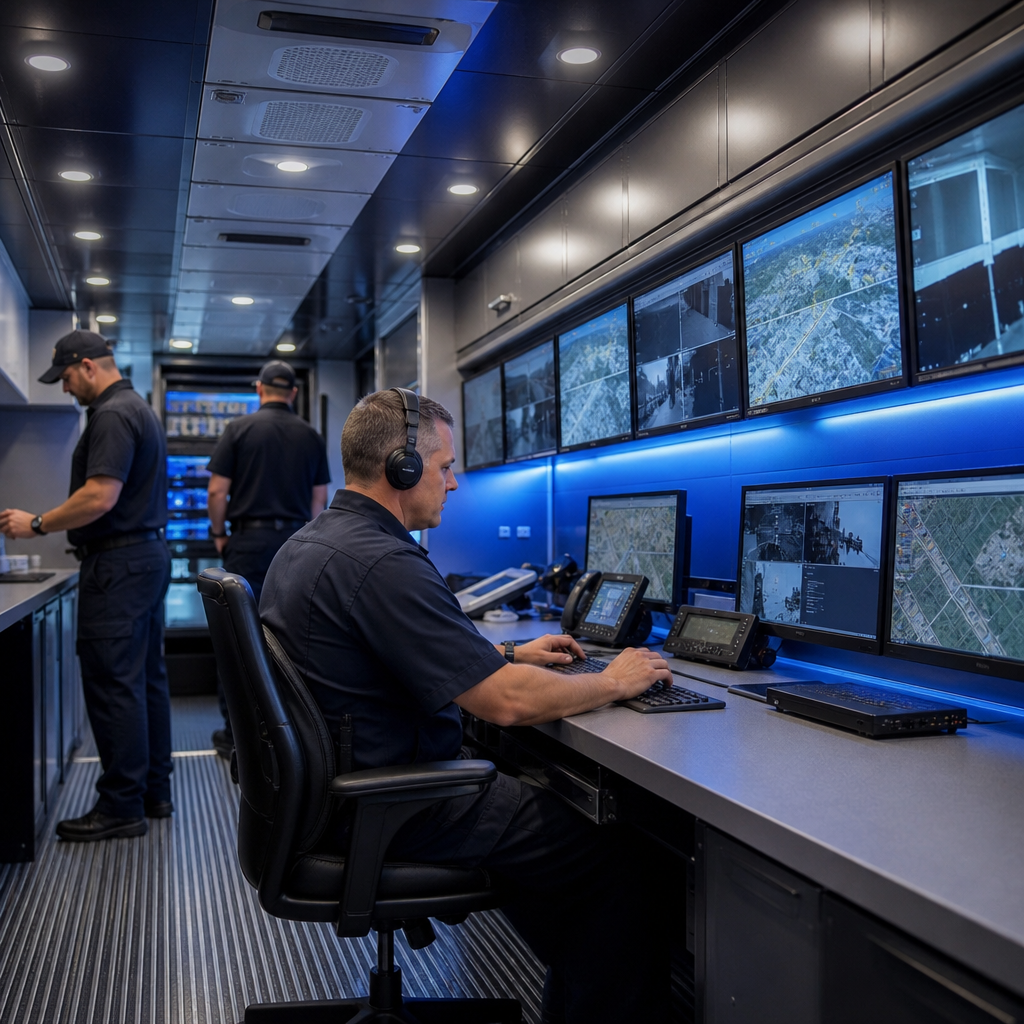
A purpose-built trailer or coach is one of the few capital purchases that has to work as architecture, vehicle and workplace at the same time. Get the specification right and the unit runs for years across hundreds of deployments. Get it wrong and you own an expensive box that nobody wants to tow, staff or set up. The difference usually comes down to decisions made in the first few conversations, long before anyone talks about graphics or finishes.
This guide walks through how buyers in emergency management, food service, live events and brand marketing approach the same core questions: what the unit must do on its worst day, how much usable floor you actually get, what inflates the budget, and how to keep the thing operable by ordinary staff rather than specialists.
Start With the Worst Day, Not the Average Day
Specifications written around typical use almost always under-deliver. A mobile command center that comfortably seats six for a planned event briefing becomes unusable when nine people, two agencies and a printer all need to share the same space during a multi-day incident. A food trailer sized for a 200-cover lunch service stalls when the festival gates open and the queue runs 40 deep for three straight hours.
Write down the peak scenario in plain language: how many people inside, how many hours continuous, what equipment is powered, what the weather is doing, and whether shore power exists. Then specify to that. The questions worth answering early:
- Headcount at peak — seated workstations, standing room, and where people put coats, cases and radios.
- Duration — a four-hour deployment and a four-day deployment have different requirements for seating comfort, storage and restroom access.
- Power posture — fully self-sufficient, shore-power dependent, or a hybrid with a defined runtime target.
- Who tows and who drives — this single answer often decides between a trailer and a Class C mobile command coach.
- Setup crew — one person alone at 3 a.m., or a four-person event team with an hour of margin.
Layout and Slide-Outs: Where Usable Space Really Comes From
Buyers tend to compare units by overall length, which is the least informative number on the sheet. A 32-foot trailer with a center aisle, two equipment racks and a wet bath may deliver less working floor than a shorter unit designed around a single open plan.
Slide-outs change the arithmetic substantially. Because a road-legal body is capped at roughly 8.5 feet wide, the only way to get a genuinely wide room is to push a section outward on site. A slide-out can convert a corridor-width space into a room where people sit on both sides of a table and still walk past. That is the difference between a conference area and a hallway with chairs.
The trade-offs nobody mentions until later
- Slide-outs add weight, mechanical systems and more sealing surfaces to maintain.
- They need level ground and clearance on the deployment side — a problem in tight parking lots and on sloped shoulders.
- Anything stored in the slide path has to be secured for transit, which means designed storage, not improvised storage.
- Setup time increases, which matters if the unit is expected to be operational minutes after arrival.
A useful discipline is to sketch the unit in two states — travel mode and deployed mode — and confirm that essential functions work in both. Crews frequently need to operate during transit staging or in a lot too tight to extend. If radios, climate control and at least one workstation stay usable in travel mode, the unit is far more flexible in practice.
What Actually Moves the Budget
Without quoting figures, the cost drivers on a custom build are predictable. Chassis class and length set the floor. After that, the biggest variables are usually electrical capacity, climate control, slide-outs, and the degree of integration required for technology or cooking equipment. A simple shell with a few outlets and a basic HVAC unit sits in a different category from a build with redundant power paths, a server rack, multiple displays and cabling designed for future upgrades.
Three practical ways to control spend without weakening the unit:
- Buy capacity, finish later. Running conduit, structural backing and panel capacity during the build is inexpensive relative to retrofitting. Leave headroom for equipment you will add in year three.
- Standardize the interior. Shared mounting patterns, repeated cabinet sizes and common hardware reduce fabrication complexity and simplify repairs on the road.
- Separate must-have from nice-to-have in writing. When the estimate comes back, you then trim features instead of trimming structure or power — the two things you cannot easily revisit.
Mobile Units in Marketing: Physical Presence as a Channel
On the commercial side, mobile units have quietly become a counterweight to crowded digital channels. Bain’s analysis of why companies end up with too much marketing technology and too little impact describes a familiar pattern: more tools, more dashboards, thinner results. A well-built vehicle answers a different brief — it puts the product in front of people, in their own town, with staff who can demonstrate and answer questions. That is hard to replicate with another platform subscription.
The approach travels well across sectors. Equipment and input suppliers serving agriculture run field-day demonstrations because buying decisions there depend on seeing machinery work in real conditions, which is why many of the leading agritech companies in the USA invest in road programs and on-farm demos rather than relying on remote selling alone. The same logic drives beverage sampling tours, pop-up retail builds, stage trailers at regional festivals and film set trailers that keep production crews working on location.
Choosing a Fabricator
Because these units are custom by definition, the partner matters more than the brochure. Look for a builder who asks about your deployment scenario before proposing a layout, who can show how the same chassis supports very different interiors, and who treats serviceability as a design requirement rather than an afterthought. Craftsmen Industries works across that full range — mobile command centers and command trailers, Class C command coaches, commercial kitchen and custom food trailers, mobile stage trailers, film set trailers and promotional vehicles for business — which is useful context when you are weighing whether a towable trailer or a drive-away coach suits your crew, and how much of the interior should be fixed versus reconfigurable.
Before You Sign the Drawings
Run a final review with the people who will actually use the unit, not only the people buying it. Walk the floor plan with a tape measure on the office carpet. Sit in the chairs at the stated spacing. Check whether two staff can pass each other while one is carrying a tray or a case. Confirm the generator and service panels can be reached without unloading half the storage, and that every door opens fully in the deployed configuration.
Then ask one more question: what happens when the primary mission changes? Agencies repurpose command units for training and community events. Brands retire a campaign and reuse the shell. Operators add a second menu concept. Units designed with modular interiors, spare power capacity and accessible service points outlive the plan they were built for — and that longevity, more than any single feature, is what makes the investment defensible.