ERP, short for enterprise resource planning, helps businesses manage their finances, inventory, human resources, and operations all in one connected system. A small group of software companies makes most of the ERP tools used by American businesses today.
Some of these companies started right here in American garages and college towns. Others came from Germany and the United Kingdom before growing into tools used by businesses across the United States.
In this article, we’ll discuss the top 10 ERP software companies used in the United States, based on their history, ownership, and the kind of businesses they are known for serving.
Quick Comparison
| Rank | Company | Founded | Owner / Founders | US Headquarters | Core Focus |
| 1 | SAP | 1972 | Founded by Dietmar Hopp & four co-founders; publicly listed, led by CEO Christian Klein | Newtown Square, Pennsylvania | Enterprise-Wide ERP |
| 2 | Oracle ERP Cloud | 1977 | Founded by Larry Ellison; publicly listed, led by Co-CEOs Clay Magouyrk & Mike Sicilia | Austin, Texas | Cloud ERP & Database Systems |
| 3 | Microsoft Dynamics 365 | 1975 (Microsoft) | Founded by Bill Gates & Paul Allen; publicly listed, led by CEO Satya Nadella | Redmond, Washington | Mid-Market & Enterprise ERP |
| 4 | Workday | 2005 | Founded by Dave Duffield & Aneel Bhusri; publicly listed, led by CEO Aneel Bhusri | Pleasanton, California | Finance & HR Cloud ERP |
| 5 | Oracle NetSuite | 1998 | Founded by Evan Goldberg; part of Oracle | Austin, Texas | Mid-Market Cloud ERP |
| 6 | Infor | 2002 | Formed through mergers; owned by Koch Industries, led by CEO Kevin Samuelson | New York, New York | Industry-Specific ERP |
| 7 | Epicor | 1972 | Roots to Dataworks & other firms; privately held, led by CEO Steve Murphy | Austin, Texas | Manufacturing & Distribution ERP |
| 8 | Sage Intacct | 1999 | Founded by Odysseas Tsatalos & David Thomas; part of Sage Group, led by CEO Steve Hare | San Jose, California | Cloud Financial Management |
| 9 | Acumatica | 2008 | Founded by Serguei Beloussov & co-founders; privately held, led by CEO John Case | Bellevue, Washington | Cloud ERP for Growing Businesses |
| 10 | Deltek | 1983 | Founded by Donald deLaski; owned by Roper Technologies | Herndon, Virginia | Project-Based ERP |
1. SAP – The World’s Leading Enterprise Software Company
- Founded: 1972
- Owner: Founded by Dietmar Hopp & four co-founders; publicly listed, led by CEO Christian Klein
- Headquarters (US): Newtown Square, Pennsylvania
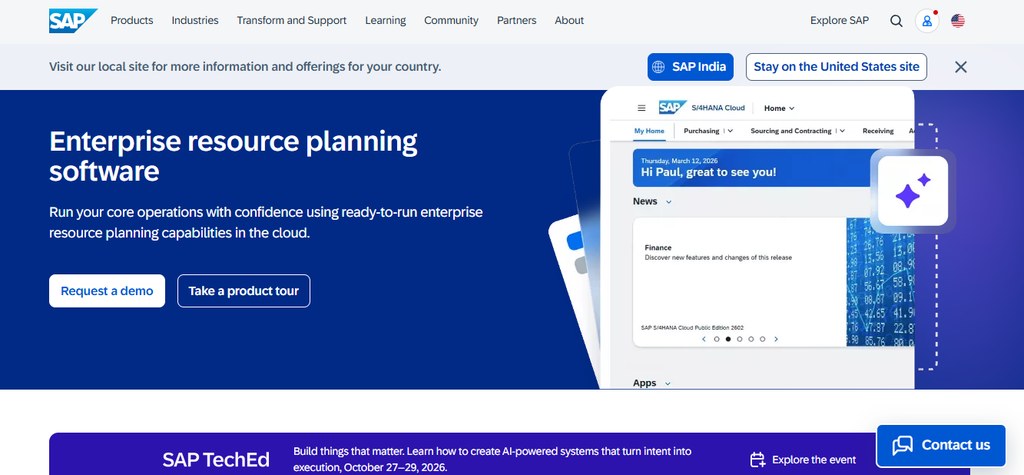
SAP was started in 1972 by five former IBM engineers in Germany, including Dietmar Hopp and Hasso Plattner, after their earlier project at IBM was shelved. The five decided to build their own software company focused on helping large businesses manage their entire operations in real time. That early vision grew into one of the biggest enterprise software companies in the world.
SAP’s ERP systems are used by many of the largest companies in the United States to manage finance, supply chains, and manufacturing together. Christian Klein joined SAP as a student in 1999 and worked his way up through the company over two decades. He became sole CEO in 2020 and continues leading SAP’s global operations today.
What SAP does: Helps large businesses manage finance, supply chains, and operations in one connected system.
Services: Enterprise resource planning, supply chain management, financial software, and business analytics.
2. Oracle ERP Cloud – A Database Giant’s Enterprise Software Suite
- Founded: 1977
- Owner: Founded by Larry Ellison; publicly listed, led by Co-CEOs Clay Magouyrk & Mike Sicilia
- Headquarters: Austin, Texas
Oracle was started in 1977 by Larry Ellison and two partners, originally focused on building database software for businesses and governments. That early database work became the foundation for a much larger software company over the following decades. Oracle eventually expanded into full enterprise resource planning systems used to manage entire companies.
The company grew its ERP business partly through acquisitions, including rival PeopleSoft in 2005. Oracle’s cloud ERP system now competes directly with SAP for large enterprise customers across the country. Clay Magouyrk and Mike Sicilia became Oracle’s co-CEOs in 2025, continuing the push toward AI-powered cloud applications.
What Oracle ERP Cloud does: Provides large businesses with cloud-based financial and operational management tools.
Services: Financial management, supply chain planning, human resources software, and procurement tools.
3. Microsoft Dynamics 365 – A Software Giant’s Business Management Platform
- Founded: 1975 (Microsoft)
- Owner: Founded by Bill Gates & Paul Allen; publicly listed, led by CEO Satya Nadella
- Headquarters: Redmond, Washington
Microsoft was started in 1975 by childhood friends Bill Gates and Paul Allen, who wanted to write software for the earliest personal computers. The company became famous for Windows, used on most computers worldwide. Microsoft later entered the ERP market by acquiring smaller companies like Great Plains and Navision in the early 2000s, eventually combining them into Dynamics 365.
The platform now blends ERP and CRM features in one cloud-based system, appealing to businesses already using Microsoft Office and Teams. This familiar connection to everyday Microsoft tools has helped Dynamics 365 grow steadily among mid-sized American businesses. Satya Nadella has led Microsoft as CEO since 2014, pushing the company toward artificial intelligence across its business software.
What Microsoft Dynamics 365 does: Combines ERP and business management tools with familiar Microsoft software.
Services: Financial management, supply chain tools, human resources software, and AI-powered business insights.
4. Workday – A Cloud ERP Pioneer Born From a Lake Tahoe Breakfast
- Founded: 2005
- Owner: Founded by Dave Duffield & Aneel Bhusri; publicly listed, led by CEO Aneel Bhusri
- Headquarters: Pleasanton, California
Workday was started in 2005 when Dave Duffield and Aneel Bhusri, both former executives at PeopleSoft, met for breakfast near Lake Tahoe after Oracle bought their old company. They decided to build something different: ERP software delivered entirely through the cloud, rather than installed on company computers. This cloud-first approach was still fairly unusual for enterprise software at the time.
Workday focused heavily on combining financial management with human resources software in one connected system. The company grew into one of the largest cloud ERP providers, especially popular among large employers managing complex payroll and benefits. After some recent leadership changes, Aneel Bhusri returned to serve as Workday’s CEO.
What Workday does: Combines financial management and human resources software in one cloud system.
Services: Financial management, human capital management, payroll processing, and workforce planning.
5. Oracle NetSuite – A Cloud ERP Pioneer for Growing Businesses
- Founded: 1998
- Owner: Founded by Evan Goldberg; part of Oracle
- Headquarters: Austin, Texas
NetSuite was started in 1998 by Evan Goldberg, a former Oracle employee, with early financial backing from Oracle founder Larry Ellison himself. Goldberg’s idea was to combine financial management, inventory tracking, and online store tools into one system delivered entirely over the internet. This all-in-one approach made NetSuite especially popular with growing mid-sized businesses that could not afford massive enterprise systems.
The company went public in 2007 and continued growing as an early cloud computing pioneer. In 2016, Oracle bought NetSuite entirely for $9.3 billion, bringing it fully under Oracle’s larger software portfolio. NetSuite continues to operate as its own business unit within Oracle, still focused mainly on small and mid-sized companies.
What Oracle NetSuite does: Provides growing businesses with combined financial and operational management tools.
Services: Financial management, inventory tracking, order management, and e-commerce integration.
6. Infor – An Industry-Focused ERP Built Through Many Mergers
- Founded: 2002
- Owner: Formed through mergers; owned by Koch Industries, led by CEO Kevin Samuelson
- Headquarters: New York, New York
Infor was formed in 2002 through a series of mergers between smaller software companies, originally under the name Agilisys. The business grew quickly by buying up other ERP and business software companies, adding dozens of products over the following years. This acquisition-heavy strategy helped Infor build deep expertise across many different industries.
The company became especially known for building ERP systems tailored to specific industries like manufacturing, healthcare, and food service, rather than one-size-fits-all software. Koch Industries, one of the largest private companies in America, bought Infor and has continued investing in its growth. Kevin Samuelson currently leads the company as CEO.
What Infor does: Provides industry-specific ERP software tailored to manufacturing, healthcare, and other sectors.
Services: Industry-specific ERP systems, supply chain management, and cloud-based business applications.
7. Epicor – A Manufacturing-Focused ERP With Deep Texas Roots
- Founded: 1972
- Owner: Roots to Dataworks & other firms; privately held, led by CEO Steve Murphy
- Headquarters: Austin, Texas
Epicor traces its roots back to several smaller software companies founded in the 1970s and 1980s, which eventually merged together under the Epicor name. The combined business built a strong reputation specifically in manufacturing and distribution software, an area many larger ERP providers treated as secondary. This focus helped Epicor stand out among smaller and mid-sized manufacturers.
The company has changed ownership several times over the decades, passing through different private equity firms along the way. Steve Murphy, a former OpenText executive, became Epicor’s CEO in 2017 and continues leading the company today. Epicor remains especially popular among manufacturers who need software built specifically for their industry.
What Epicor does: Provides ERP software tailored specifically to manufacturers and distributors.
Services: Manufacturing execution systems, distribution management, supply chain planning, and financial software.
8. Sage Intacct – A Silicon Valley Accounting Tool Now Owned by a British Giant
- Founded: 1999
- Owner: Founded by Odysseas Tsatalos & David Thomas; part of Sage Group, led by CEO Steve Hare
- Headquarters: San Jose, California
Intacct was started in 1999 in San Jose, California, by Odysseas Tsatalos and David Thomas, who saw a gap in the market between simple accounting software and massive enterprise systems. They wanted to build cloud-based financial software specifically for mid-sized companies that had outgrown basic bookkeeping tools. This focused approach helped Intacct grow steadily within its specific niche.
In 2017, British software company Sage Group bought Intacct for $850 million, rebranding it as Sage Intacct. The product remains focused mainly on financial management rather than broader manufacturing or supply chain features. Steve Hare, who leads the wider Sage Group as CEO, oversees Sage Intacct’s continued growth in the US market.
What Sage Intacct does: Provides cloud-based financial management software for growing mid-sized companies.
Services: General ledger accounting, accounts payable and receivable, financial reporting, and cash management.
9. Acumatica – A Cloud ERP Built by Former Microsoft Executives
- Founded: 2008
- Owner: Founded by Serguei Beloussov & co-founders; privately held, led by CEO John Case
- Headquarters: Bellevue, Washington
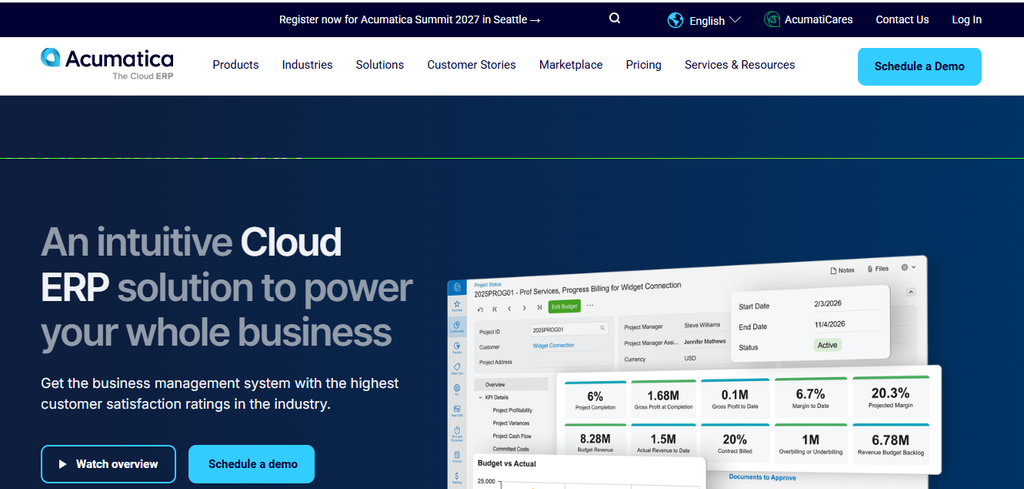
Acumatica introduced its ERP product in 2008, built with a strong focus on flexible, cloud-based technology from the very beginning. The company later brought in former Microsoft executives to help lead its growth, starting with Jon Roskill becoming CEO in 2014. This Microsoft connection shaped much of Acumatica’s approach to building adaptable, customer-friendly software.
The company grew steadily by focusing on small and mid-sized businesses that needed flexible pricing based on usage rather than the number of individual users. John Case, another former Microsoft executive, became Acumatica’s CEO in 2022. Acumatica remains privately held and continues focusing on cloud ERP for growing companies.
What Acumatica does: Provides flexible, cloud-based ERP software for small and mid-sized businesses.
Services: Financial management, distribution management, project accounting, and manufacturing tools.
10. Deltek – A Project-Focused ERP for Government Contractors and Consultants
- Founded: 1983
- Owner: Founded by Donald deLaski; owned by Roper Technologies
- Headquarters: Herndon, Virginia
Deltek was started in 1983 by Donald deLaski, building software specifically designed to help businesses track time and costs on individual projects. This project-based approach set Deltek apart from typical ERP systems built mainly around manufacturing or retail operations. The company found strong early demand among government contractors and professional services firms needing detailed project tracking.
Deltek’s software became especially important for architecture, engineering, and consulting firms that bill clients based on hours and project milestones. The company has changed ownership several times over the decades, now belonging to industrial technology company Roper Technologies. Deltek remains focused specifically on project-based businesses rather than general manufacturing or retail ERP.
What Deltek does: Provides project-based ERP software for government contractors and professional services firms.
Services: Project accounting, time and expense tracking, resource planning, and government contract compliance tools.
Frequently Asked Questions (FAQs)
1. Which is the most widely used ERP software in the USA?
SAP is considered one of the world’s leading ERP software companies and is used by many large businesses in the United States. Its ERP solutions help organizations manage finance, supply chains, operations, and other core business processes.
2. Which ERP companies are both owned by Oracle?
Oracle ERP Cloud and Oracle NetSuite are both owned by Oracle, although they serve different types and sizes of businesses. Oracle ERP Cloud is generally positioned for larger and more complex organizations, while NetSuite is widely used by growing and mid-sized businesses.
3. Which ERP company focuses specifically on human resources and finance together?
Workday focuses on combining financial management with human resources software in a cloud-based system. Its platform helps organizations manage areas such as accounting, workforce management, payroll, planning, and human capital operations.
4. Which ERP company is now owned by Koch Industries?
Infor is owned by Koch Industries, one of the largest privately held companies in the United States. Infor provides enterprise software designed for industries such as manufacturing, healthcare, distribution, and other specialized business sectors.
5. Which ERP company focuses mainly on manufacturing and distribution?
Epicor focuses heavily on manufacturing and distribution businesses, offering software designed around the operational needs of those industries. Its solutions can help businesses manage areas such as production, inventory, supply chains, finance, and customer operations.
6. Which ERP company was bought by a British software giant?
Sage Intacct was acquired by the UK-based Sage Group in 2017 for approximately $850 million. Sage Intacct provides cloud-based financial management software and is widely used by businesses and organizations that need accounting and financial management capabilities.
7. Are ERP software companies in the USA regulated?
Yes, ERP companies must comply with applicable data privacy, cybersecurity, and other regulations depending on their operations and the markets they serve. Their business customers may also require specific security and compliance standards when using ERP systems to manage sensitive information.
8. Which ERP company focuses specifically on project-based businesses?
Deltek focuses on project-based ERP and business software, particularly for government contractors, professional services firms, and other project-oriented organizations. Its solutions can help businesses manage projects, accounting, resources, contracts, and compliance.
9. Which ERP company was built by former Microsoft executives?
Acumatica has been associated with several former Microsoft executives, including CEO John Case. The company provides cloud ERP software designed to help small and mid-sized businesses manage financials, distribution, manufacturing, projects, and other business operations.
10. Why do these ten companies matter to everyday businesses?
These companies provide software that businesses of different sizes use to manage finances, inventory, employees, projects, supply chains, and other operations through connected systems. ERP platforms can help organizations centralize information and improve business processes.
Conclusion
America’s ERP Software Industry is a confluence of Silicon Valley start-ups, Wall Street databases, and European software giants. Oracle, Microsoft, Workday, Infor, Epicor, Acumatica, and Deltek are US-based companies that have either participated in the development of enterprise resource planning software or have significantly contributed to its growth.
SAP and Sage Intacct’s parent company are also part of the story, having developed ERP systems from the perspective of German and British enterprise software legends. The companies above provide the US-based enterprise resource planning software that modern multinational corporations use to optimize their operations.
This technology helps companies run their finances, supply chains, and other critical functions on a daily basis, and it will continue to serve that purpose as artificial intelligence changes the field.