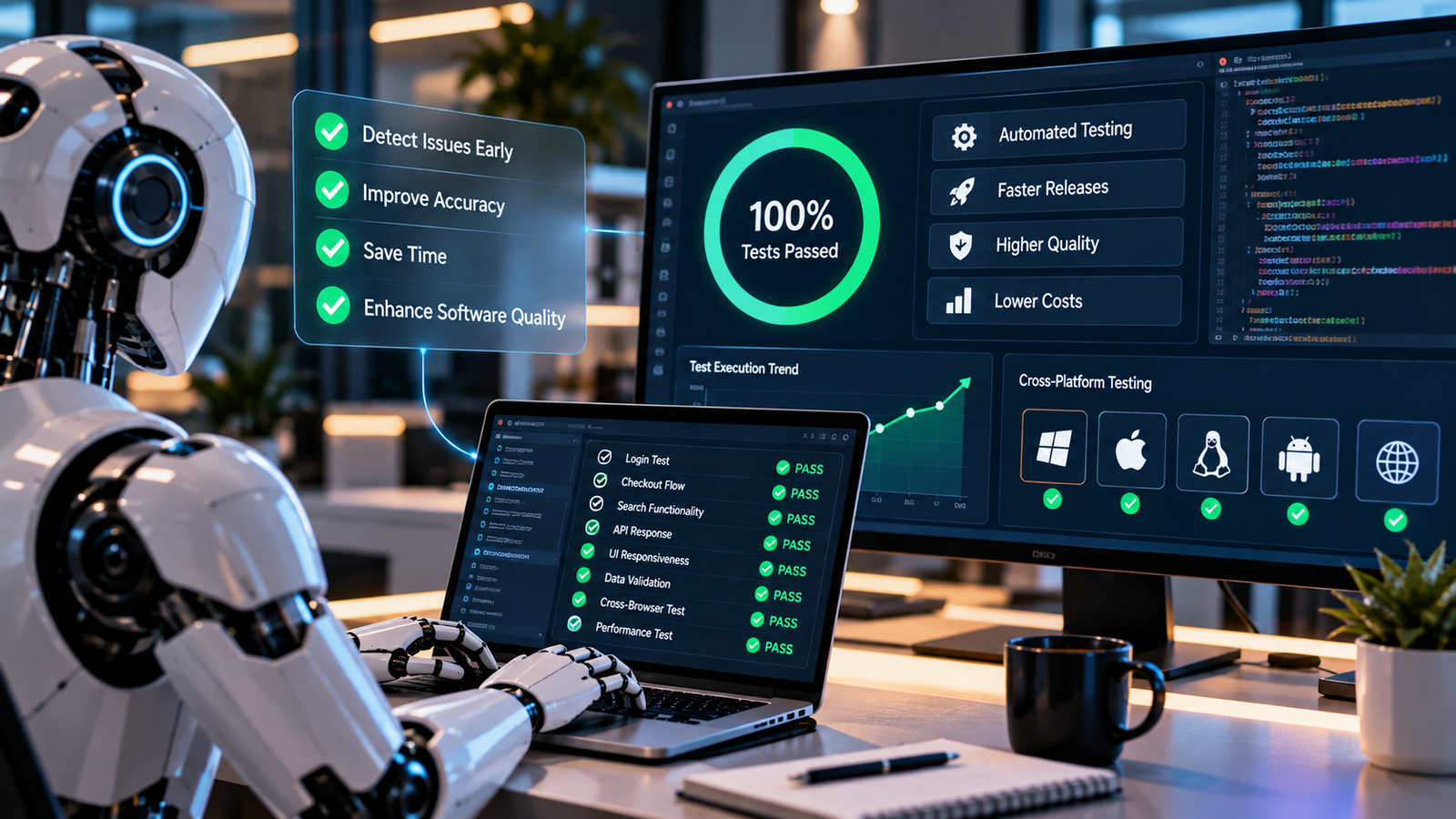
Introduction
Software teams are expected to deliver new features quickly while keeping websites and applications dependable. Every update creates an opportunity to improve the customer experience, but it can also introduce defects in forms, navigation, account access, or checkout. Testing helps teams find these problems before customers encounter them. As applications grow, however, checking every workflow manually becomes difficult to sustain. This is one reason artificial intelligence is attracting attention in software quality assurance.
Why traditional testing can become slow
Traditional testing often involves writing scripts, selecting test cases, preparing data, and repeating the same actions after each release. These practices remain useful, particularly when a test must verify a precise business rule. The challenge appears when teams need to maintain hundreds of tests while the interface changes frequently. A small redesign can require updates to several scripts, and important workflows may remain untested simply because creating coverage takes too long.
How AI assists test creation
AI-assisted tools can explore reachable pages, identify interactive elements, and draft tests based on the workflows they discover. For example, a tool may find a registration form, enter sample information, submit it, and prepare a test for a reviewer to examine. This can reduce the effort required to establish initial coverage. With AI test automation, teams can focus more of their time on deciding what should happen and reviewing whether a generated test checks the right outcome.
Finding defects earlier
Automated tests can check common journeys such as signing in, submitting a form, navigating between pages, or completing a purchase. When a test fails, screenshots, step details, and logs can help developers understand what happened. Evidence is important because a failure may indicate an application bug, an expired test account, a network issue, or an outdated test expectation. A useful process investigates the cause rather than treating every red result as proof that the application is broken.
Why human review still matters
AI cannot independently define every business requirement. A checkout page may look correct while applying the wrong discount, and a confirmation message may appear even when information was not saved. Teams should add explicit assertions for important outcomes, use safe test data, and review generated steps before relying on them for release decisions. Human judgment is especially important for security-sensitive, financial, and destructive workflows.
Conclusion
AI is changing software testing by reducing repetitive setup and helping teams discover useful test scenarios sooner. Its value comes from combining exploration, repeatable execution, clear evidence, and thoughtful review—not from assuming that automation catches everything. When teams pair AI assistance with automated regression testing, they can recheck important features after changes and spend more time investigating complex issues. The result can be a more efficient development process and a more reliable experience for users.
A practical review before release
Before a release, choose a small set of user journeys and confirm that each test has a clear purpose. Check that the sample account is valid, the starting state is predictable, and the expected result is written down. Review failures with screenshots and step details rather than relying on a pass rate alone. It is also helpful to keep a record of defects found by the suite, since this shows whether the tests are protecting important parts of the product. As the application changes, update tests when requirements change intentionally and remove checks that no longer provide value. This keeps the test suite useful instead of allowing it to become a maintenance burden.
Questions to ask before publishing
Before publishing a new feature, ask whether the test covers the main user goal, whether its expected result is explicit, and whether another developer could understand a failure report. Check that the test uses a safe account and can be repeated without relying on leftover data. These small habits make automation easier to trust. They also help teams explain why a check exists and decide when it should be updated as the product changes.