Data centers are the places that keep websites, mobile apps, cloud platforms and online services running. Data centers contain servers, storage systems, networking equipment and the power and cooling systems needed to operate data centers. As businesses use cloud computing and artificial intelligence the demand for reliable data center infrastructure continues to grow.
The USA is home to major data center companies. Some data center companies provide space and connectivity for businesses to install their IT equipment while other data center companies develop large facilities for cloud providers and major enterprises. Data center companies provide services such as colocation, interconnection, managed infrastructure and built data center campuses.
This list highlights ten established data center operators with a presence in the US market. The ranking considers data center operators market presence, service range, geographic reach and role in the industry. It is a comparison rather than an official ranking, by revenue or capacity.
Equinix
Image Courtesy: Equinix (Official Website)
Equinix is one of the companies in the global data center industry. It was started in Silicon Valley in 1998. The company created a business method that let different networks connect and share data inside shared buildings. Now its services help companies in fields like finance, retail, healthcare, manufacturing and technology.
| Founded: | 1998 |
| Headquarters: | Redwood City, California, USA |
| Latest Revenue: | $9.217 billion (FY2025) |
| Main Products/Services: | Colocation, interconnection, data center services and digital infrastructure |
A big part of Equinix’s work is interconnection. With this service customers can create links with cloud providers, networks and other businesses instead of using the public internet. This can make communication between systems better and help move data between different platforms.
Equinix has a network of data centers including places in the United States. Its mix of colocation and network links makes it a good choice for companies that need infrastructure and access to a big digital ecosystem. The company works with companies of all sizes from businesses to big international companies.
Digital Realty
Image Courtesy: Digital Realty (Official Website)
Digital Realty owns, builds and runs data centers used by cloud companies, technology firms and big companies. Its global collection allows customers to place their systems close to their users, business partners and digital services.
| Founded: | 2004 |
| Headquarters: | Austin, Texas, USA |
| Latest Revenue: | $6.113 billion (FY2025) |
| Latest Net Income: | $1.31 billion (FY2025) |
| Main Products/Services: | Data center leasing, colocation, interconnection and digital infrastructure |
The company offers colocation and interconnection services letting customers put their equipment in managed buildings and connect with networks and other businesses. It also helps with bigger infrastructure needs for companies that are growing their cloud work or handling a lot of data.
Digital Realty’s size makes it a key player in the data center market. Its FY2025 revenue was $6.113 billion with net income around $1.31 billion. These numbers show the company’s financial performance, not just from its US locations.
With its collection and range of infrastructure services Digital Realty helps companies that need growing capacity and reliable connections as their technology needs increase.
QTS Data Centers
Image Courtesy: QTS Data Centers (Official Website)
| Founded: | 2003 |
| Headquarters: | Sterling, Virginia, USA |
| Latest Revenue: | Not publicly disclosed |
| Latest Net Income: | Not publicly disclosed |
| Main Products/Services: | Hyperscale data centers, colocation, enterprise infrastructure and data center development |
QTS Data Centers focuses on digital infrastructure for companies, cloud providers and those with tough computing needs. Its buildings offer the space, power, cooling and support needed to keep servers and other IT equipment working.
The company operates across North America and Europe with a presence in the United States. Its services go from colocation space for customer equipment to buildings made for major tech and cloud businesses.
QTS also pays attention to energy use. How efficient the buildings are. These areas are becoming more important because data centers use a lot of electricity and need cooling especially when handling high-density computing tasks.
As a company that runs data centers QTS helps businesses that need a lot of computing power without building and managing everything by themselves. Its private ownership means that current income and profit numbers are not shared with the public.
CyrusOne
Image Courtesy: CyrusOne (Official Website)
CyrusOne builds and runs data centers for big companies and big customers. The company has locations in US areas, including Texas, Virginia, Arizona and Illinois as well as operations in Europe.
| Founded: | 2001 |
| Headquarters: | Dallas, Texas, USA |
| Latest Revenue: | Not publicly disclosed |
| Latest Net Income: | Not publicly disclosed |
| Main Products/Services: | Colocation, hyperscale data centers, build-to-suit facilities and high-density infrastructure |
Its services include colocation, where customers put their IT equipment in a managed place and build-to-suit projects made for specific business needs. These projects can give customers control over the building size, power and infrastructure planning.
CyrusOne also handles density computing setups, which need careful planning for power and cooling. These skills are becoming more important as companies use applications like AI and advanced cloud computing.
The company helps customers that need growing infrastructure and space for growth. As a company CyrusOne does not share its income and profit numbers like public companies do.
CoreSite
Image Courtesy: CoreSite (Official Website)
CoreSite started in 2001 under the name CRG West. Used the CoreSite name in 2009. It gives data center and interconnection services for businesses that need infrastructure and direct access to networks, cloud platforms and other companies.
| Founded: | 2001 |
| Headquarters: | Denver, Colorado, USA |
| Latest Revenue: | Not publicly disclosed separately |
| Latest Net Income: | Not publicly disclosed separately |
| Main Products/Services: | Colocation, interconnection, cloud connectivity and data center services |
Its buildings are in US areas where network links matter to businesses. Through interconnection services customers can link their systems with cloud providers, telecom networks and other businesses. This can help companies handle data transfers and link parts of their tech setup.
CoreSite is part of American Tower, a listed company that works in communications infrastructure. Its data center work focuses on colocation and connections while American Tower also works in areas of communications. The parent company’s overall income should not be mixed with CoreSites income.
CoreSite is important for businesses that care about network access and connecting with a digital system. Its buildings support companies that need to link cloud services, apps and company systems.
Vantage Data Centers
Image Courtesy: Vantage Data Centers (Official Website)
Vantage Data Centers specializes in building and running data center campuses. Its buildings are made for customers who need a lot of computing power, including cloud companies and big tech businesses.
| Founded: | 2010 |
| Headquarters: | Denver, Colorado, USA |
| Latest Revenue: | Not publicly disclosed |
| Latest Net Income: | Not publicly disclosed |
| Main Products/Services: | Hyperscale data centers, large campus developments and custom infrastructure |
A big campus can be built in steps allowing the capacity to grow as customer needs change. Planning involves factors like electricity, cooling, building schedules and space for future growth. These are especially important for customers running computing workloads.
Vantage is in North America and other international markets. Its focus on infrastructure makes it an important company in a market where demand for large data center buildings is growing along with cloud computing and AI.
The company is private so its overall income and profit are not shared with the public. Its business is about providing big-scale infrastructure that customers can use to grow their work.
Aligned Data Centers
Image Courtesy: Aligned Data Centers (Official Website)
Aligned Data Centers builds data center buildings for companies that need room to grow their computing work. Its US presence includes the Dallas–Fort Worth area, where the company has its American headquarters in Plano, Texas.
| Founded: | 2013 |
| Headquarters: | Plano, Texas, USA |
| Latest Revenue: | Not publicly disclosed |
| Latest Net Income: | Not publicly disclosed |
| Main Products/Services: | Hyperscale data centers, colocation, liquid cooling and modular infrastructure |
Cooling is a part of Aligned’s work. As computers get more powerful, managing the heat becomes harder. The company offers cooling options, like air cooling and water cooling depending on what the building and customers need.
Aligned’s buildings are made for digital tasks, including setups that need more power. Its building method also lets capacity grow step by step helping customers expand their tech as their needs change.
The company is private so its separate yearly income and profit are not shared. Aligneds focus on growing buildings and cooling tech makes it important for companies with computing needs.
DataBank
Image Courtesy: DataBank (Official Website)
DataBank started with a data center in a Federal Reserve Bank building in Dallas. Since then it has grown through buildings and buying other companies creating a presence in many US cities. The company has more than 70 data centers across more than 25 US cities.
| Founded: | 2005 |
| Headquarters: | Dallas, Texas, USA |
| Latest Revenue: | Not publicly disclosed |
| Latest Net Income: | Not publicly disclosed |
| Main Products/Services: | Colocation, managed services, cloud infrastructure, security and compliance services |
Its work goes beyond offering space for servers. Customers can use colocation, managed systems, cloud services and security help depending on their needs. These services can help companies that do not want to handle all their tech work
DataBank serves companies that need places close to their users, offices or work areas. A group of data centers in cities can help businesses plan for local coverage, links and backup if one place has a problem.
As a company DataBank does not share its separate income and profit. Its range of tech and managed services makes it an option for companies looking for help with both physical data center work and other IT needs.
Switch
Image Courtesy: Switch (Official Website)
Switch was started in 2000. Built its business around creating, building and running big data center buildings. Its campuses provide infrastructure for companies that need a lot of computing power, network links and support for tech systems.
| Founded: | 2000 |
| Headquarters: | Las Vegas, Nevada, USA |
| Latest Revenue: | Not publicly disclosed separately |
| Latest Net Income: | Not publicly disclosed separately |
| Main Products/Services: | Colocation, data center campuses and technology infrastructure |
The company has run data center campuses in places like Las Vegas and other US cities. Its buildings bring together power, cooling, links and physical setup to support business apps, data storage and online services.
Energy use and building design are parts of big data center work. Providers must balance the need for service, with electricity use, cooling needs and long-term costs. These factors matter to customers who run equipment all the time.
Switch is part of an ownership setup so financial details for its parent company or investors should not be automatically considered as Switch’s own revenue. The revenue and net income of Switch as an entity are not made public individually.
Iron Mountain Data Centers
Image Courtesy: Iron Mountain Data Centers (Official Website)
Iron Mountain is well known for information storage and records management. Its business also includes a data center segment. This part of the company offers facilities and services for organizations that require secure managed digital infrastructure.
| Founded: | Data center business developed within Iron Mountain, whose parent company was founded in 1951 |
| Headquarters: | Portsmouth, New Hampshire, USA |
| Latest Revenue: | $803.429 million in data center segment revenue (FY2025) |
| Main Products/Services: | Data center colocation, storage, power and infrastructure services |
The company shared about $803.429 million in revenue for its global data center segment in FY2025. This number is for the data center business not for the whole Iron Mountain company, which also runs in other information management services. The total company revenue was $6.90 billion in the same financial year.
Iron Mountain Data Centers offers colocation and infrastructure for businesses that need environments for their IT equipment. Its broader experience in information management also links its data center operations with customers that manage business records and digital information.
The data center segment has grown as the need for infrastructure has increased. Its services help businesses that want managed facilities, power capacity and the infrastructure needed to run technology systems reliably.
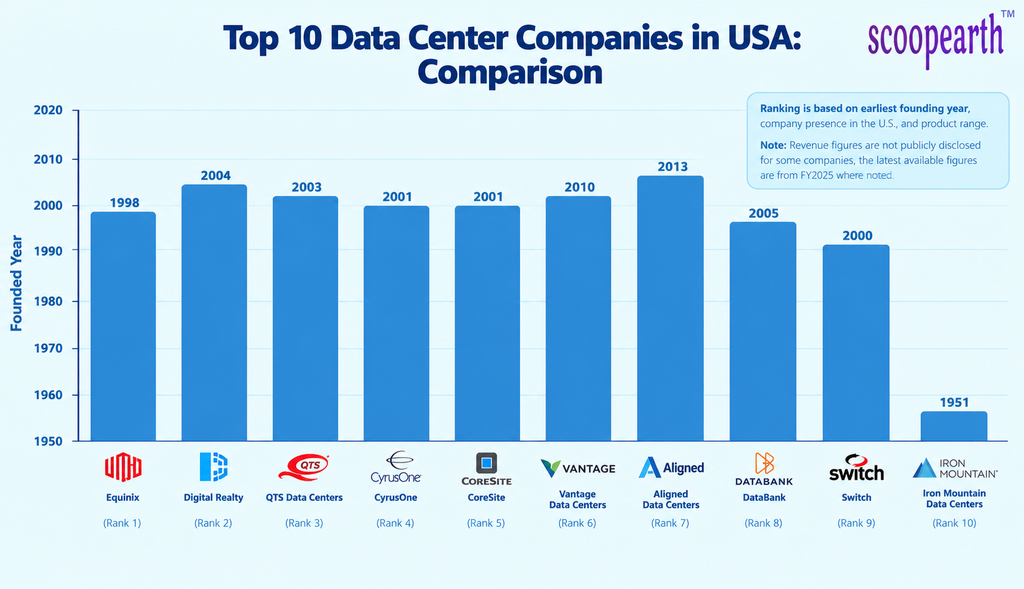
Top 10 Data Center Companies in USA: Comparison
| Rank | Company | Founded | Latest Revenue | Main Products/Services |
| 1 | Equinix | 1998 | $9.217 billion (FY2025) | Colocation, interconnection and digital infrastructure |
| 2 | Digital Realty | 2004 | $6.113 billion (FY2025) | Data center leasing, colocation and interconnection |
| 3 | QTS Data Centers | 2003 | Not publicly disclosed | Hyperscale data centers and colocation |
| 4 | CyrusOne | 2001 | Not publicly disclosed | Colocation, hyperscale and build-to-suit facilities |
| 5 | CoreSite | 2001 | Not publicly disclosed separately | Colocation and interconnection |
| 6 | Vantage Data Centers | 2010 | Not publicly disclosed | Hyperscale campuses and custom infrastructure |
| 7 | Aligned Data Centers | 2013 | Not publicly disclosed | Hyperscale facilities and cooling systems |
| 8 | DataBank | 2005 | Not publicly disclosed | Colocation, managed services and cloud infrastructure |
| 9 | Switch | 2000 | Not publicly disclosed separately | Colocation and large data center campuses |
| 10 | Iron Mountain Data Centers | Parent founded in 1951 | $803.429 million (FY2025 data center segment) | Colocation and data center infrastructure |
What Should Businesses Consider When Choosing a Data Center Company?
Selecting a data center provider is not about how big the company is. A business must look at where the facility’s how much power it has, how it cools, how well the network connects and whether there is space for growth later. If a business serves customers in an area a nearby data center can cut delays.
Security and reliability matter too. A business must examine physical access limits, power, plans for disaster recovery and how fast the provider can fix technical problems. Companies that follow rules may also need data centers that meet particular compliance standards.
Cost is also a factor. A business should compare the price of space, power fees, network charges, installation costs and the terms of the contract. For AI or other heavy computing jobs a business must make sure the data center can provide the needed power and cooling before agreeing.
Conclusion
The US data center market has providers with different strengths. Equinix and Digital Realty give infrastructure and good connectivity. Companies like QTS, CyrusOne, Vantage and Aligned focus on big deployments. CoreSite highlights interconnection, while DataBank offers colocation plus managed services. Switch and Iron Mountain Data Centers also help businesses that need a lot of infrastructure.
How open companies are about money differs. Companies that are listed publicly publish their results. Many private operators keep their revenue and profit private. When a business picks a provider the best comparison looks at more than size. It also looks at where the data center’s how much power it can give, how reliable it is, how good the connectivity is, how secure it is and the long‑term cost.
FAQs
What are the top data center companies in the USA?
Some well‑known operators are Equinix, Digital Realty, QTS Data Centers, CyrusOne, CoreSite, Vantage Data Centers, Aligned Data Centers, DataBank, Switch and Iron Mountain Data Centers. Each one gives a mix of colocation, connectivity, managed services and large‑scale infrastructure.
What does a data center company do?
A data center company owns, builds or runs places that hold servers, storage gear and networking tools. It gives services like power, cooling, physical security and network links so businesses can keep their tech running.
Which data center companies are publicly listed?
Equinix, Digital Realty and Iron Mountain are publicly listed. American Tower, which owns CoreSite, is also traded publicly.. You should not mix a parent company’s money with a subsidiary’s money unless the numbers are shown separately.
Which companies focus on data centers?
QTS, CyrusOne, Vantage Data Centers and Aligned Data Centers serve hyperscale customers. Those customers usually need a lot of space, power and cooling for cloud platforms and heavy computing jobs.
What is the difference between colocation and hyperscale data centers?
Colocation lets a business put its servers and networking gear in someone elses facility that gives power, cooling and security. Hyperscale data centers are built for big computing needs, usually for cloud and tech firms.
Why is interconnection important?
Interconnection lets a business link directly with networks, cloud providers and other groups. It can make data move better and tie together parts of a companys IT setup. Equinix and CoreSite are known for this service.
Do all data center companies publish revenue figures?
No. Listed companies usually give their financial results. Private operators often keep revenue and profit private. If a company does not share numbers, say the revenue is “Not publicly disclosed” instead of guessing.
What should businesses check before selecting a data center provider?
A business should look at the location of how power the data center can supply, cooling, network links, security, backup power, technical help and the terms of the contract. It should also check whether the data center can grow as demand grows for jobs that need a lot of power.