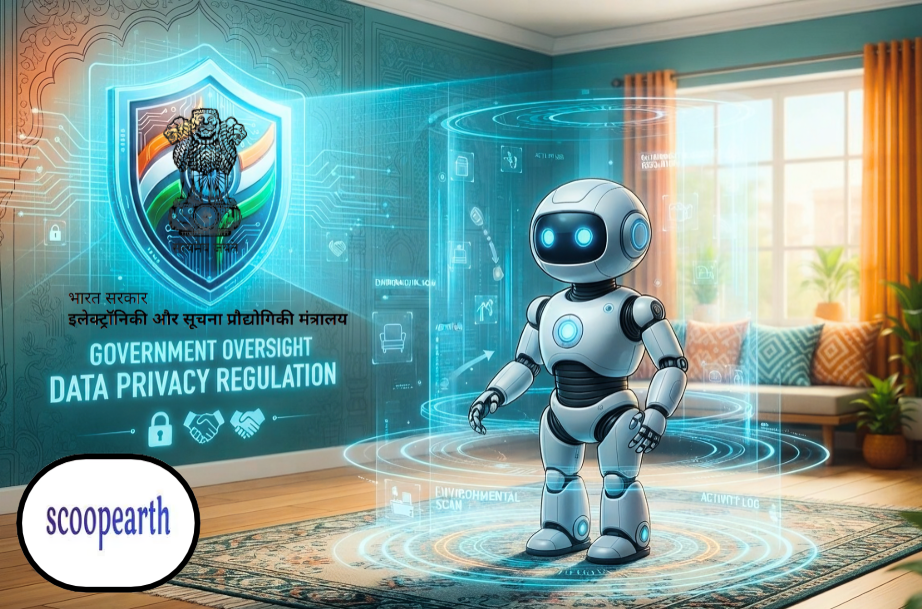
The Ministry of Electronics and Information Technology has expressed concerns over the way first-person videos and sensor data are being collected from gig workers to create and train physical artificial intelligence models. The regulatory attention follows closely after Pronto’s in-home video recording program, as competing providers Snabbit and Urban Company have opted out of the same practice. The ministry’s senior officials held a meeting with representatives of home services platforms such as Snabbit, Pronto, and Urban Company and technology and robotics firms to address issues of workers’ rights, consumer privacy, and data sovereignty, according to a report. Despite their involvement in the consultation, none of the three platforms are currently gathering domestic footage for artificial intelligence training.
Government-led consultation and data sovereignty
Consumer privacy, labour rights and national sovereignty were central themes in the consultation driven by the government. The new trend of introducing AI development into private homes using machine interpreters in the form of head-mounted cameras or sensor-strapping commentary wears is the direct introduction of AI technology into the interior of the home.
This raises substantial regulatory issues regarding individual populations whose daily use, real estate, and feeling of dependence are being recorded in training sets without their knowledge or explicit consent.
A broader geopolitical and economic discussion took place at the ministerial meeting on the implications of the collection of sensitive domestic information followed by its transmission and sale to another country by a physical artificial intelligence developer. Some executives voiced worries that unchecked data interflows would not put the country on the right side of the future in terms of technological control and security.
Broader implications and operational approaches among platforms
Several home services companies have worked on the new trend of collecting egocentric data for use in machine learning. Pronto is one of the key instant househelp companies to actively launch in-home video recording programs using its dedicated Verified service.
Other companies in the home service industry, like Urban Company and Snabbit, have actively avoided the practice of inside home taping for artificial intelligence training. During the consultation presided over by the Ministerial Secretary S Krishnan, officials requested detailed information about the standard operating procedures for gathering, processing, and archiving first-person videos.
Specific inquiries were made of the companies about the precautions taken to secure informed consent from workers and consumers, and about the measures taken to protect against any unauthorized disclosure of data.
The long-term observation by the Ministry of Electronics and Information Technology reveals a growing conflict between the constant need of global artificial intelligence companies for groundbreaking inputs from the real world and the necessity to uphold the right to privacy within the country’s borders.
Physical artificial intelligence models need large quantities of egocentric data, including human motion and spatial interactions in the real world, as well as dexterous and intelligent tasks performed in the real world, to work well in the real world.
The rapid and cost-effective commercialisation of this data collection model points to critical gaps in current data governance structures. The current set of regulations may not be comprehensively sufficient to manage the full lifecycle of egocentric data, from its initial collection by gig workers to its ultimate application by AI developers.
Conclusion
The recent ministerial review process under the supervision of the Ministry of Electronics and Information Technology reflects the increasing regulatory and ethical challenges in the fast-growing physical AI area, wherein data sovereignty, privacy, and worker rights pose significant concerns. With home services platforms such as Pronto exploring the domain of first-person recordings and sensor parameters for robotics training, the twofold challenge is to align new technology with strong data protection. As investment and infrastructure companies come to India, it will be crucial to set up clear standard operating procedures and regulations for the processing and sharing of real-world human data within India and globally.