
Penetration Testing Services – Muster
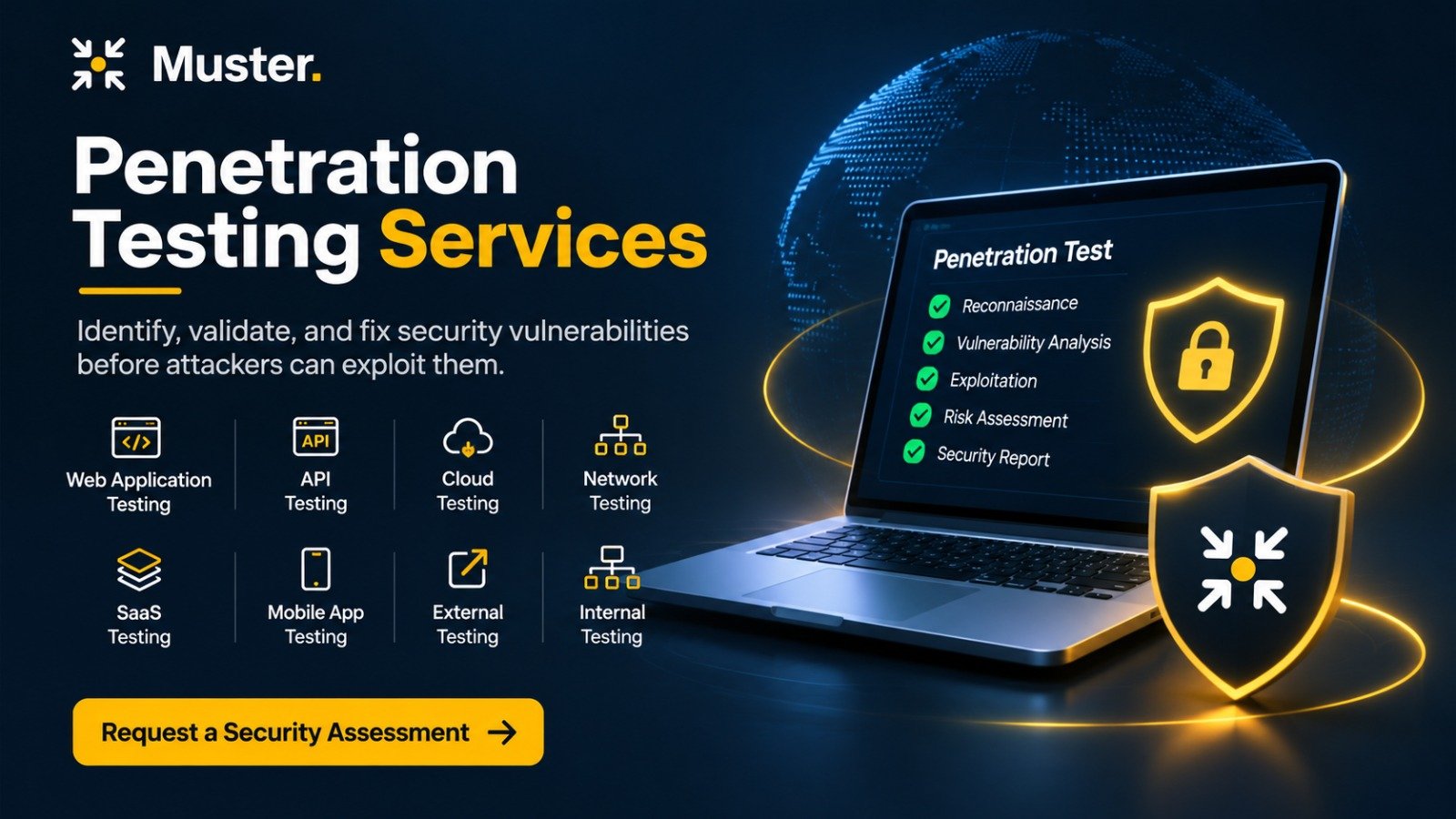
SUMMARY
Cyber threats are becoming increasingly sophisticated, making it essential for businesses to understand where their security defenses may fail. A single vulnerability in a web application, API, network, or cloud environment can expose sensitive information, disrupt business operations, and damage customer trust.
Muster Security provides professional penetration testing services designed to identify, validate, and help remediate security vulnerabilities before malicious attackers can exploit them. Our security testing approach combines manual penetration testing techniques, automated security tools, and real-world attack simulations to evaluate your organization’s security posture.
Whether you operate a SaaS platform, enterprise application, eCommerce website, cloud infrastructure, or complex corporate network, our penetration testing services help uncover security weaknesses that traditional vulnerability scans may overlook.
We focus on practical security validation, helping your organization understand not only what vulnerabilities exist but also how they could affect your business.
What Are Penetration Testing Services?
Penetration testing services involve authorized security assessments that simulate real-world cyberattacks against applications, networks, systems, and infrastructure. The objective is to identify exploitable vulnerabilities and determine how attackers could use them to gain unauthorized access, compromise sensitive data, or disrupt business operations.
Unlike basic vulnerability scanning, penetration testing involves security professionals manually investigating potential weaknesses, validating security findings, and examining how multiple vulnerabilities could be combined into an attack path.
A professional penetration test may evaluate:
- Authentication and authorization mechanisms.
- Web application security vulnerabilities.
- API endpoints and access controls.
- Network services and exposed infrastructure.
- Cloud configurations and identity permissions.
- Business logic vulnerabilities.
- Session management and access restrictions.
- Data exposure and sensitive information handling.
- Security controls and defensive mechanisms.
At Muster Security, our objective is to provide actionable findings that help businesses reduce security risks and improve their overall security posture.
Our Penetration Testing Services
We provide comprehensive penetration testing services covering different technology environments and attack surfaces.
1. Web Application Penetration Testing
Web applications frequently handle sensitive customer information, financial transactions, authentication credentials, and business-critical operations.
Our web application penetration testing identifies vulnerabilities that attackers could exploit to compromise applications or access restricted information.
Our testing covers:
- SQL injection and command injection.
- Cross-site scripting (XSS).
- Cross-site request forgery (CSRF).
- Broken access control.
- Authentication and session management.
- Server-side request forgery (SSRF).
- File upload vulnerabilities.
- Security misconfigurations.
- Business logic vulnerabilities.
- Sensitive data exposure.
We follow established security testing methodologies, including OWASP guidance, to assess application security comprehensively.
2. Network Penetration Testing
Network penetration testing evaluates the security of internal and external network environments to identify weaknesses that could allow unauthorized access.
Our network security assessments examine:
- Open ports and exposed services.
- Firewall and network segmentation.
- Misconfigured network devices.
- Insecure protocols and services.
- Remote access vulnerabilities.
- Authentication weaknesses.
- Privilege escalation opportunities.
- Internal network attack paths.
We help organizations understand how attackers could potentially move through their network and access sensitive systems.
3. API Penetration Testing
APIs connect applications, services, databases, and third-party platforms. Insecure APIs can expose sensitive information and create opportunities for unauthorized access.
Our API penetration testing focuses on identifying weaknesses in API authentication, authorization, data validation, and business logic.
Key testing areas include:
- Broken Object Level Authorization (BOLA).
- Broken Function Level Authorization (BFLA).
- Broken authentication.
- Excessive data exposure.
- Mass assignment vulnerabilities.
- Rate limiting weaknesses.
- Injection vulnerabilities.
- Improper security configurations.
- API business logic flaws.
- Sensitive information disclosure.
We assess REST, GraphQL, and other supported API architectures to identify security risks across your API ecosystem.
4. Cloud Penetration Testing
Cloud environments introduce unique security challenges involving identity permissions, storage configurations, networking, and exposed services.
Our cloud penetration testing evaluates cloud infrastructure and configurations to identify potential attack paths.
Testing may include:
- Identity and access management (IAM).
- Publicly accessible cloud storage.
- Misconfigured cloud resources.
- Excessive permissions.
- Insecure network configurations.
- Exposed credentials and secrets.
- Container and workload security.
- Cloud API security.
- Serverless application security.
- Privilege escalation risks.
We assess supported cloud environments, including AWS, Microsoft Azure, and Google Cloud Platform, within an explicitly authorized scope.
5. Mobile Application Penetration Testing
Mobile applications can introduce security vulnerabilities through insecure data storage, weak authentication, exposed APIs, and improper communication security.
Our mobile application penetration testing evaluates Android and iOS applications for weaknesses that could compromise user information or application functionality.
Our assessment includes:
- Insecure local data storage.
- Weak authentication mechanisms.
- Insecure API communication.
- Certificate validation weaknesses.
- Reverse engineering exposure.
- Hardcoded secrets.
- Session management issues.
- Improper cryptographic implementation.
- Mobile platform security misconfigurations.
6. Internal and External Penetration Testing
Internal and external penetration testing evaluate your organization’s security from different attacker perspectives.
External penetration testing examines internet-facing assets such as public IP addresses, websites, VPN gateways, and exposed services.
Internal penetration testing simulates an attacker who has already gained access to an internal network, helping identify lateral movement opportunities and privilege escalation risks.
Both assessments help organizations understand how security weaknesses could impact their infrastructure.
7. SaaS Penetration Testing
SaaS platforms manage customer information, user accounts, integrations, and business-critical data. Security weaknesses can expose multiple customers or compromise tenant boundaries.
Our SaaS penetration testing focuses on:
- Multi-tenant isolation.
- Tenant-to-tenant data access.
- Role-based access control.
- Authentication and authorization.
- API security.
- Subscription and payment workflows.
- Business logic vulnerabilities.
- Third-party integrations.
- Administrative access controls.
- Cloud infrastructure security.
We help SaaS companies identify vulnerabilities that could affect platform security and customer trust.
Our Penetration Testing Methodology
Muster Security follows a structured penetration testing methodology designed to provide consistent, evidence-based security assessments.
Step 1: Planning and Scoping
We begin by understanding your technology environment, business requirements, and security objectives.
This phase includes:
- Defining testing objectives.
- Identifying in-scope assets.
- Establishing testing permissions.
- Understanding application architecture.
- Defining testing limitations.
- Establishing communication procedures.
Step 2: Reconnaissance and Information Gathering
Our security testers collect relevant information about the target environment to understand its architecture and potential attack surface.
Activities may include:
- Domain and subdomain discovery.
- Technology fingerprinting.
- Public asset identification.
- Application endpoint discovery.
- Service identification.
- Attack surface mapping.
Step 3: Vulnerability Identification
We investigate potential security weaknesses using a combination of automated tools and manual testing techniques.
This phase identifies vulnerabilities in applications, APIs, networks, cloud environments, and authentication mechanisms.
Step 4: Exploitation and Security Validation
Where authorized and safe, our testers attempt to validate identified vulnerabilities through controlled exploitation.
This helps determine whether a vulnerability is genuinely exploitable and what level of access or business impact it could create.
Step 5: Risk Assessment
We evaluate confirmed findings based on their severity, exploitability, potential impact, and business context.
Each finding receives an appropriate risk rating to help prioritize remediation efforts.
Step 6: Reporting and Remediation Guidance
We provide a detailed penetration testing report containing:
- Executive summary.
- Assessment scope.
- Testing methodology.
- Confirmed vulnerabilities.
- Risk severity classifications.
- Technical evidence.
- Potential business impact.
- Recommended remediation steps.
Step 7: Retesting and Verification
After your team implements security fixes, we can perform retesting to verify whether the reported vulnerabilities have been properly addressed.
Penetration Testing vs. Vulnerability Assessment
Although penetration testing and vulnerability assessments are related, they serve different security objectives.
| Comparison | Vulnerability Assessment | Penetration Testing |
| Primary objective | Identify security weaknesses | Validate exploitable weaknesses |
| Approach | Automated and manual scanning | Manual testing and controlled exploitation |
| Exploitation | Generally not performed | Performed when authorized |
| Business impact | Identifies potential exposure | Demonstrates validated impact |
| Reporting | Vulnerability list | Detailed findings and attack paths |
| Outcome | Security weakness identification | Practical security validation |
Both approaches are valuable. Organizations can combine vulnerability assessments with regular penetration testing for stronger security coverage.
Why Choose Muster Security for Penetration Testing?
Choosing the right security testing partner is important for identifying vulnerabilities that automated tools may miss.
Muster Security focuses on practical security assessments that help businesses understand and address real-world security risks.
What makes our approach valuable:
- Manual Security Testing: Human-led assessments to identify complex vulnerabilities and business logic issues.
- Industry-Recognized Methodologies: Testing aligned with OWASP guidance and established penetration testing practices.
- Comprehensive Coverage: Assessments across web applications, APIs, networks, mobile applications, and cloud environments.
- Actionable Reporting: Clear technical findings with evidence, risk ratings, and remediation recommendations.
- Business-Focused Risk Assessment: Understanding how vulnerabilities could affect your operations and sensitive information.
- Retesting Support: Verification of security fixes to help improve your security posture.
Our goal is to help your organization move beyond simply identifying vulnerabilities and toward building stronger, more resilient systems.
Who Needs Penetration Testing Services?
Penetration testing is valuable for organizations that develop, operate, or manage digital systems and sensitive business information.
Our services can support:
- SaaS Companies: Protect customer accounts, tenant data, APIs, and cloud environments.
- Financial Technology Companies: Identify vulnerabilities affecting payment systems and financial applications.
- eCommerce Businesses: Secure customer accounts, checkout processes, and payment integrations.
- Healthcare Organizations: Assess applications and infrastructure that process sensitive information.
- Enterprise Organizations: Evaluate internal networks, external infrastructure, and business-critical applications.
- Technology Startups: Identify security weaknesses before product launches and business expansion.
- Cloud-First Businesses: Assess cloud configurations, identity permissions, and exposed workloads.
When Should You Perform a Penetration Test?
Organizations should conduct penetration testing at important stages of their software development and infrastructure lifecycle.
Consider scheduling an assessment:
- Before launching a new web application or SaaS platform.
- After significant application or infrastructure changes.
- Before major product releases.
- Following cloud migration or infrastructure expansion.
- After implementing major authentication changes.
- Before security audits or compliance assessments.
- Following a security incident.
- As part of a recurring security testing program.
The appropriate testing frequency depends on your organization’s risk profile, technology changes, regulatory requirements, and security objectives.
Frequently Asked Questions About Penetration Testing Services
1. What are penetration testing services?
Penetration testing services involve authorized security assessments that simulate real-world cyberattacks to identify and validate vulnerabilities in applications, networks, APIs, and infrastructure.
2. How much do penetration testing services cost?
The cost depends on testing scope, application complexity, infrastructure size, testing requirements, and assessment duration. A focused application test generally requires a different level of effort than a large enterprise infrastructure assessment.
3. How long does a penetration test take?
A penetration test may take several days to several weeks, depending on the number of assets, testing depth, application complexity, and scope.
4. What is included in a penetration testing report?
A typical report includes an executive summary, testing scope, methodology, vulnerability descriptions, severity ratings, technical evidence, business impact, and remediation recommendations.
5. Is penetration testing different from vulnerability scanning?
Yes. Vulnerability scanning identifies potential weaknesses, while penetration testing goes further by manually investigating and validating whether those weaknesses can be exploited.
6. Do you provide web application penetration testing?
Yes. Web application penetration testing evaluates authentication, authorization, session management, input validation, business logic, and other application security controls.
7. Can penetration testing identify API vulnerabilities?
Yes. API penetration testing can identify authorization flaws, authentication weaknesses, injection vulnerabilities, excessive data exposure, and business logic issues.
8. Is cloud penetration testing possible?
Yes. Cloud penetration testing can assess authorized cloud resources, configurations, identity permissions, exposed services, and application workloads, subject to the cloud provider’s testing policies.
9. How often should businesses perform penetration testing?
Organizations should perform penetration testing regularly and whenever significant changes occur in applications, infrastructure, or security architecture. Annual testing may be a baseline for some organizations, but higher-risk environments may require more frequent assessments.
10. Does penetration testing guarantee complete security?
No. Penetration testing provides a point-in-time assessment of the defined scope. It helps reduce security risks but cannot guarantee that every vulnerability or future attack will be identified.
11. Do you provide remediation recommendations?
Yes. A professional penetration testing report should include practical remediation guidance to help development and security teams address identified vulnerabilities.
12. What is the difference between internal and external penetration testing?
External testing examines systems accessible from outside an organization’s network, while internal testing evaluates security weaknesses that could be exploited after gaining internal network access.
Secure Your Digital Assets with Muster Security
Your organization’s security should never depend on assumptions. Vulnerabilities can exist in applications, APIs, networks, and cloud environments without being immediately visible.
With Muster Security’s penetration testing services, you can identify security weaknesses, understand potential attack paths, and take practical steps toward reducing cybersecurity risks.
Whether you need web application testing, API security testing, network penetration testing, SaaS security assessments, or cloud penetration testing, our team can help evaluate your security requirements.
Ready to strengthen your security posture?
Contact Muster Security to discuss your penetration testing requirements and plan an assessment aligned with your business objectives.



Note: We at scoopearth take our ethics very seriously. More information about it can be found here.