

Climate change has forced companies to find better ways to make energy, move products, handle trash and lower pollution. In the United States climate technology companies are trying out ideas that include cars and energy storage as well as hydrogen power, recycling and removing carbon from the air. Climate tech is a ranging industry. Some companies already sell products in amounts while others are working on new technologies that still need more testing and money to develop. Their efforts are important because cutting emissions means making changes in transport, electricity, manufacturing and other areas.
This list of the 10 climate tech companies in the USA takes into account their technology, how much they are selling and how relevant their work is to climate issues. It is a choice made by editors, not a ranking based on money made market share or how much pollution was cut. The companies are from parts of the industry so they should not be judged only by how much money they make.
The next sections describe what each company does, the things they offer and the most recent financial details they have shared. For companies that are private and do not share financial details, revenue and net income are listed as not publicly available instead of being guessed.
1. Fluence Energy
Solar panels and wind turbines do not produce electricity at the same level throughout the day. Fluence Energy helps address this challenge by developing battery storage systems and software for electricity networks.
| Founded: 2018 |
| Headquarters: Arlington, Virginia |
| Latest Revenue: $2.26 billion (FY2025) |
| Latest Net Income: Net loss of $68.0 million (FY2025) |
| Main Products/Services: Battery energy storage systems, energy management software and grid services |
Fluence Energy was formed as a venture between Siemens and AES. The company combines experience in power systems and energy storage. Its systems can store electricity. Release it when demand rises or renewable generation falls. Its software also helps operators monitor and manage energy assets.
Fluence Energy is included because storage is a part of integrating more renewable power into electricity grids. The company reported $2.26 billion in revenue in FY2025 although it recorded a net loss. Its financial results show that commercial scale and profitability are two measures of business performance.
2. Plug Power
Plug Power develops hydrogen technology for industrial applications and energy systems. Its products include fuel cells that convert hydrogen into electricity equipment for producing hydrogen and systems used to store and distribute it.
| Founded: 1997 |
| Headquarters: Latham, New York |
| Latest Revenue: $709.9 million (FY2025) |
| Latest Net Income: Net loss of $1.69 billion (FY2025) |
| Main Products/Services: Hydrogen fuel cells, electrolyzers, hydrogen production systems and fuelling infrastructure |
One application is powering material-handling equipment in warehouses and distribution centres. Hydrogen technology may also be useful in some activities where switching directly to battery-powered equipment is difficult.
However hydrogen is not automatically a fuel. Its environmental impact depends heavily on how it’s produced and the energy used in the process. Plug Power’s FY2025 results reported revenue of about $709.9 million and a net loss of $1.69 billion. The figures highlight the pressure involved in developing equipment, production facilities and hydrogen supply networks.
3. Rivian

Rivian is an electric vehicle manufacturer whose products include pickup trucks, SUVs and delivery vans. Its vehicles are designed for customers as well as commercial use.
| Founded: 2009 |
| Headquarters: Irvine, California |
| Latest Revenue: $5.39 billion (FY2025) |
| Latest Net Income: Net loss of $3.63 billion (FY2025) |
| Main Products/Services: Electric pickup trucks, SUVs, commercial electric vans and vehicle software |
Electric vehicles can reduce tailpipe emissions because they do not burn petrol or diesel while driving. Their total environmental impact still depends on battery manufacturing, electricity sources, vehicle use and other life-cycle factors.
Rivian’s work with vehicles is also relevant to businesses looking to reduce emissions from delivery fleets. The company reported $5.39 billion in revenue for FY2025 with software and services contributing to its business alongside vehicle sales. It also recorded a loss of about $3.63 billion. Rivian’s inclusion reflects its role in transport, one of the main areas of climate technology.
4. ChargePoint

Electric vehicle adoption depends on more than the cars themselves. Drivers need charging points while businesses need ways to manage charging equipment and payments. ChargePoint operates in this part of the market.
| Founded: 2007 |
| Headquarters: Campbell, California |
| Latest Revenue: $411.2 million (FY2026) |
| Latest Net Income: Net loss of $220.2 million (FY2026) |
| Main Products/Services: Electric vehicle chargers, charging management software and network services |
The company supplies charging hardware and software for workplaces, commercial properties, fleets and public locations. Its network services allow operators to monitor charging activity and manage equipment.
Unlike Rivian, ChargePoint does not primarily manufacture vehicles. It provides infrastructure that supports their use. The company reported $411.2 million in revenue for the year ended January 31 2026 and a net loss of $220.2 million. Its results show that the charging market has potential but still faces challenges related to costs, equipment sales and the pace of electric vehicle adoption.
5. Gevo
Some industries cannot easily replace conventional fuels with electricity. Aviation is one example. Gevo is working on alternative fuels that could help lower emissions in selected applications.
| Founded: 2005 |
| Headquarters: Englewood, Colorado |
| Latest Revenue: $160.6 million (FY2025) |
| Latest Net Income: Net loss attributable to Gevo, Inc. of $33.8 million (FY2025) |
| Main Products/Services: Renewable fuels, ethanol, renewable natural gas and sustainable aviation fuel development |
The company develops technology and projects for producing fuels from raw materials. Its work includes aviation fuel, ethanol and renewable natural gas. Sustainable aviation fuel is designed for use in aircraft as an alternative to jet fuel although its actual climate benefit depends on how it is produced and the resources used.
Gevo reported $160.6 million in revenue for FY2025. Its revenue increased following the addition of GevoND operations, which contributed ethanol-related sales. The company still recorded a loss attributable to Gevo, Inc. Of around $33.8 million. Its work represents the role alternative fuels may play in industries where emissions are difficult to eliminate.
6. Solid Power

Battery technology affects electric vehicle range, charging, safety and cost. Solid Power is developing all-solid-state batteries, which use an electrolyte instead of the liquid electrolyte found in many conventional lithium-ion batteries.
| Founded: 2011 |
| Headquarters: Louisville, Colorado |
| Latest Revenue: $17.9 million (FY2025, excluding grant income) |
| Latest Net Income: Net loss of $93.4 million (FY2025) |
| Main Products/Services: All-solid-state battery technology, solid electrolyte materials and battery development support |
The company works with battery industry partners to develop and test its technology. Than selling large numbers of finished batteries to everyday consumers its focus includes materials, research and supporting development with industry partners.
Solid-state batteries could offer advantages. Manufacturing them reliably and affordably at scale remains a challenge. Solid Power reported $17.9 million in revenue and $3.8 million in grant income in FY2025. Its net loss was $93.4 million. The company is relevant to climate tech because battery improvements could support transport and energy storage provided the technology proves commercially viable.
7. Redwood Materials
Batteries contain materials that should not simply be thrown away at the end of their useful life. Redwood Materials focuses on recovering materials from used batteries and manufacturing waste so they can be reused in the supply chain.
| Founded: 2017 |
| Headquarters: Carson City, Nevada |
| Latest Revenue: Not publicly disclosed |
| Latest Net Income: Not publicly disclosed |
| Main Products/Services: Battery recycling, material recovery and battery materials for energy storage and electric vehicles |
Founded by former Tesla chief technology officer JB Straubel the company works with materials such as lithium, nickel, cobalt and copper. It also produces materials used in battery manufacturing. Has expanded into energy storage.
Recycling can reduce waste. Limit the need for newly mined resources. However it cannot replace all mining requirements particularly while demand for batteries continues to grow.
Redwood is privately owned and does not publish standard annual revenue and net income figures comparable to those of listed companies. It earns a place on this list because recovering battery materials is a part of building a more circular battery industry.
8. Form Energy
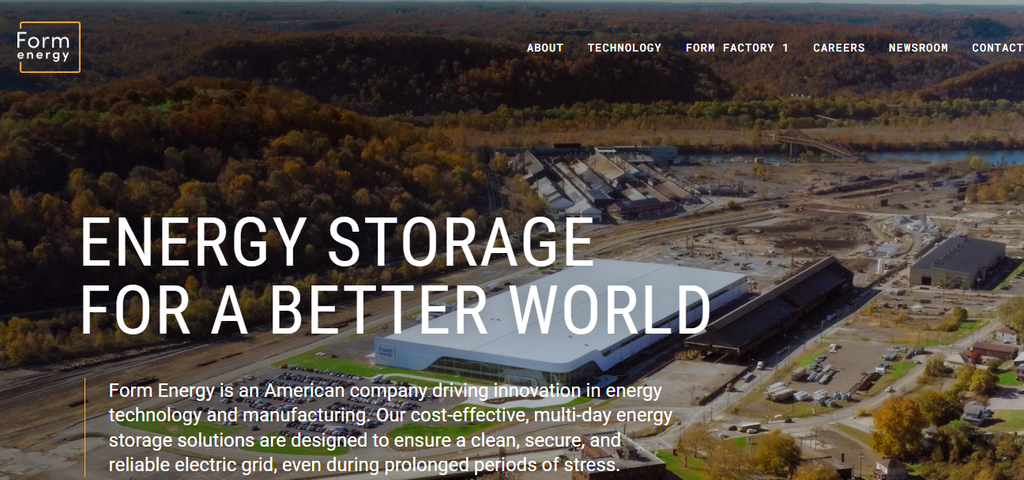
Many battery systems are designed to store electricity for hours. Form Energy is developing iron-air batteries intended to store energy for longer periods with its first commercial product designed for up to 100 hours of storage.
| Founded: 2017 |
| Headquarters: Somerville, Massachusetts |
| Latest Revenue: Not publicly disclosed |
| Latest Net Income: Not publicly disclosed |
| Main Products/Services: Iron-air batteries and long-duration electricity storage |
Long-duration storage could help electricity grids manage periods of low wind or solar generation. The company’s system uses iron and air in a chemical process to store and release electricity.
Form Energy is developing its technology for grid-scale use. Has been expanding manufacturing operations in the United States. Its intended customers are utilities and energy developers rather than ordinary household buyers.
The company is privately held. Its latest revenue and net income are not publicly disclosed. Its technology addresses a requirement from conventional short-duration batteries: keeping electricity available across longer periods when renewable generation may be limited.
9. Twelve
Twelve is developing technology that uses carbon dioxide as a material to make useful products. By treating captured carbon only as waste its process aims to turn it into building blocks for chemicals, materials and fuels.
| Founded: 2015 |
| Headquarters: Berkeley, California |
| Latest Revenue: Not publicly disclosed |
| Latest Net Income: Not publicly disclosed |
| Main Products/Services: Carbon transformation technology, chemicals and sustainable aviation fuel development |
The company’s technology uses an electrolyser to combine carbon dioxide, water and energy in chemical conversion processes. One of its areas of development is aviation fuel, which could offer a lower-emission alternative to conventional jet fuel if its full production cycle delivers the expected benefits.
Carbon transformation is not the same as removing carbon from the atmosphere. The environmental impact depends on the energy source, carbon supply and what happens when the final product is used.
Twelve is privately. Does not publicly disclose standard annual revenue and net income figures. Its work represents an emerging approach to reducing reliance on fossil-based materials, in selected industries.
10. Heirloom
Heirloom focuses on air capture, a technology designed to remove carbon dioxide directly from the atmosphere. Its process uses limestone, an occurring material that absorbs carbon dioxide as it forms a mineral.
| Founded: 2020 |
| Headquarters: Brisbane, California |
| Latest Revenue: Not publicly disclosed |
| Latest Net Income: Not publicly disclosed |
| Main Products/Services: Direct air capture and carbon removal |
The company aims to speed up this process, separate the captured carbon dioxide and store it permanently. The material can then be used again allowing the process to continue.
Direct air capture is still being done and can need a lot of energy, machines and money. It is also not the same as stopping emissions from happening in the place. For this reason carbon removal is usually seen as one part of a plan to fight climate change, not as a way to replace reducing pollution.
Heirloom is a company and its most recent sales and profits are not shared with the public. It is mentioned because carbon removal might help deal with emissions that’re hard to get rid of but costs and how to store the carbon for a long time are important things to think about.
Top 10 Climate Tech Companies in USA: Comparison
| Rank | Company | Founded | Latest Revenue | Main Products/Services |
| 1 | Fluence Energy | 2018 | $2.26 billion (FY2025) | Battery storage and energy software |
| 2 | Plug Power | 1997 | $709.9 million (FY2025) | Hydrogen systems and fuel cells |
| 3 | Rivian | 2009 | $5.39 billion (FY2025) | Electric vehicles and commercial vans |
| 4 | ChargePoint | 2007 | $411.2 million (FY2026) | EV charging equipment and software |
| 5 | Gevo | 2005 | $160.6 million (FY2025) | Renewable fuels and natural gas |
| 6 | Solid Power | 2011 | $17.9 million (FY2025, excluding grant income) | Solid-state battery technology |
| 7 | Redwood Materials | 2017 | Not publicly disclosed | Battery recycling and material recovery |
| 8 | Form Energy | 2017 | Not publicly disclosed | Long-duration iron-air batteries |
| 9 | Twelve | 2015 | Not publicly disclosed | Carbon transformation and fuels |
| 10 | Heirloom | 2020 | Not publicly disclosed | Direct air capture and carbon removal |
Which Climate Tech Company Is Best for Your Needs?
There is no climate tech company that is best for every purpose. The right company depends on the problem that needs to be solved.
For electricity storage Fluence Energy and Form Energy work on systems that can help manage power. Businesses exploring hydrogen technology may look at Plug Power while Gevo focuses on fuels for applications where electrification can be difficult.
For transport Rivian develops vehicles and ChargePoint provides charging infrastructure. Solid Power focuses on next-generation battery research whereas Redwood Materials works on recovering materials from used batteries. Twelve and Heirloom approach the climate challenge from the carbon side through carbon transformation and direct air capture.
Before choosing a company for a partnership, project or investment, compare its technology maturity, operating costs, financial position, commercial deployments and verified environmental benefits. A promising idea is not the same as a technology that’s already affordable and proven at scale.
Conclusion
Climate technology covers different ways to reduce emissions, use resources more efficiently and support a cleaner energy system. Some companies in this list are already generating billions of dollars in revenue while others are developing technologies that still need time and investment to scale.
Their work also shows that there is no solution to climate change. Battery storage, electric transport, cleaner fuels, recycling and carbon removal address problems. The useful way to assess a climate tech company is to look beyond its claims and consider the technology it delivers, its financial position and the measurable environmental benefits it can provide.
FAQs
1. What are climate tech companies?
Climate tech companies develop products and services that aim to reduce greenhouse gas emissions, improve energy efficiency, or remove carbon dioxide from the atmosphere. Their work can include renewable energy, electric vehicles, battery storage, cleaner fuels, recycling, low-carbon manufacturing, and carbon removal.
2. Which are the climate tech companies in the USA?
Companies worth knowing include Fluence Energy, Plug Power, Rivian, ChargePoint, Gevo, Solid Power, Redwood Materials, Form Energy, Twelve, and Heirloom. They operate in different areas, so the most relevant company depends on whether the focus is transportation, electricity, materials, fuel production, or carbon removal.
3. What is the difference between climate tech and clean energy?
Clean energy usually refers to energy sources and systems that produce electricity with relatively low greenhouse gas emissions, such as solar and wind power. Climate tech is a broader category that also includes electric transportation, battery recycling, industrial emissions reduction, energy efficiency, and carbon removal.
4. How do climate tech companies help reduce carbon emissions?
Their impact depends on the technology. Electric vehicles can reduce tailpipe emissions, battery storage can help integrate renewable electricity, and some alternative fuels may lower life-cycle emissions. Carbon removal technologies aim to take carbon dioxide out of the atmosphere. Each approach should be evaluated based on its overall environmental impact.
5. Are climate tech companies profitable?
Some climate tech companies generate revenue, but revenue does not automatically mean profitability. Several companies in the sector have reported financial losses, while private companies do not always disclose detailed financial information. Research, development, and manufacturing costs can be high for technologies that are still scaling up.
6. What is long-duration energy storage?
Long-duration energy storage holds electricity for extended periods and releases it when needed. It can help electricity grids manage fluctuations in wind and solar power generation. Technologies differ in cost, storage duration, and efficiency, so the most suitable system depends on the requirements of the grid or project.
7. Why is battery recycling important for climate technology?
Battery recycling can recover materials such as lithium, nickel, cobalt, and copper from used batteries and manufacturing waste. Reusing these materials can reduce waste and support battery supply chains. The environmental benefits depend on the recycling process, energy consumption, and the quantity of materials successfully recovered.
8. What is direct air capture?
Direct air capture is a technology that removes carbon dioxide from the surrounding air using chemical or mineral processes. The captured carbon can be stored or used in certain products. Its climate value depends on how much carbon is removed, the energy required, and whether the carbon is stored permanently.
9. How can someone evaluate a climate tech company?
Evaluate the company’s technology, commercial deployments, financial results, operating costs, and evidence supporting its environmental claims. It is also useful to check whether claimed emissions reductions are independently measured and whether the technology can operate at a meaningful scale. For investment decisions, review the company’s risks and financial disclosures carefully.