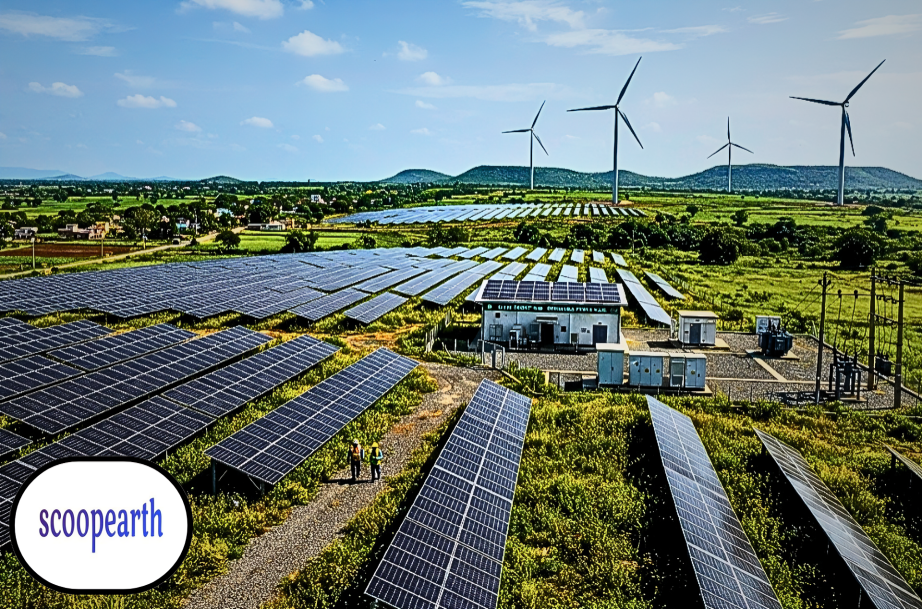
India has just delivered its strongest six months for solar power in the country’s history. The country added a record 27 GW of solar capacity in the first half of 2026, a 49% jump over the 18 GW added in the same period last year, according to Mercom India Research’s latest Q2 and H1 2026 India Solar Market report. Behind that number is a shift worth celebrating: solar in India is no longer just a policy target tracked by ministries. It is showing up in everyday decisions, a farmer leasing land to a solar developer, a business owner cutting a power bill with rooftop panels, a household choosing solar over another year of rising tariffs.
The most encouraging part of that growth is where it is coming from. Open access solar capacity, largely commercial and industrial consumers generating their own power rather than depending entirely on the grid, rose 42% year-on-year to nearly 6 GW over the same period. That is not a handful of large projects driving the number up. It is thousands of individual businesses reaching the same conclusion on their own, and that kind of widespread, independent demand is exactly the foundation a lasting energy transition is built on.
Speaking on this shift from ambition to action, Mayank Garg, CEO of Aroma Solar, said, “Solar energy in India has crossed a turning point. People are not just talking about it anymore; they are acting on it. Farmers are leasing land for solar projects and earning a steady income. Businesses are cutting their electricity bills. Households are generating their own power. India added over 55 GW of clean energy capacity in the last financial year alone. The environmental case for solar was always strong. What has changed is that the financial case is now equally strong, and when both work together, adoption moves fast.”
That shift from talk to action has been made possible by an equally remarkable story happening upstream. Module manufacturing capacity listed under the government’s Approved List of Models and Manufacturers has crossed 217 GW as of August 2026, up from just 2.3 GW in 2014. In a little over a decade, India has built a domestic manufacturing base nearly a hundred times larger, precisely so that when demand for solar stopped being theoretical and became every day, the country would be ready to meet it.
With India targeting 500 GW of non-fossil fuel capacity by 2030, the momentum from this year’s first half puts that goal well within reach. Rising demand from households and businesses, matched by a manufacturing base built to scale alongside it, is exactly the combination that will carry India’s solar story into its next chapter.