

Artificial intelligence is now part of everyday digital tasks in the USA. People use AI to write emails, search for information, create images, study, analyse documents, write code and complete office work. What started mainly as a technology used by specialists has become much easier for ordinary users to access.
The market is also much bigger than popular chatbots. OpenAI has ChatGPT Google has Gemini Microsoft has Copilot while companies such as Anthropic, Meta, Adobe and NVIDIA are building types of AI products and infrastructure.
A 2026 Pew Research Center survey found that 44% of U.S. Adults had used ChatGPT followed by Gemini at 24% Copilot at 17% Meta AI at 14% Grok at 8% and Claude at 6%. These figures show the levels of consumer use among major chatbot services.
This list of the 10 AI tools in the USA looks at widely used platforms as well as companies with an important role in the country’s AI market. The ranking considers user reach, product range, AI capabilities, business presence and relevance to consumers and organisations.
Important: Revenue and net income figures below refer to the company or developer not the individual AI tool. Most companies do not report financial results for products such as ChatGPT, Gemini or Copilot.
1. ChatGPT
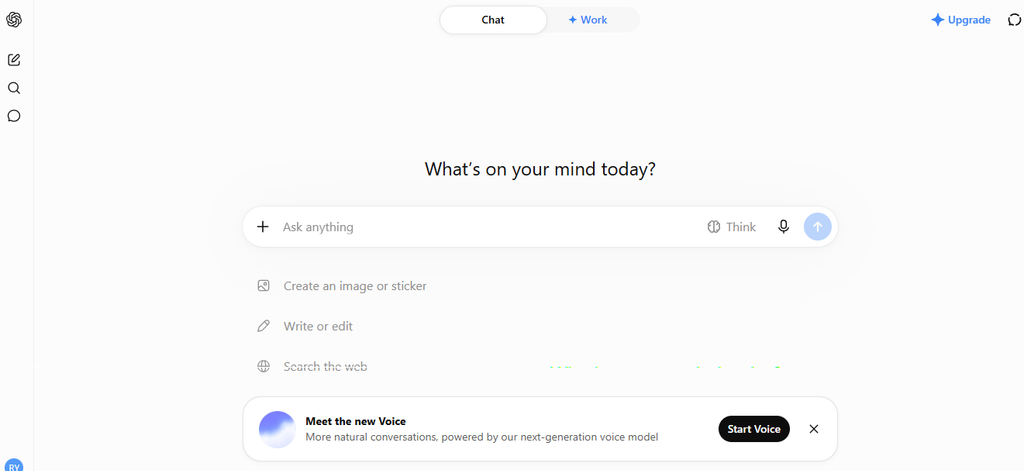
ChatGPT is one of the widely used AI tools in the USA and has become a general-purpose assistant for writing, research, coding, studying and creative work.
| Founded: 2022 |
| Developer: OpenAI |
| Headquarters: San Francisco, California |
| Latest Revenue: $13.07 billion, 2025 |
| Latest Net Income: Net loss of $38.5 billion, 2025 |
| Main Products/Services: ChatGPT, API services, AI models and business AI tools |
ChatGPT is designed to handle many different types of tasks from one platform. A user can ask it to explain a topic, rewrite an email, analyse a document, write code or create an image.
OpenAIs financial position is different from that of listed technology companies because the company has not historically published regular public annual reports in the same way as companies such as Microsoft or Alphabet. Financial documents reported in 2026 showed OpenAIs 2025 revenue at $13.07 billion. A net loss of $38.5 billion although the loss was heavily affected by accounting items connected with its corporate restructuring.
OpenAI also said its annualised revenue had passed $20 billion during 2025, which’s a different measure from reported annual revenue and should not be treated as the same figure.
For consumers however ChatGPTs importance is easier to see through its range of uses. It has moved beyond conversations into research, coding, images, files and business workflows.
2. Google Gemini
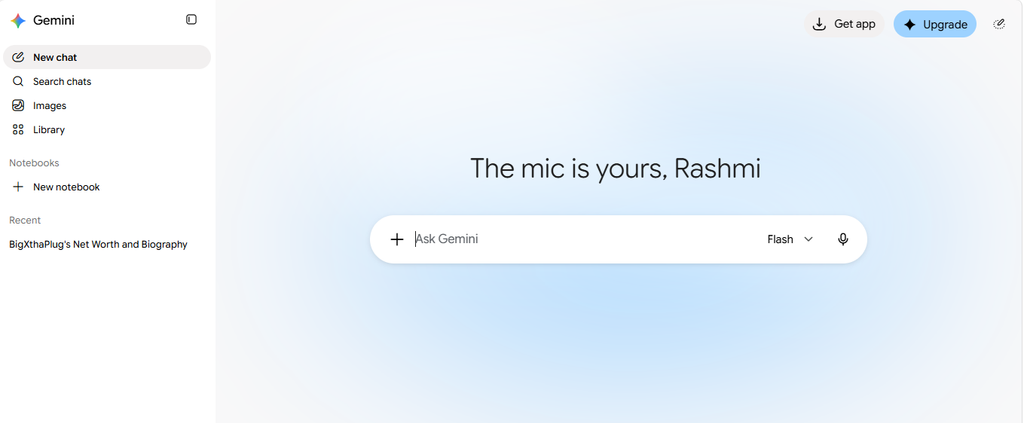
Google Gemini combines AI with Google’s large ecosystem of search Android, Gmail, Docs, YouTube and other services.
| Founded: 2023 |
| Developer: Google, Alphabet Inc. |
| Headquarters: Mountain View, California |
| Latest Revenue: $402.84 billion, 2025 — Alphabet |
| Latest Net Income: $132.17 billion, 2025 — Alphabet |
| Main Products/Services: Gemini, Google Search, Google Cloud AI and AI-powered Google services |
Gemini is Google’s consumer-facing AI assistant and has expanded quickly since its launch. It can work with text, images, audio, video and other types of information.
Alphabet’s 2025 annual report recorded revenue of $402.84 billion and net income of $132.17 billion. Google Cloud revenue reached $58.71 billion during the year.
These figures are for the Alphabet as a whole, not Gemini. The company does not report its revenue and net income separately.
It is closely connected to Google’s product ecosystem. That gives it a position from a standalone chatbot because users can access AI features while working with Google’s existing services.
Google also reported growth in the Gemini app. In 2026 the company said the app had passed one billion users. That figure includes users and should not be confused with U.S.-only usage.
3. Microsoft Copilot
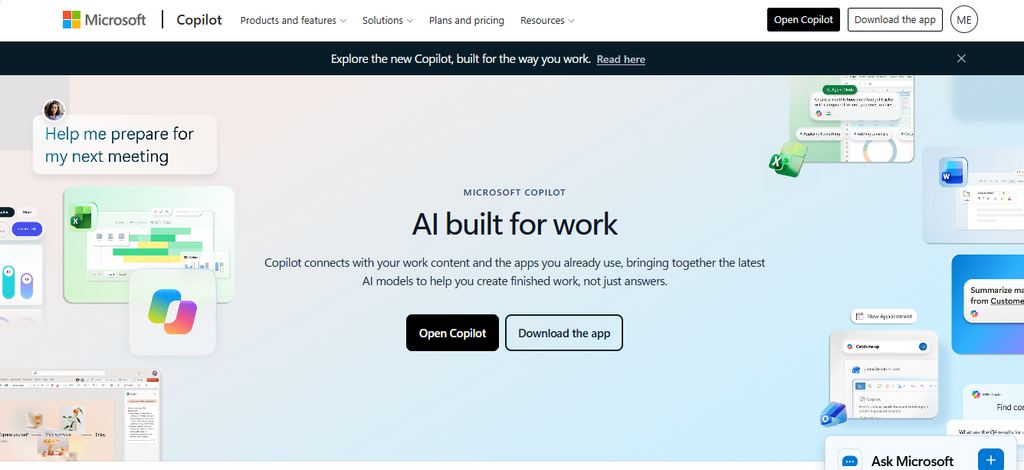
Microsoft Copilot is aimed strongly at workplace productivity. It is built into a growing range of Microsoft products.
| Founded: 2023 |
| Developer: Microsoft |
| Headquarters: Redmond, Washington |
| Latest Revenue: $281.72 billion, FY2025 |
| Latest Net Income: $101.83 billion, FY2025 |
| Main Products/Services: Copilot, Microsoft 365, Azure AI, GitHub Copilot and enterprise software |
It is particularly relevant to people who already use Microsoft products such as Word, Excel, PowerPoint, Outlook and Teams.
Microsoft’s FY2025 annual report recorded revenue of $281.724 billion and income of $101.832 billion for the year ended June 30 2025.
Those figures belong to Microsoft, not Copilot itself. The company does not publish a revenue and net income statement for the Copilot brand.
The AI assistant has become a part of Microsoft’s larger AI strategy. The company has also expanded Copilot into coding, research, business agents and other areas.
Microsoft reported that 30 million paid Microsoft 365 Copilot seats by June 2026. Its integration with existing workplace software gives it a role from consumer-focused chatbots.
For businesses using Microsoft services Copilot can fit into software they are familiar with rather than requiring a completely separate workflow.
4. Meta AI
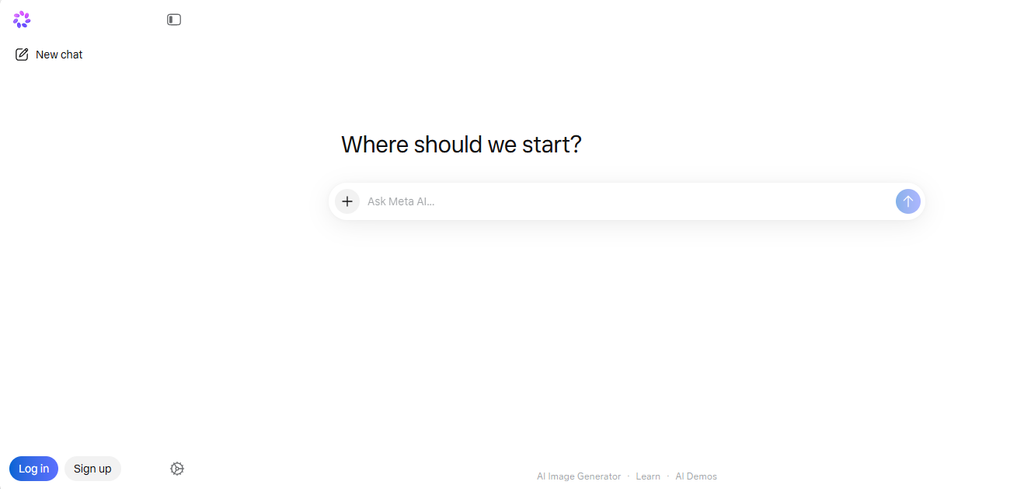
Meta AI brings intelligence into social and messaging services used by millions of people around the world.
| Founded: 2023 |
| Developer: Microsoft |
| Headquarters: Redmond, Washington |
| Latest Revenue: $281.72 billion, FY2025 |
| Latest Net Income: $101.83 billion, FY2025 |
| Main Products/Services: Copilot, Microsoft 365, Azure AI, GitHub Copilot and enterprise software |
Meta’s approach is different because its AI assistant is closely connected with its existing platforms.
Users can access Meta AI through supported Meta services and use it for questions, image creation, recommendations and other everyday tasks. The company has also been adding voice and other AI features.
Meta reported revenue of $200.966 billion and income of $60.458 billion for 2025.
Again these are Meta company figures, not Meta AI revenue. Meta does not separately report the performance of its AI assistant.
Pew Research Centers 2026 survey found that 14% of U.S. Adults had used Meta AI.
The connection with Instagram, Facebook, WhatsApp and Messenger gives Meta an existing audience for distributing AI features. Users may encounter the assistant while using another service or searching for a separate AI application.
5. Claude
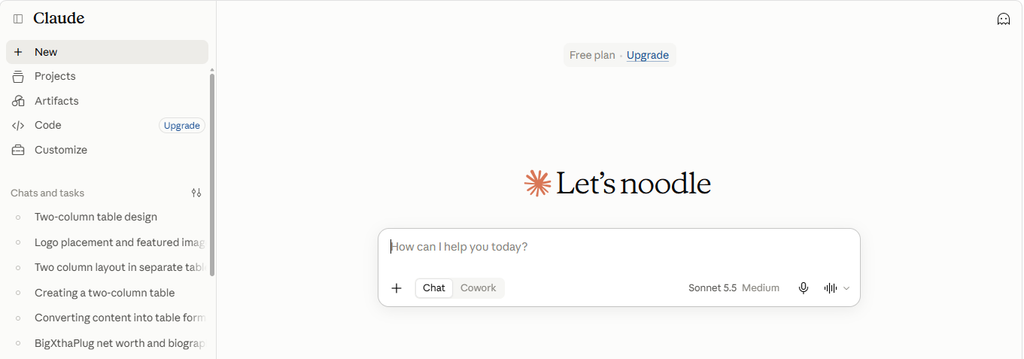
Claude is Anthropics AI assistant and has developed a strong presence in professional writing, coding, research and business use.
| Founded: 2021 |
| Developer: Anthropic |
| Headquarters: San Francisco, California |
| Latest Revenue: $4.6 billion, 2025 — Anthropic |
| Latest Net Income: Not publicly disclosed |
| Main Products/Services: Claude, Claude Code, enterprise AI and API services |
Anthropic created Claude as a general-purpose AI assistant that can work with text, documents, coding tasks and other forms of information.
The service competes with ChatGPT, Gemini and other large AI platforms. Pews 2026 survey found that 6% of U.S. Adults said they had used Claude.
Anthropics 2025 revenue reached $4.6 billion according to financial information reported in connection with its 2026 IPO filing. The company has not provided a reported net income figure comparable with listed companies.
Claude’s business use has also expanded. The company has developed tools, for coding and enterprise workflows moving the product beyond chatbot conversations.
For users the appeal is often tied to handling longer documents, writing, programming and other work that can require several steps.
6. NVIDIA

NVIDIA is different from the names on this list because its AI role is mainly built around the hardware and software that run AI systems.
| Founded: 1993 |
| Headquarters: Santa Clara, California |
| Latest Revenue: $215.9 billion, FY2026 |
| Latest Net Income: $120.07 billion, FY2026 |
| Main Products/Services: AI GPUs, data-centre platforms, networking, CUDA software and AI computing systems |
NVIDIAs name became closely linked to the AI boom because its graphics processors are widely used to train and run AI models.
The company’s fiscal 2026 revenue reached $215.9 billion, up 65% from the previous year. Its annual report also showed operating income of $130.4 billion.
Unlike ChatGPT or Gemini, NVIDIA is not primarily a consumer AI chatbot. Its importance comes from the hardware and software that support AI applications.
Its data‑centre business has become an important part of the company. NVIDIA reported $193.5 billion in 2026 revenue from its Compute & Networking segment.
For ordinary users, the company may not be as visible as a chatbot. Behind the scenes however, NVIDIAs processors and software are used across AI development, cloud computing and data‑centre systems.
7. Amazon
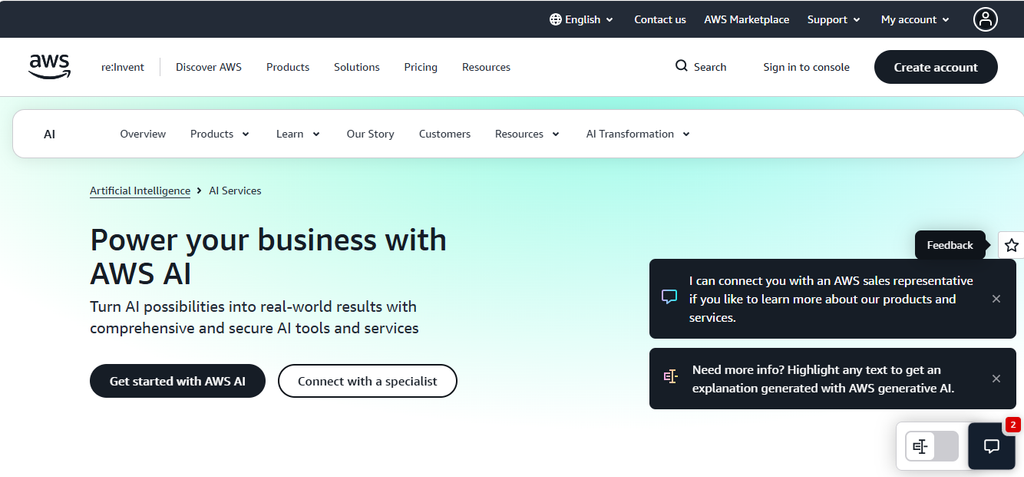
Amazon has been developing AI across shopping, cloud computing, business software and its consumer products.
| Founded: 1994 |
| Headquarters: Seattle, Washington |
| Latest Revenue: $716.9 billion, 2025 |
| Latest Net Income: $77.7 billion, 2025 |
| Main Products/Services: Amazon Q, AWS AI services, Alexa+, Bedrock and cloud AI infrastructure |
Amazon’s AI business is spread across parts of the company. AWS provides cloud computing and AI services to businesses and developers, while Amazon also uses AI in shopping and consumer products.
The company reported $716.9 billion in sales and $77.7 billion in net income for 2025. AWS sales reached $128.7 billion during the year.
These numbers cover Amazon’s business and are not standalone figures for its AI products.
Amazon Q is aimed at business users and developers while AWS provides access to AI models and tools through its cloud platform. The company has also continued developing Alexa+ as a consumer assistant.
Amazon therefore covers parts of the AI market rather than relying on one chatbot. Its combination of cloud infrastructure and consumer products gives it a role in the industry.
8. IBM
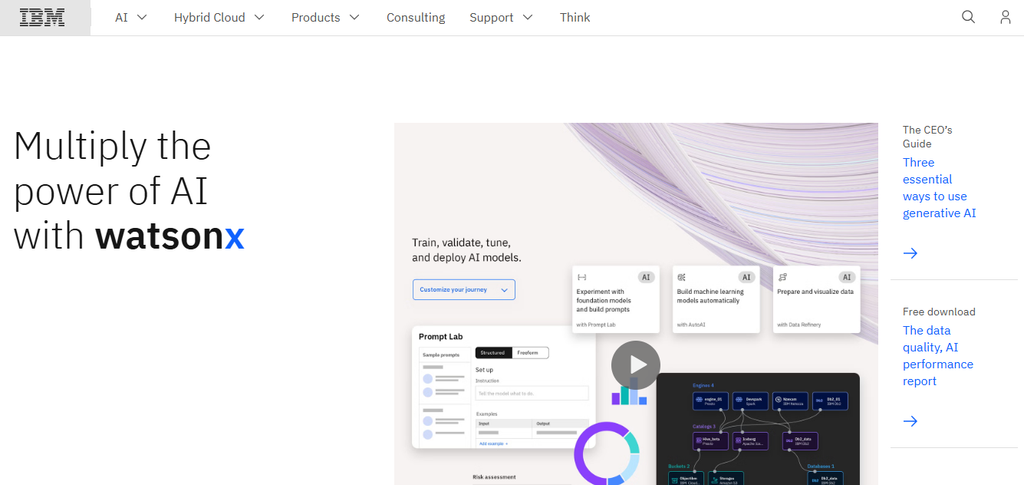
IBM has been working with intelligence for decades and now focuses heavily on AI for businesses and organisations.
| Founded: 1911 |
| Headquarters: Armonk, New York |
| Latest Revenue: $67.54 billion, 2025 |
| Latest Net Income: $10.59 billion, 2025 |
| Main Products/Services: watsonx, enterprise AI, cloud software, automation and consulting |
IBM’s AI strategy is focused more on businesses than on consumer chatbots. Its watsonx platform provides tools for organisations working with AI models, data and governance.
IBM reported $67.535 billion in revenue for 2025 and income of $10.593 billion.
The company said its software revenue reached $29.962 billion in 2025 with growth in areas including cloud, automation and data.
IBM’s long history in enterprise technology also influences how it approaches AI. Instead focusing mainly on a consumer chatbot, it provides AI‑related software and consulting services for companies.
Its AI products are particularly relevant to organisations that need to connect intelligence with existing business data, cloud systems and enterprise applications.
9. Adobe

Adobe has added AI features across its digital marketing products, making it an important
| Founded: 1982 |
| Headquarters: San Jose, California |
| Latest Revenue: $23.77 billion, FY2025 |
| Latest Net Income: $7.13 billion, FY2025 |
| Main Products/Services: Adobe Firefly, Photoshop, Illustrator, Premiere Pro, Acrobat and Creative Cloud |
Adobe’s AI strategy is centred on business software. Its Firefly family of AI tools can help users create and edit images and other content.
Adobe reported revenue of $23.769 billion for fiscal 2025 and net income of $7.13 billion.
Digital Media, which includes many of Adobe’s products, generated $17.65 billion in revenue during the year.
These figures belong to Adobe as a company rather than to Firefly alone. Adobe does not report Firefly’s standalone revenue and net income.
The approach of the company is useful for people who already use creative software. By using AI alone and then moving the result into a design application users can access AI features directly inside Adobe’s broader software environment.
10. Salesforce
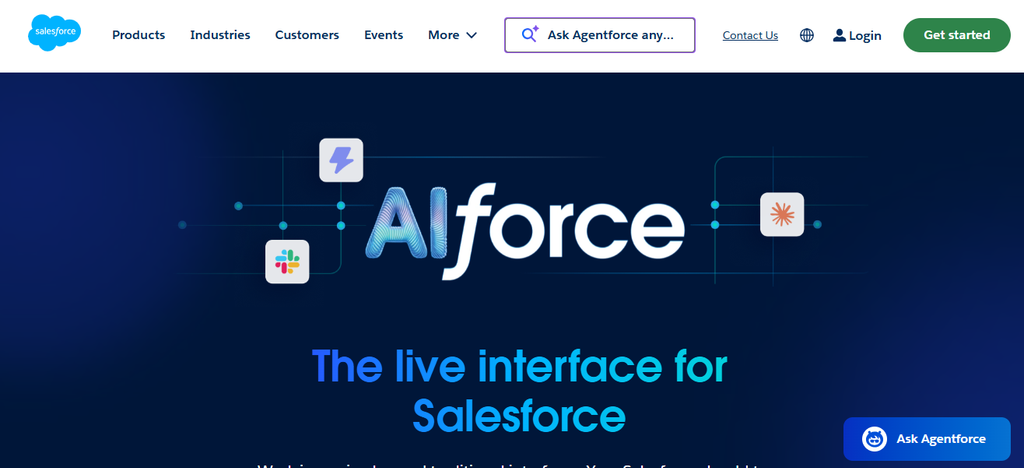
Salesforce has brought intelligence into customer relationship management through products such as Agentforce.
| Founded: 1999 |
| Headquarters: San Francisco, California |
| Latest Revenue: $41.5 billion, FY2026 |
| Latest Net Income: Approximately $7.46 billion, FY2026 |
| Main Products/Services: Agentforce, Data 360, CRM software, Slack and enterprise AI |
Salesforce’s AI strategy is mainly aimed at businesses. Its Agentforce products are designed to let organisations use AI agents for tasks related to sales, customer service and business data.
The company reported $41.5 billion in revenue for 2026, which ended on January 31 2026. It also said that Agentforce and Data 360 annual recurring revenue had crossed $2.9 billion with $800 million coming from Agentforce.
The $41.5 billion figure represents Salesforce’s company revenue, not the revenue of Agentforce.
Salesforce also reported that its AI agents had completed 2.4 billion work units by the time of its FY2026 results.
This makes Salesforce different from consumer chatbot platforms. Its AI products are designed to work inside business systems, where companies can connect customer information, applications and automated tasks.
Top 10 AI Tools in USA: Comparison
| Rank | AI Tool/Company | Founded | Latest Revenue | Latest Net Income | Main Products/Services |
| 1 | ChatGPT / OpenAI | 2022 | $13.07B, 2025 | Net loss $38.5B, 2025 | ChatGPT, AI models, API and business AI |
| 2 | Gemini / Alphabet | 2023 | $402.84B, 2025 | $132.17B, 2025 | Gemini, Google AI, Search and Cloud |
| 3 | Microsoft Copilot | 2023 | $281.72B, FY2025 | $101.83B, FY2025 | Copilot, Microsoft 365, Azure AI |
| 4 | Meta AI / Meta | 2023 | $200.97B, 2025 | $60.46B, 2025 | Meta AI, Facebook, Instagram, WhatsApp |
| 5 | Claude / Anthropic | 2021 | $4.6B, 2025 | Not publicly disclosed | Claude, Claude Code and enterprise AI |
| 6 | NVIDIA AI | 1993 | $215.9B, FY2026 | $120.1B, FY2026 | AI GPUs, data centres and AI computing |
| 7 | Amazon AI | 1994 | $716.9B, 2025 | $77.7B, 2025 | Amazon Q, AWS AI, Bedrock and Alexa+ |
| 8 | IBM AI | 1911 | $67.54B, 2025 | $10.59B, 2025 | watsonx, enterprise AI and automation |
| 9 | Adobe AI | 1982 | $23.77B, FY2025 | $7.13B, FY2025 | Firefly, Photoshop, Acrobat and Creative Cloud |
| 10 | Salesforce AI | 1999 | $41.5B, FY2026 | Approx. $7.46B, FY2026 | Agentforce, Data 360 and CRM AI |
Note: The financial numbers are company-level figures unless it is clearly mentioned otherwise. They should not be seen as income or profit made by the AI product. OpenAIs 2025 numbers come from reports that are available, many private companies do not share the amount of financial information, as public companies.
Which AI Tool Should You Consider?
The right AI tool depends on the task you need to complete. A person who wants a general assistant might look at ChatGPT, Gemini or Claude. Someone who works mainly with Microsoft tools may find Copilot more useful. These choices fit daily needs and environments.
Creative professionals have options. Adobe’s AI tools are built into their software like Photoshop and Premiere Pro. NVIDIA provides the computing technology that runs many AI systems but it does not offer a typical chatbot for everyday users.
Businesses often need tools. IBM, Salesforce and Amazon offer AI products designed for enterprise use. These are built to work with company data, cloud systems and business processes. They are not simple chatbots.
Before choosing an AI service users should think about price, privacy, the features available and the kind of information being used. It’s also important to remember that AI-generated answers can be wrong. Important facts should always be verified with trusted sources.
Conclusion
The AI market in the USA includes more than just chatbots. You find consumer assistants like ChatGPT, Gemini and Meta AI. There are also tools, enterprise platforms, creative software and the computing power that runs AI systems.
Financial data shows why it’s important to tell the difference between an AI product and its parent company. A company’s total revenue can include businesses that are not related to its AI tool.
For users the best choice depends on the task, the features available, the cost, privacy needs and how much control they want over the final result.
FAQs
1. What are the top AI tools in the USA?
Some of the well-known AI tools in the USA include ChatGPT, Gemini, Microsoft Copilot, Meta AI, and Claude. Companies such as NVIDIA, Amazon, IBM, Adobe, and Salesforce also offer AI products, often designed for businesses, developers, or creative professionals.
2. Which AI tool is widely used in the USA?
ChatGPT had the highest reported usage among chatbot platforms in the Pew Research Center’s 2026 survey. The study found that 44% of U.S. adults had used ChatGPT, followed by Gemini at 24% and Copilot at 17%. These figures reflect U.S. adult usage rather than global usage.
3. Does ChatGPT have publicly reported revenue?
OpenAI has reported financial information, although not in the same way as publicly traded companies. Financial documents reported $13.07 billion in revenue for 2025 and a $38.5 billion net loss. These figures apply to OpenAI as a company and not specifically to ChatGPT.
4. Does Gemini have revenue?
Alphabet does not report a separate revenue figure for Gemini. Its financial reports cover the company and its broader business units rather than individual products. In 2025, Alphabet reported $402.84 billion in revenue and $132.17 billion in net income, which includes Google’s broader business rather than Gemini alone.
5. Which AI company has the highest revenue in this list?
Amazon had reported revenue of $716.9 billion in 2025 among the companies being compared. This figure represents Amazon’s overall business, including retail and AWS, rather than revenue generated specifically by its AI operations.
6. Which AI tool is useful for work?
Adobe’s AI tools integrate directly with applications such as Photoshop, Illustrator, and Premiere Pro. Canva also provides AI-powered design features, while Midjourney focuses on AI-generated images. The appropriate tool depends on whether the user needs photo editing, graphic design, image generation, or a broader creative workflow.
7. Is NVIDIA an AI tool?
NVIDIA is better described as an AI technology and infrastructure company rather than a consumer AI tool. It develops GPUs, networking systems, and software used to build and operate AI systems. NVIDIA does not primarily offer a consumer chatbot, and its reported revenue reflects its overall business rather than a single AI product.
8. Which AI platforms are mainly used by businesses?
Microsoft Copilot, IBM watsonx, Salesforce Agentforce, and Amazon Web Services AI services are designed for business use. These platforms can integrate with company software, cloud systems, internal data, and automated workflows, distinguishing them from consumer-focused chatbots.
9. Are the revenue figures in this article the revenue of each AI tool?
No. The figures for companies such as Microsoft, Alphabet, Meta, and Amazon represent overall company revenue rather than revenue from individual AI tools. These companies generally do not disclose standalone revenue figures for products such as Copilot, Gemini, Meta AI, or other individual AI services.
10. Are these AI tools free to use?
Some AI tools offer free access, while others use subscriptions, business plans, or pay-as-you-go pricing. Free versions may have limits on models, features, or usage. Before choosing a paid plan, users should review pricing, usage limits, privacy policies, and whether the available features meet their needs.