
Introduction
Robotics is one of the fastest-growing technology sectors in India. From manufacturing plants and warehouses to hospitals, farms and defence, robots are helping businesses complete tasks faster, improve accuracy and reduce manual work.
In the past few years, India has made significant progress in robotics and automation. Companies are developing robots that can move products inside warehouses, assemble vehicles, clean roads, inspect underwater structures and even assist farmers with agricultural activities.
The growth of artificial intelligence (AI), machine learning, computer vision and industrial automation has also created new opportunities for robotics companies. Both established businesses and startups are investing in research, product development and advanced robotic systems.
India is home to several promising robotics companies, including Addverb, DiFACTO, GreyOrange, Ati Motors and Peppermint Robotics. These businesses are developing solutions for different industries and helping India become an important player in the global robotics market.
In this article, we will look at the top 10 robotics companies in India, their headquarters, products, services and financial performance. The financial figures are included wherever reliable information is publicly available. Since many robotics companies are privately held, some do not publish complete revenue and profit figures.
Top 10 Robotics Companies in India
The following companies have been selected based on their robotics technology, industry presence, products, innovation and contribution to India’s automation sector. The list includes established industrial automation businesses as well as emerging robotics startups. It is not a strict ranking by revenue.
1. Addverb Technologies
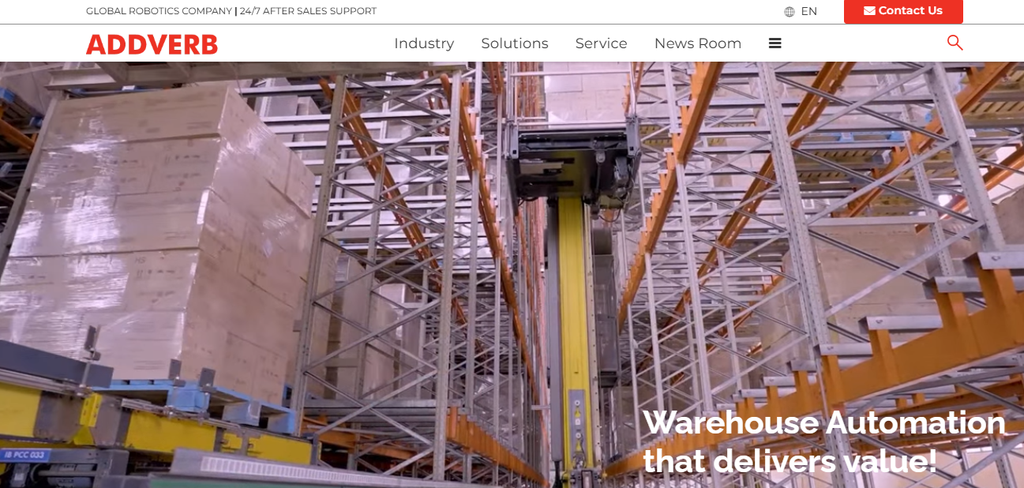
Addverb Technologies is one of India’s well-known robotics and warehouse automation companies. It was founded in 2016 by a group of professionals with experience in the manufacturing and supply chain industries.
The company develops robots and automated systems that help businesses manage warehouse operations. Its solutions are designed to reduce manual work, improve inventory movement and make product handling more efficient. Addverb offers different types of robots, including Autonomous Mobile Robots (AMRs), automated guided vehicles, sorting robots and picking systems. These machines can move goods, transport materials and support order processing inside large warehouses.
One of the company’s major strengths is its ability to provide complete warehouse automation solutions. Instead of supplying only robots, it also offers software and integrated systems that help businesses manage their operations.
Addverb works with major organisations such as Reliance, Flipkart, PepsiCo, Unilever and ITC. Its international operations also cover markets in the United States, Europe and other regions.
Reliance Retail acquired a 54% stake in Addverb in 2022, giving the company access to additional resources for expansion and product development. The company is also exploring humanoid robotics and Physical AI, which could create new opportunities beyond traditional warehouse automation.
Financial performance:
| Financial Metric | Financial Year | Value |
|---|---|---|
| Group revenue reported by Addverb | FY 2024-25 | ₹800 crore |
| Revenue of Addverb Technologies Limited (standalone) | FY 2024-25 | ₹330.85 crore |
| Standalone net profit/loss | FY 2024-25 | -₹88.95 crore |
The ₹800 crore figure is the company’s reported business revenue, while the standalone figures come from the statutory financial statements of Addverb Technologies Limited. They represent different reporting scopes.
2. GreyOrange
GreyOrange is a robotics and warehouse automation company founded in India in 2011. It has developed a strong presence in the international supply chain and logistics industry. The company focuses on helping warehouses, distribution centres and fulfilment facilities improve their operations through intelligent robots and automation software.
Its robotic systems are designed to move products, transport inventory and support order fulfilment. These robots can work alongside warehouse employees and help businesses manage large volumes of products.
One of GreyOrange’s important offerings is its AI-powered warehouse management and orchestration technology. Its software helps coordinate robots, workers and warehouse activities so that operations can run smoothly.
The company also develops autonomous mobile robots that can move products from one location to another without requiring constant human control. GreyOrange serves businesses in industries such as retail, e-commerce, manufacturing and logistics. Its technology is particularly useful for companies that handle thousands of orders every day.
Financial performance:
| Financial Metric | FY 2023-24 |
|---|---|
| Revenue | ₹340.4 crore |
| Total expenses | ₹325.7 crore |
| Profit after tax | ₹10.8 crore |
| Net profit margin | 3.2% |
These figures relate to GreyOrange’s reported financial performance for FY 2023-24. Its Indian subsidiary also reported revenue of ₹328.33 crore in FY 2024-25, which should not be directly compared with the earlier group-level figures.
3. DiFACTO Robotics and Automation
DiFACTO Robotics and Automation is an Indian company specialising in industrial automation and robotic solutions. It has been working in the automation industry for several years and provides technology to manufacturing businesses. The company mainly focuses on helping factories automate repetitive, time-consuming and complex production activities.
Its solutions include robotic welding, material handling, assembly automation, machine tending and automated production lines. These systems are useful in industries where products need to be manufactured with high accuracy and consistency.
For example, automobile manufacturers use industrial robots for welding vehicle components, painting parts and handling heavy materials. These robots can perform repetitive tasks with consistent accuracy and reduce the need for workers to perform dangerous activities.
DiFACTO also provides engineering, system integration, installation and technical support services. This means it helps customers select suitable robotic equipment and integrate it into their existing manufacturing facilities.
The company has experience in industries such as automotive, engineering and general manufacturing. Its focus on customised automation solutions makes it relevant to businesses looking to modernise their factories.
4. Ati Motors
Ati Motors is an Indian robotics company that develops autonomous mobile robots for industrial and manufacturing environments. It was founded in Bengaluru and has attracted attention for its work in factory automation.
The company develops robots that can transport materials, move products and support internal logistics operations. These robots are particularly useful in factories where materials need to travel between different production stations. Its Sherpa series of autonomous mobile robots is designed to carry heavy loads and move materials across industrial facilities. The robots use sensors, navigation systems and intelligent software to understand their surroundings and move safely.
Traditional material transportation often requires workers to operate forklifts or manually move products using carts. Ati Motors aims to make these activities more efficient through autonomous technology. Its robots can be used in automotive manufacturing, engineering, logistics and other industrial environments.
The company has also expanded its international presence and works towards providing automation solutions to global manufacturing businesses. Ati Motors is an interesting example of how Indian startups are developing advanced robotics products for real-world industrial problems.
Financial performance:
| Financial metric | FY 2025-26 |
|---|---|
| Operating revenue | ₹43.7 crore |
| Net profit | ₹2.6 crore |
| Revenue growth | 35% |
These figures were reported for FY 2025-26 in July 2026.
5. Peppermint Robotics
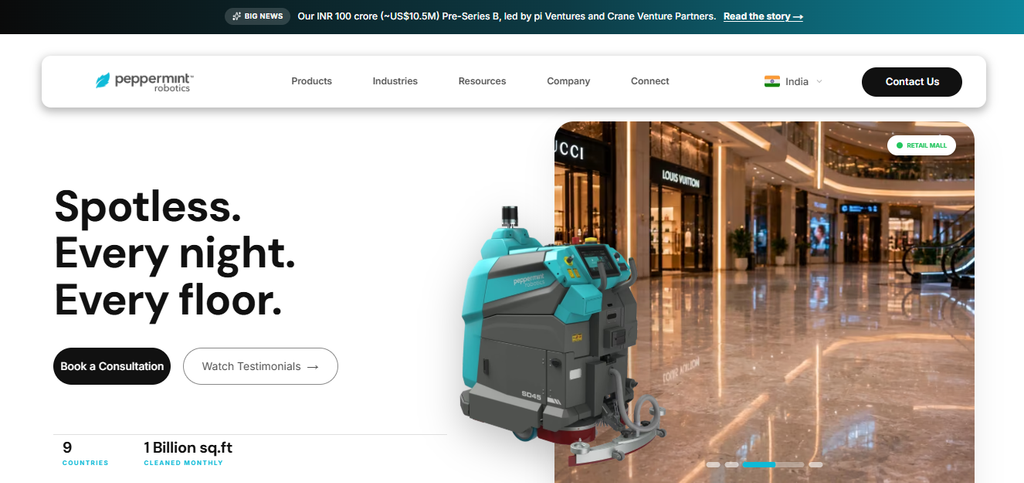
Peppermint Robotics is an Indian robotics startup that develops autonomous robots for cleaning and facility management. The company focuses on creating machines that can perform repetitive cleaning activities in commercial and industrial spaces.
Its robots are designed for locations such as shopping malls, airports, hospitals, offices, factories and large commercial buildings. Cleaning large areas manually can take considerable time and require significant manpower. Peppermint’s autonomous cleaning robots help businesses manage these activities more efficiently.
The robots use technologies such as computer vision, LiDAR and intelligent navigation to understand their surroundings. They can identify obstacles, navigate through spaces and perform cleaning tasks with limited human intervention.
The company also develops its own robotics software, known as Peppermint OS. This software helps control robot movement, navigation and cleaning operations. Peppermint follows a business model in which it sells robots and also generates revenue through maintenance services, spare parts and upgrades.
The company is expanding its product portfolio to include industrial cleaning and material-handling robots. Its work shows how robotics can be used beyond manufacturing and warehouse operations.
Financial performance:
| Financial Metric | Operating Revenue |
|---|---|
| FY 2023-24 | ₹6.26 crore |
| FY 2024-25 | ₹21 crore |
Peppermint’s operating revenue increased significantly in FY 2024-25, according to reporting based on information shared by the company.
6. Genrobotics
Genrobotics is an Indian robotics company that develops machines to perform dangerous and physically demanding jobs. It is particularly recognised for its work in sewer-cleaning and sanitation robotics. One of its best-known products is Bandicoot, a robotic machine designed to clean manholes and sewer systems.
In many places, sewer cleaning has traditionally involved workers entering dangerous manholes and coming into direct contact with harmful gases and waste materials. This creates serious health and safety risks.
Bandicoot aims to reduce these risks by allowing operators to control a robotic system that can enter manholes and perform cleaning activities. The robot is equipped with mechanical arms and specialised tools that help remove waste and clean sewer areas. It can also be used to inspect locations that are difficult for humans to access.
Apart from sewer-cleaning robots, Genrobotics works on other robotic solutions for industrial and public infrastructure applications. The company’s work is important because it demonstrates how robotics can solve social problems while improving workplace safety. Its technology has attracted attention from government organisations and infrastructure-related businesses.
Financial performance:
| Financial Metric | FY 2024-25 |
|---|---|
| Revenue | ₹32.53 crore |
| Net profit | ₹3.18 crore |
| EBITDA | ₹6.04 crore |
| Net profit margin | Approximately 9.8% |
The figures relate to Genrobotic Innovations Private Limited, the primary company behind Genrobotics.
7. Novus Hi-Tech Robotic Systemz
Novus Hi-Tech Robotic Systemz is an Indian technology company that develops autonomous mobility and robotic solutions. It focuses on creating intelligent systems that can understand their surroundings and perform tasks with limited human involvement.
The company works in areas such as autonomous vehicles, mobile robotics, intelligent transportation and industrial automation. Its technology combines sensors, artificial intelligence, computer vision and navigation systems. These technologies help machines identify objects, understand their environment and make decisions.
One of the important applications of its technology is autonomous material movement. Robots and intelligent vehicles can help transport products and equipment within industrial facilities.
The company also works on solutions related to autonomous driving and intelligent mobility. Such technologies can be useful in logistics, industrial transportation and other applications where automated movement is required.
Novus has experience in developing robotic and autonomous systems for business and industrial customers. Its long presence in the sector makes it one of the notable Indian companies in this field.
Financial performance:
| Financial Metric | Financial Year | Value |
|---|---|---|
| Revenue | FY 2024-25 | ₹86.61 crore |
| Net profit | FY 2024-25 | ₹4.93 crore |
| Net profit margin | FY 2024-25 | 5.7% |
| Revenue growth | FY 2024-25 | 161% |
These figures are reported for The Hi-Tech Robotic Systemz Limited.
8. Sagar Defence Engineering
Sagar Defence Engineering is an Indian company working on autonomous systems and advanced robotics for defence and maritime applications. The company develops unmanned platforms that can operate with limited or no direct human control. Its work includes autonomous surface vessels, underwater systems and unmanned technologies for security and surveillance.
One of its major areas of focus is maritime robotics. These systems can support activities such as monitoring, inspection, surveillance and other operations in water-based environments. Unmanned systems are becoming increasingly important for defence organisations because they can perform certain tasks without putting human operators directly in dangerous situations.
Sagar Defence Engineering also works on technologies that combine robotics, navigation, sensors and communication systems. Its solutions have applications in maritime security, defence research and infrastructure monitoring.
The company is contributing to India’s efforts to develop more domestic capabilities in advanced defence technologies.
Financial performance:
| Financial Metric | FY 2024-25 |
|---|---|
| Revenue | ₹107.62 crore |
| Net profit | ₹33.34 crore |
| Net profit margin | Approximately 31% |
These figures are reported for Sagar Defence Engineering Private Limited. The company’s business includes unmanned and defence systems, rather than only conventional industrial robots.
9. Planys Technologies
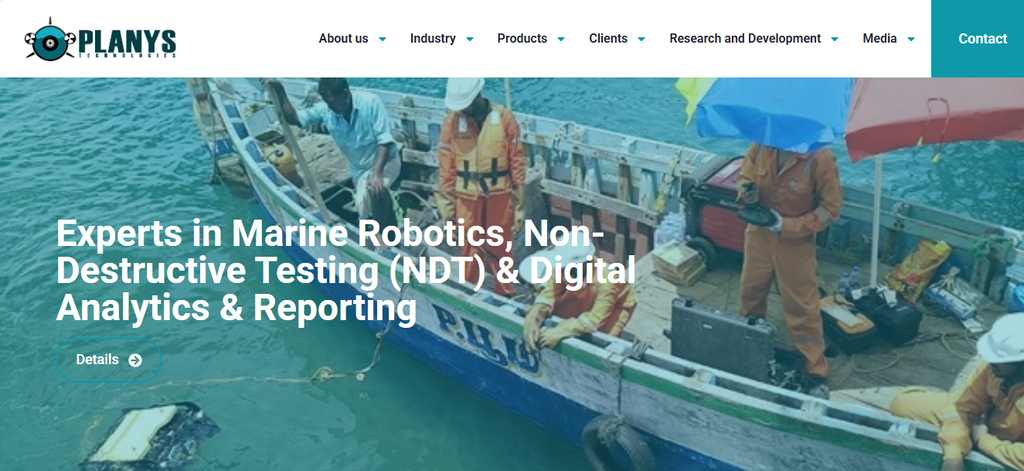
Planys Technologies is an Indian deep-tech company that develops underwater robotic systems. It was founded by graduates of the Indian Institute of Technology Madras and focuses on making underwater inspection safer and more efficient.
Inspecting underwater structures is often difficult because human divers face risks from limited visibility, water pressure and other environmental conditions. Planys addresses this problem by developing remotely operated vehicles (ROVs) and underwater inspection systems.
These robots can be used to inspect bridges, dams, ports, ships, pipelines and other underwater infrastructure. The machines are equipped with cameras, sensors and specialised inspection equipment. They collect information from underwater locations and help engineers understand the condition of structures.
For example, port authorities can use underwater robots to inspect submerged structures without depending entirely on human divers. Planys also provides inspection and engineering services to customers in infrastructure, marine and industrial sectors. The company is an important example of how robotics can be used in specialised environments where human access is limited or risky.
Financial performance:
| Financial Metric | Latest Publicly Verified Information |
|---|---|
| Revenue | Not reliably disclosed |
| Net profit | Not reliably disclosed |
| Funding milestone | ₹100 crore funding round reported in Dec 1, 2025 |
Funding received by a company is different from its revenue or profit. Therefore, the funding amount should not be treated as annual business income.
10. Unbox Robotics
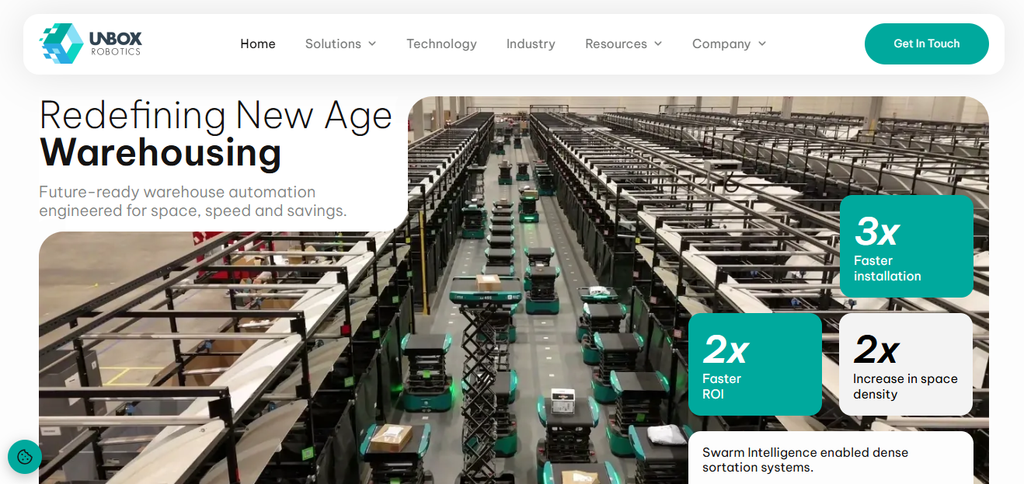
Unbox Robotics is an Indian startup that develops robotic solutions for warehouse and logistics operations. The company focuses on making parcel sorting and order processing faster and more efficient.
E-commerce businesses and logistics companies handle thousands of parcels every day. Sorting these parcels manually can be time-consuming and may lead to operational delays.
Unbox Robotics develops automated parcel-sorting systems that help businesses manage this process. Its robots can move parcels across sorting areas and direct them towards the correct destinations. This helps logistics companies improve the speed and accuracy of their warehouse operations.
The company uses robotics, intelligent software and automation technology to build systems that can work in modern fulfilment centres. Its solutions are particularly useful for e-commerce companies, courier services and third-party logistics providers.
Unbox Robotics has also attracted investment from venture capital firms, which supports its expansion and product development activities. The company represents India’s growing startup ecosystem in logistics and warehouse robotics.
Financial Comparison of the Top 10 Robotics Companies in India
The following table provides a quick comparison of the financial performance of these companies. It includes the latest figures available in the sources reviewed, but the reporting years are not identical.
| Company | Financial Year | Revenue | Net Profit / Loss |
|---|---|---|---|
| Addverb Technologies Ltd. (standalone) | FY25 | ₹330.85 Cr | -₹88.95 Cr |
| GreyOrange (reported group figures) | FY24 | ₹340.4 Cr | ₹10.8 Cr |
| DiFACTO Robotics | Not available | Not disclosed | Not disclosed |
| Ati Motors | FY26 | ₹43.7 Cr | ₹2.6 Cr |
| Peppermint Robotics | FY25 | ₹21 Cr | Not disclosed |
| Genrobotics | FY25 | ₹32.53 Cr | ₹3.18 Cr |
| Novus Hi-Tech | FY25 | ₹86.61 Cr | ₹4.93 Cr |
| Sagar Defence Engineering | FY25 | ₹107.62 Cr | ₹33.34 Cr |
| Planys Technologies | Not available | Not disclosed | Not disclosed |
| Unbox Robotics | Not available | Not disclosed | Not disclosed |
Source: Company financial statements and reported financial disclosures. Cr = crore. FY24 = 2023-24, FY25 = 2024-25 and FY26 = 2025-26. Addverb’s standalone figure is different from its reported group revenue. GreyOrange’s figures are also on a different reporting basis. These figures should not be treated as a like-for-like ranking.
Why Is the Robotics Industry Growing in India?
India’s robotics industry is growing because businesses are increasingly adopting automation to improve productivity and reduce operational costs.
Some important reasons behind this growth are:
1. Increasing industrial automation: Manufacturing companies are using robots for welding, painting, assembly and material handling. These machines help factories improve production speed and maintain consistent quality.
2. Growth of e-commerce: Online shopping has increased the demand for efficient warehouses and delivery systems. Robotics companies such as Addverb, GreyOrange and Unbox Robotics are helping businesses automate warehouse operations.
3. Artificial intelligence development: AI and machine learning are making robots more intelligent. Modern robots can identify objects, understand their surroundings and perform tasks with less human involvement.
4. Government support: Initiatives such as Make in India and the government’s focus on domestic manufacturing are creating opportunities for robotics and automation businesses.
5. Demand for workplace safety: Robots can perform dangerous activities such as sewer cleaning, underwater inspection and handling hazardous materials. This reduces the need for workers to enter risky environments.
Conclusion
India’s robotics industry is developing rapidly, with companies working on innovative solutions for manufacturing, logistics, agriculture, healthcare, defence and infrastructure.
Companies such as Addverb Technologies and GreyOrange are transforming warehouse operations through intelligent automation. Ati Motors and Peppermint Robotics are developing autonomous machines for industrial and commercial applications. Genrobotics is using robotics to improve sanitation and workplace safety, while Planys Technologies is making underwater inspections safer.
At the same time, companies such as Sagar Defence Engineering and Novus Hi-Tech are exploring advanced autonomous systems for specialised applications.
Although the industry still faces challenges such as high development costs, limited access to specialised components and the need for skilled professionals, its long-term opportunities are promising.
With increasing investment in artificial intelligence, automation and domestic manufacturing, Indian robotics companies have the potential to become important players in the global technology market. The coming years could bring significant developments in industrial robots, autonomous machines and humanoid robotics.
Overall, robotics is not just about replacing manual work. It is about making industries safer, improving productivity and creating smarter ways to solve everyday problems.
FAQs:
1. Which is the best robotics company in India?
Addverb Technologies, GreyOrange, DiFACTO Robotics and Ati Motors are among India’s well-known robotics companies. They offer solutions for warehouse automation, industrial manufacturing and autonomous operations.
2. Which is the largest robotics company in India?
Addverb Technologies is one of India’s major warehouse robotics and automation companies. It develops robotic systems and automated solutions for large-scale logistics and manufacturing operations.
3. What does Addverb Technologies do?
Addverb Technologies develops robots and automated systems for warehouses, manufacturing facilities and logistics operations. Its solutions include autonomous mobile robots, sorting systems and automated storage technologies.
4. Which Indian company makes sewer-cleaning robots?
Genrobotics develops Bandicoot, a robotic system designed to clean manholes and sewer systems. Its technology aims to reduce the need for workers to enter hazardous underground spaces.
5. Which robotics company is based in Bengaluru?
Ati Motors and DiFACTO Robotics and Automation are among the robotics companies headquartered in Bengaluru. Both companies work on automation technologies for industrial applications.
6. What does GreyOrange do?
GreyOrange develops warehouse robots and AI-powered automation solutions for supply chain operations. Its technologies help businesses improve inventory movement, order fulfilment and warehouse productivity.
7. Which Indian company makes underwater robots?
Planys Technologies develops underwater robotic systems for inspection and industrial applications. Its technology supports underwater infrastructure inspections and marine engineering activities.
8. What does Ati Motors manufacture?
Ati Motors develops autonomous mobile robots for material transportation and industrial automation. Its robots help move materials within factories, warehouses and other industrial facilities.
9. Which robotics company in India makes cleaning robots?
Peppermint Robotics develops autonomous cleaning robots for commercial and industrial spaces. Its products are designed to automate floor-cleaning operations in locations such as offices, hospitals and large facilities.
10. What does Unbox Robotics do?
Unbox Robotics develops robotic systems for parcel sorting and warehouse automation. Its solutions help logistics and e-commerce businesses improve sorting speed and operational efficiency.
11. Are robotics companies growing in India?
Yes, robotics companies are growing in India due to increasing demand for automation, artificial intelligence and smart manufacturing. Businesses are adopting robotic technologies to improve productivity, reduce repetitive manual work and enhance operational accuracy.
12. Which industries use robotics in India?
Several industries use robotics in India, including manufacturing, logistics, healthcare, agriculture, defence and infrastructure. Robots support activities such as assembly, material handling, medical assistance, inspection and automated cleaning.
13. What is the main purpose of industrial robots?
Industrial robots help automate repetitive, heavy and complex tasks. They improve productivity, accuracy and consistency while reducing manual effort and supporting safer working conditions.
14. Are Indian robotics companies developing AI-powered robots?
Yes, several Indian robotics companies use artificial intelligence, computer vision and machine learning to develop intelligent robotic systems. These technologies help robots recognise objects, navigate environments, make decisions and perform tasks with greater precision.
15. What is the future of robotics in India?
The future of robotics in India is expected to be shaped by increasing investment in artificial intelligence, automation, manufacturing and autonomous technologies. Growing demand from industries such as logistics, healthcare, agriculture and infrastructure may create further opportunities for Indian robotics companies.