

Buying a home, renting an apartment or investing in property is not just about finding the right location. The real estate company behind the property plays a role in what kind of homes are available, what services are offered and how the building is handled. In the United States real estate companies work in areas like home building, commercial property services, shopping centers, rental housing and industrial buildings.
Some companies build thousands of homes each year. Others manage office buildings, warehouses and retail spaces. There are also firms that help businesses buy, sell, lease and maintain properties. These companies operate in different ways so looking only at their revenue does not tell the full story.
This guide highlights the 10 real estate companies in the USA. It includes a mix of known firms from across the industry. The ranking is based on business size, market reach, the range of services they offer and how important they are to the real estate market. This is not a ranking and the list does not mean every company is the right fit for every buyer or investor.
The financial numbers come from the recent full-year reports mostly for fiscal year 2025. Revenue and net income are for the company not for one property or brand.
1. CBRE Group

CBRE Group is one of the companies in the commercial real estate services sector. Unlike a homebuilder that earns money by selling houses, CBRE works with businesses, landlords, investors and institutions that need support in managing or using estate.
| Founded: 1906 |
| Headquarters: Dallas, Texas, USA |
| Latest Revenue: $40.6 billion (FY2025) |
| Latest Net Income: $1.2 billion (FY2025) |
| Main Products/Services: Commercial property sales and leasing, facilities management, property management, project management and real estate investment services. |
The company offers services across parts of property ownership. A business looking to lease office space might use CBRE for advice. A property owner might need help with building operations, maintenance or investment decisions. CBRE also provides property valuations. Supports real estate transactions.
The company’s large size is clear from its FY2025 results. Revenue reached $40.6 billion with growth in facilities management and project management areas.. This revenue includes many different types of services and costs. It does not reflect the value of property that CBRE owns.
CBRE is ranked first in this list because of its size and wide influence in the commercial real estate market. It is especially important for businesses and institutional property owners. It is less relevant to individuals looking for a house.
2. D.R. Horton
D.R. Horton is a name in the new home market. The company builds homes for a wide range of buyers. These include first-time homebuyers, families needing space and older adults who want low-maintenance living.
| Founded: 1978 |
| Headquarters: Arlington, Texas, USA |
| Latest Revenue: $34.3 billion (FY2025) |
| Latest Net Income: $3.6 billion (FY2025) |
| Main Products/Services: New homes, residential communities, home financing and related housing services. |
The business operates in the U.S. Markets. It does not focus on luxury homes. Instead D.R. Horton builds homes at price points and in a variety of community types. Its mortgage and related services are also part of the home-buying process.
D.R. Horton reported $34.3 billion in revenue and $3.6 billion in net income for fiscal 2025. These numbers reflect the range of the company’s activities, not just the price of homes it completed.
The company was ranked the U.S. Homebuilder by volume in its investor information. It also topped Pro Builder’s 2026 ranking of homebuilders by 2025 housing revenue with about $32.32 billion in revenue. This makes it a strong choice for a list focused on the residential property market.
3. Lennar Corporation
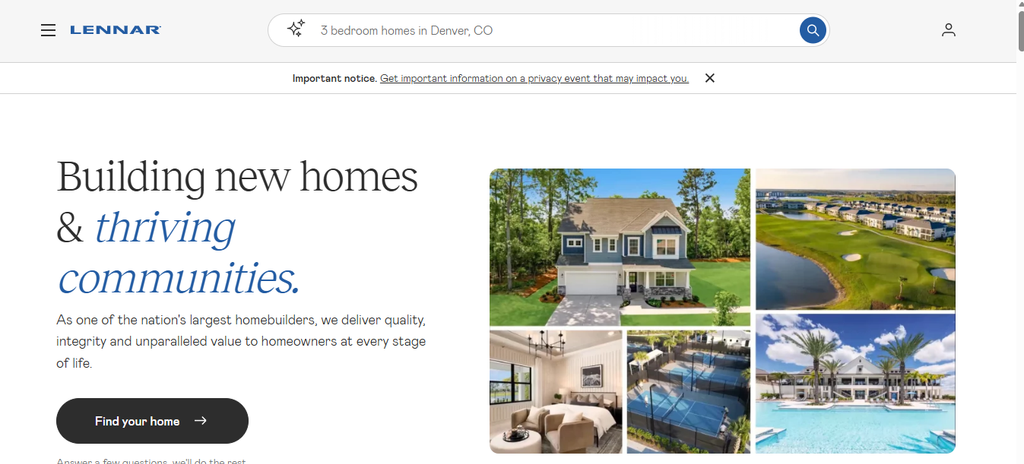
Lennar has a history in American homebuilding. The company began in Miami in 1954 as F&R Builders. It changed its name to Lennar in 1971. Over time it grew beyond building single-family homes into areas tied to residential development.
| Founded: 1954 |
| Headquarters: Miami, Florida, USA |
| Latest Revenue: $34.2 billion (FY2025) |
| Latest Net Income: $2.1 billion (FY2025) |
| Main Products/Services: Homebuilding, residential communities, land development, multifamily housing, mortgage financing and asset management. |
The company builds homes for first-time buyers families moving to homes and older adults looking for active-adult living. It also works in communities, land development and financial services linked to housing.
Lennar reported $34.2 billion in revenue and $2.1 billion in net earnings for fiscal 2025. It delivered 82,583 homes during the year according to its report. The company ranked second in Pro Builder’s 2026 list of homebuilders by 2025 housing revenue.
Its size and range of activities make Lennar relevant to more than people comparing new homes. Its work in land development and multifamily housing connects it to the broader property market.
4. JLL (Jones Lang LaSalle)

JLL has one of the histories of any company on this list. Its origins date back to 18th-century London. Today it operates globally from its headquarters in Chicago.
| Founded: 1783 |
| Headquarters: Chicago, Illinois, USA |
| Latest Revenue: Check the company’s latest FY2025 annual report for the reported figure. |
| Latest Net Income: Check the company’s latest FY2025 annual report for the reported figure. |
| Main Products/Services: Commercial property leasing, investment sales, property and facilities management, project management and real estate investment advice. |
The company works in commercial real estate. Its clients include businesses seeking office space, property owners managing buildings and investors evaluating opportunities. JLL also helps organizations plan workplaces, manage facilities and handle property transactions.
This makes its role different from that of a builder. JLL does not sell built homes to individuals. Instead it offers advice and services around buildings and property investments.
JLL belongs in this list because of its standing presence in the U.S. Commercial property sector and its wide range of services. Companies with offices, warehouses or other commercial buildings may need help with leasing, maintenance, workplace planning and investment decisions.
Financial note: Revenue and net income should be taken directly from JLLs annual filing. These figures are not estimates based on market value or transaction volume. They are not interchangeable.
5. PulteGroup

PulteGroup is another homebuilder in the U.S. Residential market. It develops communities. Builds homes for buyers at different life stages. These include first-time buyers, families needing space and older adults choosing properties designed for active living.
| Founded: 1783 |
| Headquarters: Chicago, Illinois, USA |
| Latest Revenue: Check the company’s latest FY2025 annual report for the reported figure. |
| Latest Net Income: Check the company’s latest FY2025 annual report for the reported figure. |
| Main Products/Services: Commercial property leasing, investment sales, property and facilities management, project management and real estate investment advice. |
A key feature of the company is its focus on buyer groups. It uses brands and communities tailored to specific needs. The needs of a first-time buyer can be very different from those of a household moving into a home or choosing a property for older adults.
PulteGroup ranked third in Pro Builder’s 2026 list of U.S. Homebuilders by 2025 housing revenue. It reported about $16.74 billion in revenue. This number reflects one category of revenue. It should not be treated as the company’s consolidated revenue.
The company is included because of its size in home construction and its presence across the market. For people comparing property developers it offers an example of a business focused on building and selling homes. It is not focused on managing properties.
6. NVR Inc.

NVR is a US homebuilder that operates through known residential brands, including Ryan Homes, NVHomes and Heartland Homes. Its work includes building houses. Arranging mortgage services for eligible buyers.
| Founded: 1980 |
| Headquarters: Reston, Virginia, USA |
| Latest Revenue: $10.3 billion (FY2025) |
| Latest Net Income: $1.34 billion (FY2025) |
| Main Products/Services: Residential homebuilding and mortgage banking. |
The company’s business model has a difference from some builders that buy large amounts of land well before construction. NVR has historically made use of land purchase agreements and options which can reduce the amount of capital tied up in land. The approach does not remove the risks of the housing market. It shapes how the company manages development.
For the year ended December 31 2025 NVR reported revenue of approximately $10.32 billion and net income of about $1.34 billion. It settled 21,915 homes during the year. Its annual report also recorded revenue and earnings in 2024.
NVRs position in the list reflects its established homebuilding operations and its mortgage banking business. It is a comparison for readers looking at how large residential developers organise their operations.
7. Prologis
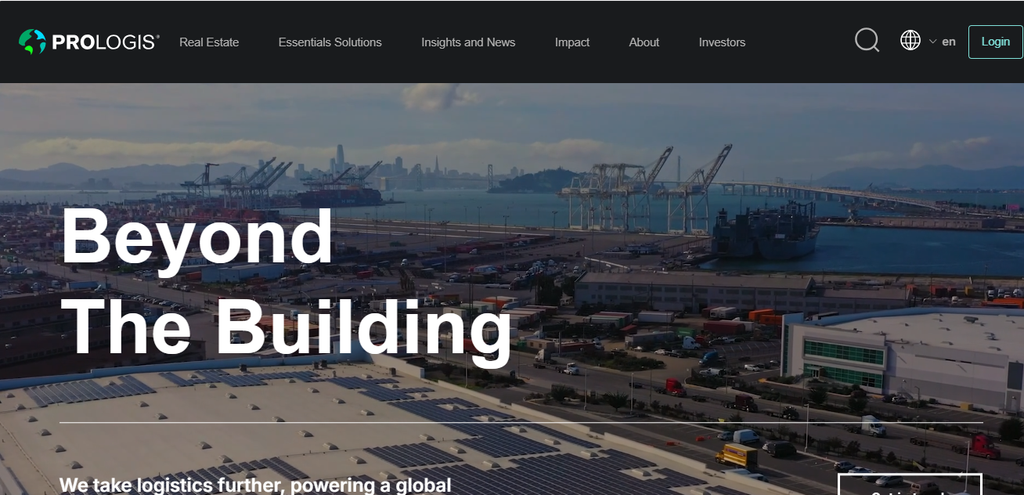
Not every real estate company builds homes. Operates office towers. Prologis focuses on logistics estate, including warehouses and industrial facilities used by businesses to store and move goods.
| Founded: 1983 |
| Headquarters: San Francisco, California, USA |
| Latest Revenue: $8.79 billion (FY2025) |
| Latest Net Income: $3.57 billion in consolidated net earnings (FY2025) |
| Main Products/Services: Logistics facilities, industrial real estate, warehouses, property leasing, development and related infrastructure solutions. |
These properties are often located near transport routes, cities and distribution centres. Retailers, manufacturers and delivery businesses need locations to keep goods moving from suppliers to customers. Prologis owns, manages and develops facilities in this part of the property market.
The company reported revenue of approximately $8.79 billion in 2025 compared with about $8.20 billion in 2024. Consolidated net earnings were $3.57 billion. These are company- figures and the profit figure can be affected by accounting items beyond rental income alone.
Prologis is included because warehouses and industrial sites are a part of real estate. Its business shows how property companies can support supply chains without selling homes or operating as estate agents.
8. Simon Property Group

Simon Property Group focuses on real estate. Its portfolio includes shopping centres and outlet properties where retailers lease space to sell clothing, electronics, food and other products.
| Founded: 1993 |
| Headquarters: Indianapolis, Indiana, USA |
| Latest Revenue: $6.36 billion (FY2025) |
| Latest Net Income: $5.36 billion in consolidated net income (FY2025) |
| Main Products/Services: Shopping malls, premium outlets, retail property leasing, property management and related real estate activities. |
The company earns much of its revenue through leasing and managing property. Its financial performance is therefore linked to factors such as income, tenant demand, property expenses and the performance of its real estate holdings.
For 2025 Simon reported revenue of approximately $6.36 billion and consolidated net income of about $5.36 billion. The net income figure was higher than in 2024, when consolidated net income was $2.73 billion. Such changes can reflect property transactions and accounting gains so a year’s net income should not be treated as a simple measure of recurring rental profit.
Simon earns a place on this list because shopping centres remain a part of the US property market. Its business differs from that of a homebuilder. It is relevant to retailers, commercial tenants and property investors.
9. Realty Income

Realty Income is a real estate investment trust called a REIT. Of focusing on building houses for sale it owns income-producing commercial properties and leases them to businesses.
| Founded: 1969 |
| Headquarters: San Diego, California, USA |
| Latest Revenue: See FY2025 Form 10-K for the company’s reported revenue. |
| Latest Net Income: See FY2025 Form 10-K for the reported net income. |
| Main Products/Services: Commercial property ownership, long-term leasing and real estate investment. |
Many of its leases are structured so tenants pay rent over periods with lease terms and responsibilities set out in agreements. The actual arrangement depends on the property and contract. This model gives Realty Income a role from companies that mainly earn money by selling completed homes.
REITs are often considered by investors who want exposure to property income through traded shares. However owning shares in a REIT is not the same as owning a building and share prices can rise or fall.
Realty Income is included because its property ownership and leasing model represents a part of the commercial real estate industry. Readers comparing real estate companies should distinguish between a developer that sells property and a REIT that owns buildings to earn income.
Financial note: Use the revenue and net income figures reported in Realty Incomes FY2025 Form 10-K. Do not substitute funds from operations (FFO) for net income as FFO is a separate measure commonly used to assess REIT performance.
10. Equity Residential

Equity Residential focuses on apartment properties rather than individual home sales. The company. Operates rental communities making it relevant to people who want to understand the business side of apartment living in the United States.
| Founded: 1969 |
| Headquarters: Chicago, Illinois, USA |
| Latest Revenue: $3.09 billion (FY2025) |
| Latest Net Income: $1.15 billion (FY2025) |
| Main Products/Services: Apartment ownership, rental housing and property management. |
Its revenue comes from rental income. This means its results depend on factors such as occupancy, rent levels, operating costs, property taxes and maintenance expenses. These pressures differ from those faced by homebuilders, whose results are directly linked to home sales and construction activity.
Equity Residential reported income of approximately $3.09 billion for 2025. Its annual report recorded income of around $1.15 billion. These figures describe the company’s reported performance, not the value of its entire property portfolio.
It rounds out the list by representing the rental housing sector. For readers interested in property ownership as a business Equity Residential offers a perspective, from builders, commercial brokers and retail property owners.
Top 10 Real Estate Companies in USA: Comparison
| Rank | Company | Founded | Latest Revenue | Main Products/Services |
| 1 | CBRE Group | 1906 | $40.6 billion (FY2025) | Commercial real estate services and facilities management |
| 2 | D.R. Horton | 1978 | $34.3 billion (FY2025) | Homebuilding and housing services |
| 3 | Lennar Corporation | 1954 | $34.2 billion (FY2025) | Homebuilding, land development and financial services |
| 4 | JLL | 1783 | See FY2025 annual report | Commercial real estate services |
| 5 | PulteGroup | 1950 | $16.7 billion in 2025 homebuilding revenue | Homebuilding and residential communities |
| 6 | NVR, Inc. | 1980 | $10.3 billion (FY2025) | Homebuilding and mortgage banking |
| 7 | Prologis | 1983 | $8.79 billion (FY2025) | Logistics and industrial real estate |
| 8 | Simon Property Group | 1993 | $6.36 billion (FY2025) | Shopping centres and retail property |
| 9 | Realty Income | 1969 | See FY2025 Form 10-K | Commercial property ownership and leasing |
| 10 | Equity Residential | 1969 | $3.09 billion (FY2025) | Apartment ownership and rental housing |
What Should You Check Before Choosing a Real Estate Company?
The right company depends on what you need. If you’re buying a built house look at the builders available communities, home designs, construction timelines, warranties and local customer service. A company with a national presence may not have the right property in your preferred area.
For property services, compare the firm’s experience with the type of building you need help with. Office leasing, warehouse management and retail property operations require knowledge.
Investors should look beyond revenue. Net income, debt, cash flow, property occupancy and the type of assets owned can all help explain a company’s position. REITs also publish measures such as funds from operations, which can be useful when read alongside financial statements.
Finally check the local team, property and contract terms. A company’s national reputation does not replace checks on an individual home, lease or investment.
Conclusion
The US real estate market includes more than homebuilders. Commercial property advisers, warehouse owners, shopping-centre operators and apartment landlords all serve parts of the industry. The companies in this list show how varied the sector can be, from constructing homes to managing buildings that businesses use every day
The suitable company depends on whether you’re buying, renting, leasing commercial space or researching property investments. Compare the services and financial information carefully and check the details of the individual property or agreement before making a decision.
Frequently Asked Questions
1. What are the top real estate companies in the USA?
There is no single ranking that covers every type of real estate business. Companies such as CBRE, D.R. Horton, Lennar, JLL, and Prologis are notable in different parts of the market. Some focus on homebuilding, while others provide commercial property services or own income-producing buildings.
2. Which is the largest homebuilder in the USA?
D.R. Horton was ranked first in Pro Builder’s 2026 list of U.S. homebuilders by 2025 housing revenue. The publication reported approximately $32.32 billion in revenue for the company. Rankings can differ depending on whether they measure revenue, home closings, or another business indicator.
3. What does CBRE Group do?
CBRE provides real estate services to businesses, landlords, and investors. Its work includes property sales and leasing, facilities management, project management, and property management. It differs from a homebuilder because a large part of its business involves services connected with commercial property.
4. Are real estate companies and real estate investment trusts the same?
Not exactly. A real estate company may build homes, manage properties, or provide brokerage services. A REIT, or real estate investment trust, owns or finances income-producing real estate and follows specific tax rules. Some REITs trade on stock exchanges, allowing investors to buy shares without purchasing a property themselves.
5. Which companies build homes in the USA?
D.R. Horton, Lennar, PulteGroup, and NVR are examples of established U.S. homebuilders. They develop communities and sell newly built homes, although their available locations, designs, and price ranges differ. Buyers should check the community, construction details, and purchase agreement before choosing a property.
6. What does Prologis specialize in?
Prologis focuses on logistics and industrial real estate, including warehouses and facilities used for storing and moving goods. Its properties serve businesses that need space near transport routes, distribution networks, and customers. It represents a part of real estate that is less visible to homebuyers but important to commercial supply chains.
7. How do real estate companies make money?
Their income depends on their business model. Homebuilders earn revenue from selling homes, commercial property firms may earn fees from management services, and property owners can earn rental income. Some companies also generate income through development, financing, and property transactions.
8. Does higher revenue mean a real estate company is better?
No. Revenue shows the amount a company reports from its business activities, but it does not explain everything about performance. Profit, debt, cash flow, property quality, and the company’s particular services also matter. A homebuilder and a rental property owner cannot always be compared fairly using revenue alone.
9. What should buyers check before choosing a homebuilder?
Buyers should check the builder’s experience, available homes, construction specifications, warranty coverage, and reputation for addressing problems. They should read the purchase agreement carefully and understand what is included in the quoted price. It is also sensible to arrange inspections where appropriate rather than relying only on the builder’s marketing materials.
10. Are these rankings official?
No. This article uses a selection of companies to cover several important areas of the U.S. real estate market. It is not a ranking of all property companies. Lists based on revenue from commercial real estate services, property ownership, or residential sales volume may produce different results.