

Introduction
Investing money is an important part of financial planning. People invest in different financial products to achieve their long-term goals, save for retirement, purchase a house, fund their children’s education and build wealth. However, not everyone has the knowledge, time or experience to select the right investments. This is where asset management companies play an important role.
Asset Management Companies (AMCs) are financial institutions that manage investments on behalf of individuals, businesses and other organisations. They collect money from investors and invest it in different financial instruments, such as stocks, bonds, government securities and other assets. Mutual funds are among the most popular investment products offered by these companies.
In India, the asset management industry has experienced significant growth over the last few years. Increasing financial awareness, digital investment platforms, systematic investment plans (SIPs), rising incomes and growing participation in the stock market have encouraged more people to invest through mutual funds.
According to the Association of Mutual Funds in India (AMFI), the Indian mutual fund industry’s Assets Under Management (AUM) reached approximately ₹82.64 lakh crore as of September 30, 2026. The industry’s average AUM for September 2026 stood at ₹87.09 lakh crore. The total number of mutual fund folios also increased to approximately 28.62 crore.
In this article, we will explore the top 10 asset management companies in India, their establishment, headquarters, investment areas, assets under management and latest publicly available financial information.
Top 10 Asset Management Companies in India
Here is a quick overview of the leading asset management companies in India based on their average AUM for July–September 2026.
- SBI Mutual Fund
- ICICI Prudential Mutual Fund
- HDFC Mutual Fund
- Nippon India Mutual Fund
- Kotak Mahindra Mutual Fund
- Aditya Birla Sun Life Mutual Fund
- UTI Mutual Fund
- Axis Mutual Fund
- DSP Mutual Fund
- Mirae Asset Mutual Fund
Let’s understand each company in detail.
1. SBI Mutual Fund
| Year of Establishment | 1987 |
| Headquarters | Mumbai, India |
| Parent Organisation | State Bank of India and Amundi |
| Average AUM (July–September 2026) | ₹13.10 lakh crore |
| Major Investment Areas | Equity, Debt, Hybrid and Index Funds |
| Q2 FY27 Net Profit | ₹701.24 crore (Consolidated) |

SBI Mutual Fund is the largest asset management company in India in terms of quarterly average assets under management. Established in 1987, the company has developed a strong position in the Indian mutual fund industry.
The company is associated with the State Bank of India (SBI), one of India’s largest public sector banks. It also has a partnership with Amundi, a leading European asset management company.
The company offers several investment products, including equity mutual funds, debt funds, hybrid funds, exchange-traded funds (ETFs) and index funds.
Some popular schemes associated with SBI Mutual Fund include SBI Small Cap Fund, SBI Bluechip Fund, SBI Contra Fund and SBI Magnum Midcap Fund.
According to AMFI’s quarterly data, SBI Mutual Fund recorded an average AUM of approximately ₹13.10 lakh crore during July–September 2026, maintaining its first position in the industry.
Financially, SBI Funds Management reported a consolidated net profit of approximately ₹701.24 crore in Q2 FY27. Its revenue for the quarter stood at approximately ₹1,192.67 crore. For the full financial year FY26, its consolidated net profit was approximately ₹3,067.38 crore.
These figures demonstrate the company’s strong business position and its ability to generate revenue from managing investments.
2. ICICI Prudential Mutual Fund
| Year of Establishment | 1993 |
| Headquarters | Mumbai, India |
| Parent Organisations | ICICI Bank and Prudential plc |
| Average AUM (July–September 2026) | ₹11.56 lakh crore |
| Major Investment Areas | Equity, Debt, Hybrid and International Funds |
| Q2 FY27 Net Profit | ₹888.96 crore |

ICICI Prudential Mutual Fund is one of the largest and most recognised asset management companies in India. Established in 1993, the company operates as a joint venture between ICICI Bank and Prudential plc.
The company provides several investment options, including large-cap funds, mid-cap funds, small-cap funds, balanced advantage funds, debt funds and international investment products.
One of its major strengths is its wide range of investment schemes. Investors can select products according to their financial goals, investment duration and risk-taking capacity.
Some popular schemes associated with ICICI Prudential Mutual Fund include ICICI Prudential Bluechip Fund, ICICI Prudential Equity & Debt Fund, ICICI Prudential Balanced Advantage Fund and ICICI Prudential Technology Fund.
According to AMFI’s September 2026 quarterly data, the company recorded an average AUM of approximately ₹11.56 lakh crore, making it the second-largest mutual fund house in India.
The company also reported strong financial results in Q2 FY27. Its profit after tax reached approximately ₹888.96 crore, compared with ₹837.99 crore in the corresponding quarter of the previous year. Its revenue from operations increased to approximately ₹1,673.79 crore during the September 2026 quarter.
For the first half of FY27, the company’s profit after tax stood at approximately ₹1,853.59 crore. These financial figures reflect its strong position in India’s growing asset management industry.
3. HDFC Mutual Fund
| Year of Establishment | 2000 |
| Headquarters | Mumbai, India |
| Parent Organisation | HDFC Asset Management Company |
| Average AUM (July–September 2026) | ₹9.69 lakh crore |
| Major Investment Areas | Equity, Debt, Hybrid and Index Funds |
| Q2 FY27 Net Profit | ₹749.81 crore |

HDFC Mutual Fund is another major player in India’s asset management industry. It is managed by HDFC Asset Management Company Limited, which was established in 1999 and began its mutual fund operations in 2000.
The company has built a strong reputation among Indian investors through its wide range of investment products and established market presence. HDFC Mutual Fund offers different types of schemes, including equity funds, debt funds, hybrid funds, index funds and exchange-traded funds.
Popular schemes associated with HDFC Mutual Fund include HDFC Flexi Cap Fund, HDFC Mid Cap Fund, HDFC Balanced Advantage Fund and HDFC Top 100 Fund.
According to AMFI data, HDFC Mutual Fund recorded an average AUM of approximately ₹9.69 lakh crore during July–September 2026, securing the third position among Indian mutual fund companies.
Its financial performance has also remained strong. HDFC Asset Management Company reported a net profit of approximately ₹749.81 crore in Q2 FY27, compared with ₹718.06 crore in the corresponding quarter of FY26.
Its revenue from operations reached approximately ₹1,168.93 crore during the September 2026 quarter. For the full financial year FY26, the company reported a net profit of approximately ₹2,859.36 crore.
4. Nippon India Mutual Fund
| Year of Establishment | 1995 |
| Headquarters | Mumbai, India |
| Parent Organisation | Nippon Life Insurance Company |
| Average AUM (July–September 2026) | ₹7.87 lakh crore |
| Major Investment Areas | Equity, Debt, ETFs and Hybrid Funds |
| Q2 FY27 Net Profit | ₹324.37 crore (Consolidated) |

Nippon India Mutual Fund is one of the most established asset management companies in the country. It started its operations in 1995 and was previously known as Reliance Mutual Fund.
In 2019, Japan-based Nippon Life Insurance Company acquired a majority stake in the mutual fund business, following which it was renamed Nippon India Mutual Fund. The company operates through Nippon Life India Asset Management Limited and offers investment products across several financial categories.
Some popular schemes include Nippon India Small Cap Fund, Nippon India Growth Fund, Nippon India Large Cap Fund and Nippon India ETF Nifty 50 BeES. The company has also developed a significant presence in the systematic investment plan market.
According to AMFI’s quarterly data, Nippon India Mutual Fund recorded an average AUM of approximately ₹7.87 lakh crore during July–September 2026. It also reported strong growth in its business during the first half of FY27.
In Q2 FY27, Nippon Life India Asset Management reported consolidated revenue from operations of approximately ₹795.75 crore and net profit of approximately ₹324.37 crore. Although its reported quarterly net profit declined compared with the previous year, its operating profit increased by approximately 25% to ₹523.4 crore.
5. Kotak Mahindra Mutual Fund
| Year of Establishment | 1998 |
| Headquarters | Mumbai, India |
| Parent Organisation | Kotak Mahindra Group |
| Average AUM (July–September 2026) | ₹6.14 lakh crore |
| Major Investment Areas | Equity, Debt, Hybrid and International Funds |
| Net Income | AMC-specific Q2 FY27 net profit not separately disclosed |

Kotak Mahindra Mutual Fund is a leading asset management company operating under the Kotak Mahindra Group. Established in 1998, the company has gradually expanded its presence in India’s mutual fund industry. It offers investment products for individuals, businesses and institutional investors.
Some popular schemes associated with the company include Kotak Flexicap Fund, Kotak Emerging Equity Fund, Kotak Equity Opportunities Fund and Kotak Liquid Fund. The company has also invested in strengthening its digital services and distribution network to make mutual fund investments more accessible.
According to AMFI’s July–September 2026 data, Kotak Mahindra Mutual Fund recorded an average AUM of approximately ₹6.14 lakh crore, placing it fifth among Indian asset management companies. Regarding financial performance, Kotak Mahindra Group reported that the combined profit after tax of Kotak AMC and its trustee company was approximately ₹1,082 crore for FY26.
6. Aditya Birla Sun Life Mutual Fund
| Year of Establishment | 1994 |
| Headquarters | Mumbai, India |
| Parent Organisations | Aditya Birla Capital and Sun Life Financial |
| Average AUM (July–September 2026) | ₹4.42 lakh crore |
| Major Investment Areas | Equity, Debt, Hybrid and International Funds |
| Q2 FY27 Net Profit | ₹221 crore |
Aditya Birla Sun Life Mutual Fund is one of the oldest private sector asset management companies in India. Established in 1994, the company operates as a joint venture between Aditya Birla Capital and Canada’s Sun Life Financial.
Over the years, it has developed a strong presence in the Indian mutual fund market by offering different investment products for retail and institutional investors.
The company manages several types of investment schemes, including equity funds, debt funds, hybrid funds, index funds and international funds.
Some popular schemes associated with the company include Aditya Birla Sun Life Frontline Equity Fund, Aditya Birla Sun Life Flexi Cap Fund, Aditya Birla Sun Life Small Cap Fund and Aditya Birla Sun Life Digital India Fund.
According to AMFI data, Aditya Birla Sun Life Mutual Fund recorded an average AUM of approximately ₹4.42 lakh crore during July–September 2026. In terms of financial performance, Aditya Birla Sun Life AMC reported a net profit of approximately ₹221 crore in Q2 FY27, compared with ₹241.32 crore in the corresponding quarter of the previous financial year. Its revenue from operations increased by approximately 5% year-on-year to ₹484 crore. Despite the decline in quarterly profit, the company continues to maintain a strong position in the Indian mutual fund industry.
7. UTI Mutual Fund
| Year of Establishment | 1963 |
| Headquarters | Mumbai, India |
| Asset Management Company | UTI Asset Management Company |
| Average AUM (July–September 2026) | ₹4.02 lakh crore |
| Major Investment Areas | Equity, Debt, Index and Retirement Funds |
| Q2 FY27 Net Profit | ₹132.31 crore (Consolidated) |

UTI Mutual Fund is one of the oldest names in India’s investment management industry. The organisation traces its history to the establishment of the Unit Trust of India in 1963. It played an important role in introducing mutual fund investments to Indian households.
UTI Mutual Fund has also developed a strong presence in the passive investment category. Its index funds and exchange-traded funds provide investment opportunities to people interested in tracking market indices.
According to AMFI’s quarterly data, the company recorded an average AUM of approximately ₹4.02 lakh crore during July–September 2026. UTI Asset Management Company reported consolidated net profit of approximately ₹132.31 crore in Q2 FY27. Its revenue from operations during the quarter stood at approximately ₹414.59 crore.
The company also reported a standalone profit after tax of approximately ₹143.10 crore for the same quarter. UTI AMC continues to play an important role in India’s mutual fund industry because of its long history, established investment products and nationwide presence.
8. Axis Mutual Fund
| Year of Establishment | 2009 |
| Headquarters | Mumbai, India |
| Parent Organisation | Axis Bank |
| Average AUM (July–September 2026) | ₹3.83 lakh crore |
| Major Investment Areas | Equity, Debt, Hybrid and International Funds |
| H1 FY27 Net Profit | ₹370 crore |

Axis Mutual Fund is a major asset management company operating under the Axis Bank Group. Established in 2009, the company has developed a strong position in India’s mutual fund industry through its investment products and financial services network.
Some popular schemes associated with the company include Axis Bluechip Fund, Axis Midcap Fund, Axis Small Cap Fund and Axis Flexi Cap Fund.
One of its major strengths is its association with Axis Bank. This relationship helps the company reach a large number of banking customers and investors through different distribution channels.
According to AMFI’s quarterly data, Axis Mutual Fund recorded an average AUM of approximately ₹3.83 lakh crore during July–September 2026.
The company has also reported positive financial performance. According to Axis Bank’s Q2 FY27 financial results, Axis AMC recorded a profit after tax of approximately ₹370 crore during the first half of FY27, representing a year-on-year increase of 36%.
9. DSP Mutual Fund
| Year of Establishment | 1996 |
| Headquarters | Mumbai, India |
| Parent Organisation | DSP Group |
| Average AUM (July–September 2026) | ₹2.44 lakh crore |
| Major Investment Areas | Equity, Debt, Hybrid and Passive Funds |
| Net Income | Latest standalone net profit not separately disclosed |

DSP Mutual Fund is another well-known asset management company in India. It operates under the DSP Group, which has a long history in India’s financial services industry. The company began its mutual fund operations in 1996 and has gradually established itself as a recognised investment management business.
Some popular schemes associated with DSP Mutual Fund include DSP Flexi Cap Fund, DSP Midcap Fund, DSP Small Cap Fund and DSP Nifty 50 Equal Weight Index Fund. One of its important areas of focus is equity investing. The company manages schemes that invest in companies across different market capitalisations and industries.
It also offers debt and passive investment products for investors looking for different approaches to portfolio diversification. According to AMFI’s quarterly data, DSP Mutual Fund recorded an average AUM of approximately ₹2.44 lakh crore during July–September 2026.
The company also recorded one of the strongest quarterly AUM growth rates among the top 10 fund houses, with its average AUM increasing by approximately 6% compared with the previous quarter.
10. Mirae Asset Mutual Fund
| Year of Establishment in India | 2007 |
| Headquarters | Mumbai, India |
| Parent Organisation | Mirae Asset Financial Group |
| Average AUM (July–September 2026) | ₹2.37 lakh crore |
| Major Investment Areas | Equity, Debt, ETFs and International Funds |
Mirae Asset Mutual Fund is one of the fastest-growing international asset management brands in India. It operates under the South Korean Mirae Asset Financial Group, which has developed a significant presence in financial services and investment management across several countries.
Mirae Asset entered the Indian mutual fund market in 2007. Since then, the company has expanded its investment products and distribution network. It offers different types of mutual fund schemes, including equity funds, debt funds, hybrid funds, exchange-traded funds and international investment products.
Some popular schemes associated with the company include Mirae Asset Large Cap Fund, Mirae Asset Emerging Bluechip Fund, Mirae Asset Tax Saver Fund and Mirae Asset Nifty 50 ETF.
The company also provides international investment opportunities through products that give Indian investors exposure to selected global markets. According to AMFI’s quarterly data, Mirae Asset Mutual Fund recorded an average AUM of approximately ₹2.37 lakh crore during July–September 2026.
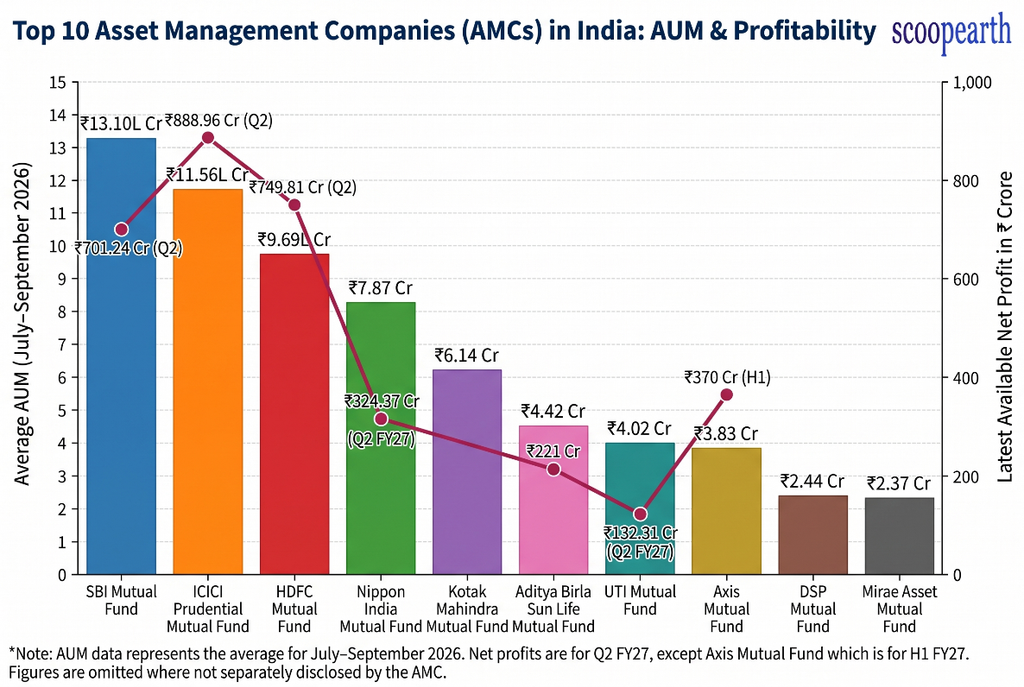
Comparison of the Top 10 Asset Management Companies in India
The following table provides a quick comparison of the leading asset management companies based on their average AUM for July–September 2026.
| Company | Average AUM (July–September 2026) | Latest Available Net Profit |
| SBI Mutual Fund | ₹13.10 lakh crore | ₹701.24 crore (Q2 FY27) |
| ICICI Prudential Mutual Fund | ₹11.56 lakh crore | ₹888.96 crore (Q2 FY27) |
| HDFC Mutual Fund | ₹9.69 lakh crore | ₹749.81 crore (Q2 FY27) |
| Nippon India Mutual Fund | ₹7.87 lakh crore | ₹324.37 crore (Q2 FY27) |
| Kotak Mahindra Mutual Fund | ₹6.14 lakh crore | AMC-specific figure not separately disclosed |
| Aditya Birla Sun Life Mutual Fund | ₹4.42 lakh crore | ₹221 crore (Q2 FY27) |
| UTI Mutual Fund | ₹4.02 lakh crore | ₹132.31 crore (Q2 FY27) |
| Axis Mutual Fund | ₹3.83 lakh crore | ₹370 crore (H1 FY27) |
| DSP Mutual Fund | ₹2.44 lakh crore | Not separately disclosed |
| Mirae Asset Mutual Fund | ₹2.37 lakh crore | Not separately disclosed |
Conclusion
The asset management industry has become an important part of India’s financial ecosystem. Increasing financial awareness, growing household incomes, digital investment platforms and rising participation in mutual funds have created significant opportunities for asset management companies.
Companies such as SBI Mutual Fund, ICICI Prudential Mutual Fund, HDFC Mutual Fund and Nippon India Mutual Fund have established strong positions because of their large investor bases, diverse investment products and extensive distribution networks.
At the same time, companies such as Kotak Mahindra Mutual Fund, Aditya Birla Sun Life Mutual Fund, UTI Mutual Fund, Axis Mutual Fund, DSP Mutual Fund and Mirae Asset Mutual Fund continue to contribute to the development of India’s mutual fund industry.
Each asset management company follows its own investment approach. Some focus heavily on equity funds, while others offer a wider combination of debt, hybrid, index and international investment products.
For investors, selecting an asset management company requires more than simply looking at its total AUM. Factors such as investment performance, fund management experience, expense ratios, risk management, portfolio quality and consistency should also be considered.
Overall, India’s asset management industry has considerable growth potential. As more individuals move towards organised investment products and long-term financial planning, these companies are expected to remain important participants in the country’s financial development.