Tom Holland Net Worth: Spider-Man Earnings, Acting Career & Lifestyle

Tom Holland‘s rise has been an early one by Hollywood standards, but it was built step by step. He made his West End debut as Billy Elliot in 2008, built his screen credentials through films like “The Impossible,” and joined the Marvel universe as Spider-Man in “Captain America: Civil War” in 2016. 

His true breakthrough came with “Spider-Man: Homecoming” in 2017, and “No Way Home” in 2021 turned him into one of the biggest young stars in the world. By 2026, he’s heading into two major summer releases, “The Odyssey” and “Spider-Man: Brand New Day,” while reportedly newly married to Zendaya.

Image Courtesy: Instagram /@tomholland2013 9 (Tom Holland)

So what has that journey actually earned him? This is one of the cleaner net worth stories you’ll find: nearly every credible source estimates his net worth at around $25 million, with only a few low-quality sites offering lower figures.

In this article, we’ll discuss Tom Holland Net Worth, Spider-Man Earnings, Acting Career & Lifestyle.

Quick Profile Overview

DetailInformation
Full NameThomas Stanley Holland
Date of BirthJune 1, 1996
Age30 years old
BirthplaceKingston upon Thames, London, England
HeightApproximately 5 ft 7 in (173 cm)
OccupationActor, dancer, entrepreneur
Breakthrough RoleBilly Elliot in Billy Elliot the Musical (West End)
Signature RolePeter Parker / Spider-Man in the Marvel Cinematic Universe
Notable FilmsSpider-Man: Homecoming, Far From Home, No Way Home, Uncharted, Cherry, The Devil All the Time
Business VentureCo-founder of BERO, a non-alcoholic beer brand
SpouseZendaya (reported marriage in early 2026)
Most-Cited Net Worth$25 million, per Celebrity Net Worth
Broader Reported Range$15 million to $25 million

Who Is Tom Holland?

Tom Holland is an English actor born on June 1, 1996, in Kingston upon Thames, London. He is the eldest of four brothers. His mother, Nicola, is a photographer, and his father, Dominic Holland, is a comedian and author. He was diagnosed with dyslexia at the age of seven, something he has spoken about openly.

Image Courtesy: Instagram /@tomholland2013 9 (Tom Holland)

Holland began as a dancer and landed the title role in the West End production of Billy Elliot the Musical, which launched his professional career. Early film work followed, including The Impossible and The Lost City of Z, before Marvel cast him as Spider-Man. Since then he has balanced franchise work with darker dramas, a streaming series, and a growing business career outside acting.

Tom Holland’s Net Worth

Here’s the honest picture: Tom Holland’s net worth is estimated at $25 million by Celebrity Net Worth, the most widely referenced tracker for public figures. That figure is best read as accumulated wealth after taxes, agents’ fees, and spending, not as a total of what he has been paid over his career.

Comparing the Estimates

SourceEstimated Net WorthNotes
Celebrity Net Worth$25 million (updated March 2026)Most consistent and widely cited figure
Social Life Magazine$25 million (2026)Notes his career is built largely on a single franchise
Unifresher$25 million (2026)Describes the figure as post-tax, post-spend wealth
ScreenWise$25 million (mid-2026)Links his wealth to a reported $20 million Spider-Man salary
Low-quality aggregator sites$15 million to $22 millionAppear on unrelated domains with templated content

The credible sources cluster tightly around $25 million, which makes this a far more settled number than many celebrity estimates. Worth flagging: some of the lower figures appear on websites with no connection to finance or entertainment reporting, a pattern often seen with automatically generated content, so they deserve little weight. 

The one real uncertainty is the future. Several outlets note that $25 million may soon look outdated if his reported Brand New Day paycheck is accurate.
Spider-Man Earnings

Image Courtesy: Instagram /@tomholland2013 9 (Tom Holland)

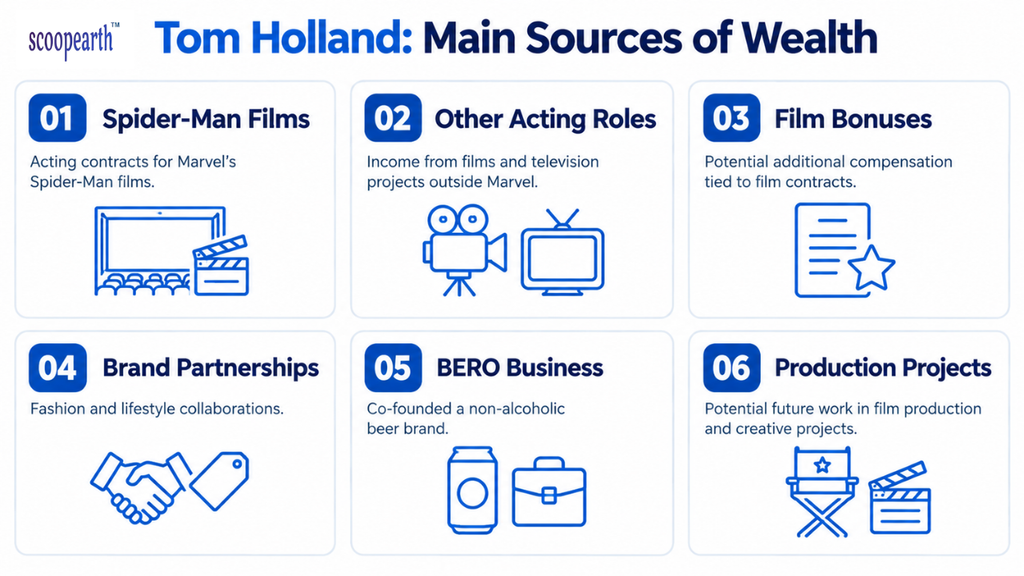
Holland’s wealth is overwhelmingly tied to one role. He was reportedly paid around $500,000 for his first solo Spider-Man film, Homecoming, a modest sum for the lead of a major franchise. Estimates put his total earnings across the first Spider-Man trilogy at roughly $10 million, which is low compared with other franchise leads, mainly because his early contracts were negotiated when he was a young, relatively unknown actor.

Image Courtesy: Instagram /@tomholland2013 9 (Tom Holland)

That changes with Spider-Man: Brand New Day, which opens on July 31, 2026. Some outlets report a salary of around $20 million for the film, though this figure is not officially confirmed and should be treated as an estimate. If accurate, that one paycheck would nearly equal his entire estimated net worth, which is why many commentators expect his financial position to jump significantly by the end of 2026.

Image Courtesy: Instagram /@tomholland2013 9 (Tom Holland)

No Way Home sits at the center of this story. It became one of the highest-grossing films ever made, yet Holland’s earnings from it reflect a standard actor’s contract rather than a share of that success.

Acting Career

Holland’s career has been a deliberate mix of blockbusters and riskier roles:

  • Early career: Billy Elliot the Musical on the West End, followed by The Impossible (2012), which earned him early praise.
  • Marvel debut: He first appeared as Spider-Man in Captain America: Civil War (2016), followed by Homecoming (2017) and further appearances in the Avengers films.

Image Courtesy: Instagram /@tomholland2013

  • Franchise leads: Far From Home (2019) and No Way Home (2021) cemented him as the character’s face.
  • Non-Marvel work: The Devil All the Time, Cherry, Uncharted, and the series The Crowded Room showed his range beyond superhero films.

Image Courtesy: Instagram /@tomholland2013

  • 2026 slate: Two major summer releases, The Odyssey and Spider-Man: Brand New Day, arriving about two weeks apart.

Image Courtesy: Instagram /@tomholland2013

Commentators have pointed out that his non-Marvel films tend to perform best when his Spider-Man fame is driving audiences, which highlights how much of his earning power still rests on one franchise.

Endorsements & Brand Partnerships

Holland’s endorsement profile is strong but less lucrative than his film work:

  • Luxury and lifestyle brands: Like most Marvel leads, he has taken on fashion and automotive partnerships over the years, though exact deal values are not publicly documented.
  • Marvel and Sony tie-ins: Franchise promotions and merchandising connected to Spider-Man add visibility, but typically do not add personal revenue beyond his contracts.
  • Brand power of the couple: Following his reported marriage to Zendaya, the pair is viewed as a major marketing draw, though both keep their finances private.

Unlike athletes whose sneaker deals can run for decades, an actor’s endorsement income often depends on the next film release, which makes his upcoming slate especially important.

Business Ventures

Beyond acting, Holland has built a business profile that is arguably his smartest long-term move:

  • BERO: He co-founded this non-alcoholic beer brand, inspired by his own decision to step back from drinking. It has been widely described as one of the more successful celebrity-backed drinks ventures and offers him real equity, something his film contracts do not.
  • The Brothers Trust: A charity he runs with his family to raise money for causes he supports. This is a philanthropic project, not a source of income.
  • Production and creative interests: He has expressed interest in producing and working behind the camera, though specific projects and their financial results are limited in public reporting.

Ownership stakes like BERO matter because they build wealth in a way salaried acting work cannot.

Lifestyle

Image Courtesy: Instagram /@tomholland2013 9 (Tom Holland)

Holland’s lifestyle is notably more restrained than the average Hollywood star:

  • Property: He is reported to own a three-bedroom flat in London valued at around $4 million. Some outlets claim larger properties, but these reports are inconsistent, and he is not known for a collection of lavish estates.
  • Spending habits: Compared with stars who treat luxury cars and watches as a brand, Holland keeps a lower profile, and much of the “luxury lifestyle” content found on social media is speculative.
  • Fitness and discipline: His training and stunt work are a major part of his public image and his career, reflecting the physical demands of the Spider-Man role.
  • Personal life: After years of rumors, he and Zendaya confirmed their relationship in November 2021, got engaged in 2024, and were reported to have married in early 2026 after her stylist mentioned it in an interview. Zendaya’s net worth is commonly estimated at around $30 million, putting the couple’s combined estimated worth at roughly $55 million.

Frequently Asked Questions (FAQs)

What is Tom Holland’s net worth? 

Most reliable sources estimate it at around $25 million in 2026, driven mainly by his role as Spider-Man.

How much did Tom Holland earn for the first Spider-Man film? 

He was reportedly paid around $500,000 for Spider-Man: Homecoming.

How much did Tom Holland earn across the Spider-Man trilogy? 

Estimates put his total earnings for the three solo films at roughly $10 million.

How much is Tom Holland paid for Spider-Man: Brand New Day? 

Some outlets report around $20 million, but this has not been officially confirmed.

How old is Tom Holland? 

He was born on June 1, 1996, in Kingston upon Thames, London, making him 30 years old.

Is Tom Holland richer than Zendaya? 

No. Zendaya is generally estimated at around $30 million, slightly above Holland’s $25 million.

What is BERO? 

BERO is a non-alcoholic beer brand Holland co-founded, and it is widely seen as one of his most successful business moves.

Is Tom Holland married? 

Reports in March 2026 indicated that he and Zendaya had married earlier that year, following their 2024 engagement.

What other films has Tom Holland starred in besides Spider-Man? 

They include The Impossible, The Lost City of Z, Cherry, The Devil All the Time, and Uncharted, plus the series The Crowded Room.

Why do some sources show a lower net worth for Tom Holland? 

Lower figures typically come from low-quality or templated websites. Established trackers consistently land on $25 million.

Conclusion

Tom Holland is a shining star of young Hollywood who has conquered the film industry at an early age. However, despite the staggering revenue that the actor generates with his work, his estimated net worth barely reaches $25 million. The figure seems low considering the earnings of his movies, but it is entirely reasonable given the state of his career. 

As Tom Holland continues to accumulate projects, his net worth is expected to grow substantially. With the announcement of two major movies, Spider-Man: Brand New Day and The Odyssey, his income is estimated to rise considerably by 2026. For now, the value of $25 million serves as only a minimum for the actor’s wealth.

From Garba to Diwali, Hoopr Unlocks Commerce and Revenue for Brands Through Chartbuster Music

Hoopr enables brands to drive commerce and revenue through Garba and Diwali festive music

Hoopr Smash offers pre-cleared popular tracks that any brand can buy and use, ensuring festive content can scale and perform without interruption.

National 14th October 2026: October to December is when brands invest the most to be seen and when it is hardest to stand out. Every brand wants its Diwali film, every D2C brand wants its festive reel, and every platform is crowded with sale announcements, offers, launches and influencer collaborations. Hoopr estimates that India already sees 32,000+ branded videos created every day, and the festive rush only adds to that.

In this environment, the question is no longer simply how much a brand spends on media. It is how effectively the creative earns attention, and increasingly, the answer lies in music, the often-underestimated element that makes festive content memorable, culturally relevant and unmistakably a brand’s own. Music also works in a brand’s favour through the way platforms distribute content. Algorithms favour popular audio, and content built on it sees about 65% more organic reach. For brands, that means the right track can take a festive campaign further than media spend alone, and give it a stronger cultural connect. 

Hoopr Smash, India’s leading marketplace for licensing music for digital and commercial content, offers 20,000+ pre-cleared tracks across Bollywood, international and regional music, by labels like Universal Music, SVF Music, Hospital Records, OML Sync and many others. With artists like Arijit Singh, Anuv Jain, Shreya Ghoshal, Diljit Dosanjh, leading regional artists like Ajay-Atul, Aditya Gadhvi, and songs from popular indie artists like Garvit-Priyansh, Char Diwari and the latest sensations – Parv & Sicklot who were on MTV Hustle 5; these tracks span genres, moods and festivals, giving brands a ready soundtrack to use during this festive season.

The results are already showing. A popular IPL franchise has seen 10Bn+ views across its Instagram reels backed by trending, licensed music from Hoopr Smash, with 2.8x the views, ~4.5x the engagement and ~12x the shares per reel.
A leading women’s ethnic wear brand also saw 2.1x the engagement rate and 2.8x the saves on reels featuring a popular track, compared with its reels on generic music. Brands are also coming back for more, with every brand that has licensed music on Hoopr Smash returning to license more tracks, a near about 100% retention rate.

Explaining why music matters so much during this period, Gaurav Dagaonkar, Co-founder & CEO, Hoopr, said, “Every festival carries its own feeling, and music is how a brand captures that moment and makes people feel emotionally connected to it. Having worked with leading brands across FMCG, sports and e-commerce, Hoopr Smash has seen a 100% retention rate, with brands coming back to our platform looking for more tracks and music to license. That feeling is what ultimately drives recall and action, and for brands, it is what turns festive content into festive performance.”

That feeling now travels faster than ever, as content and commerce increasingly sit on the same plane. But as more of this content turns commercial, it also raises an important licensing question. With this much content going live at once, a track cleared for an organic post may not cover a paid ad. To address this, licences on Hoopr Smash cover paid ads, Instagram creator reels and YouTube Shorts, giving brands clearance across the formats that matter most in the festive window.

Speaking about how Hoopr Smash supports brands through the festive rush, Meghna Mittal, Co-founder & CRO, Hoopr, said, “The festive window is short, and every brand is racing to make the most of it. That is exactly why brands shouldn’t have to choose between a track that moves people and a campaign that’s safe to run. With pre-cleared music on Hoopr Smash, creative teams move faster, viral reels stay live through peak spend, and every rupee behind them keeps driving reach and revenue. We see Hoopr Smash as a performance and revenue partner for brands through the season.” Brands, agencies and creators can explore the festive catalogue and license tracks directly at smash.hoopr.ai.

About Hoopr Smash

Hoopr Smash is India’s leading marketplace for licensing music for digital and commercial content. The platform works directly with labels to bundle their catalogues into simple, affordable licences, so brands, agencies and creators can use the music their audiences love across social media, advertising and influencer content without the usual back-and-forth with rights holders. It offers 20,000+ pre-cleared tracks from 23+ Indian labels and 3 international labels and serves 135+ brand clients, ranging from IPL franchises to leading D2C and FMCG names. Founded by Gaurav Dagaonkar and Meghna Mittal, Hoopr Smash is part of GSharp Media Pvt. Ltd. 

Hoopr Smash Logos: Hoopr Smash Logos

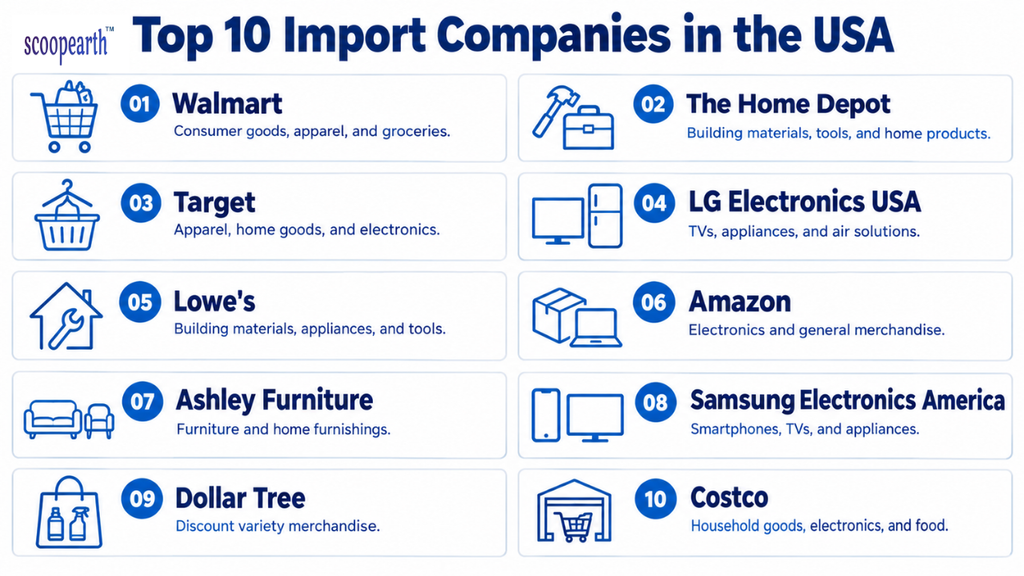
Top 10 Import Companies in USA

Top 10 import companies in USA and major businesses importing goods from global markets

America is the world’s biggest buyer. In 2025, the United States brought in roughly $3.4 trillion worth of goods, the highest yearly figure on record, with computers and telecom equipment, consumer products, vehicles, and industrial supplies leading the way. A small group of large companies is behind a big share of those shipments.

Some of these companies have been importing for decades to stock their stores. Others grew into major importers more recently on the back of online shopping and global electronics supply chains.

In this article, we’ll discuss the top 10 import companies in the United States, based on their history, ownership, and the kind of products they bring in from abroad.

Quick Comparison

RankCompanyFoundedOwner / FoundersUS HeadquartersCore Import Focus
1Walmart1962Founded by Sam Walton; publicly listed, led by CEO John FurnerBentonville, ArkansasConsumer Goods, Apparel & Groceries
2The Home Depot1978Founded by Bernie Marcus & Arthur Blank; publicly listed, led by Chair & CEO Ted DeckerAtlanta, GeorgiaBuilding Materials, Tools & Home Products
3Target1902 (Target stores 1962)Publicly listed; led by CEO Michael FiddelkeMinneapolis, MinnesotaApparel, Home Goods & Electronics
4LG Electronics USA1958 (parent company)US subsidiary of South Korea’s LG Electronics; led by CEO Don KwackEnglewood Cliffs, New JerseyTVs, Appliances & Air Solutions
5Lowe’s1921Publicly listed; led by Chairman & CEO Marvin EllisonMooresville, North CarolinaBuilding Materials, Appliances & Tools
6Amazon1994Founded by Jeff Bezos; publicly listed, led by CEO Andy JassySeattle, WashingtonElectronics & General Merchandise
7Ashley Furniture1945Privately held, owned by the Wanek family; led by CEO Todd WanekArcadia, WisconsinFurniture & Home Furnishings
8Samsung Electronics America1977US subsidiary of South Korea’s Samsung Electronics; led by CEO Yoonie Joung (North America)Bergen County, New JerseySmartphones, TVs & Appliances
9Dollar Tree1986Publicly listed; led by CEO Mike CreedonChesapeake, VirginiaDiscount Variety Merchandise
10Costco1983Founded by Jim Sinegal & Jeffrey Brotman; publicly listed, led by CEO Ron VachrisIssaquah, WashingtonHousehold Goods, Electronics & Food

Walmart – America’s Biggest Importer

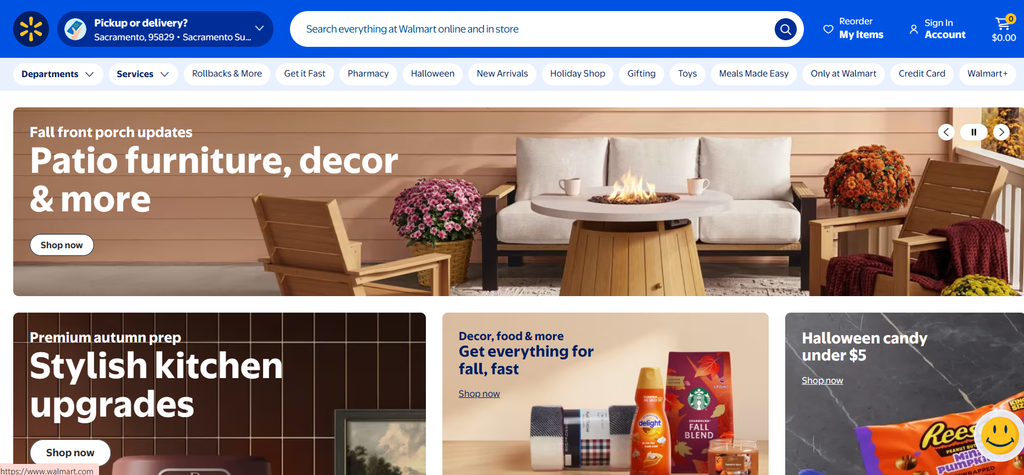
Image Courtesy: Walmart (Official Website)

  • Founded: 1962 
  • Owner: Founded by Sam Walton; publicly listed, led by President & CEO John Furner 
  • Headquarters: Bentonville, Arkansas

Sam Walton opened the first Walmart in Rogers, Arkansas, in 1962. It grew from a small-town discount store into the largest retailer in the world, and the Walton family remains its biggest shareholder.

Walmart is consistently ranked first among US importers by container volume, with an estimated 960,000 TEUs in 2024, nearly double the next company on the list. Much of that is clothing, toys, electronics, and household goods sourced from Asia and Latin America. John Furner became CEO on February 1, 2026, succeeding Doug McMillon.

What Walmart does: Operates supercenters, discount stores, warehouse clubs, and e-commerce

Services: Groceries, general merchandise, pharmacy, online shopping, and membership clubs

The Home Depot – Building the Nation with Imported Goods

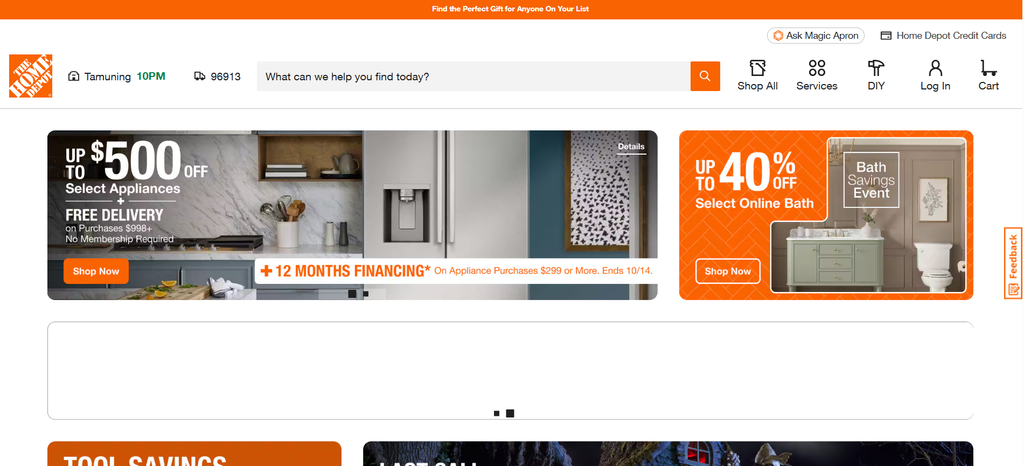
Image Courtesy: The Home Depot (Official Website)

  • Founded: 1978 
  • Owner: Founded by Bernie Marcus and Arthur Blank; publicly listed, led by Chair, President & CEO Ted Decker 
  • Headquarters: Atlanta, Georgia

The Home Depot opened its first stores in Georgia in 1979 and became the largest home improvement retailer in the country. Its huge range of tools, hardware, flooring, and garden products depends heavily on overseas suppliers.

Estimates put The Home Depot at around 516,000 TEUs in 2024, the second-highest of any US importer. Ted Decker has been CEO since 2022. In August 2026, the company announced he was taking a temporary medical leave, with senior executives managing operations in the meantime.

What The Home Depot does: Sells home improvement products and services to homeowners and professional contractors

Services: Tools, building materials, appliances, garden supplies, and installation services

Target – Style and Value, Shipped from Overseas

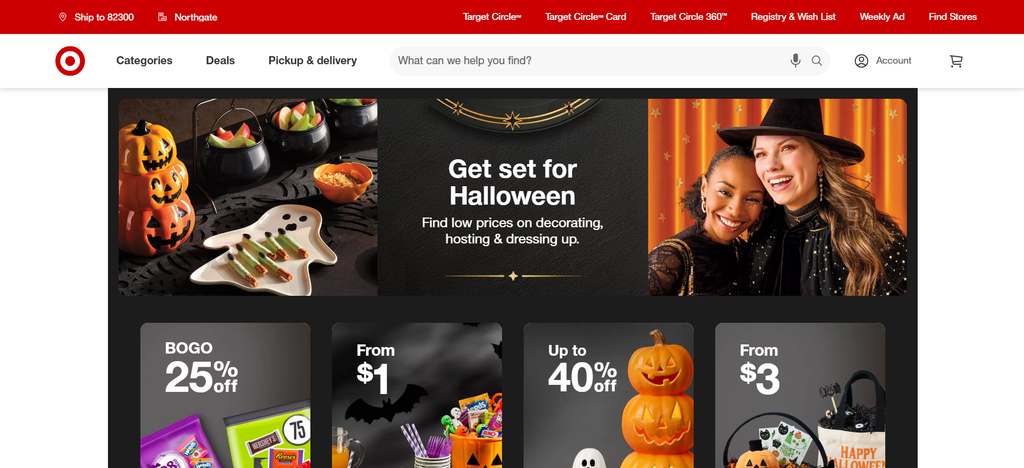
Image Courtesy:Target (Official Website)

  • Founded: 1902 (first Target store opened in 1962) 
  • Owner: Publicly listed; led by CEO Michael Fiddelke 
  • Headquarters: Minneapolis, Minnesota

Target‘s roots go back to the Goodfellow Dry Goods store in Minneapolis in 1902, and the first Target discount store opened in 1962. It built its brand on affordable, stylish products and exclusive house labels.

Target is a top-three US importer, with an estimated 420,000 TEUs in 2024, bringing in apparel, home furnishings, electronics, and packaged goods. Michael Fiddelke, a 20-year Target veteran, became CEO on February 1, 2026, succeeding Brian Cornell, who moved to executive chair.

What Target does: Runs general merchandise stores and an online shopping business

Services: Apparel, home goods, beauty, groceries, electronics, and same-day delivery

LG Electronics USA – Appliances and Screens from Asia

Image Courtesy: LG Electronics USA (Official Website)

  • Founded: 1958 (parent company, LG Electronics) 
  • Owner: US subsidiary of South Korea’s LG Electronics; led by President & CEO Don Kwack 
  • Headquarters: Englewood Cliffs, New Jersey

LG Electronics USA is the North American arm of the South Korean electronics giant. It sells TVs, refrigerators, washers, air conditioners, and commercial displays to American households and businesses.

Unlike most companies on this list, LG is a manufacturer rather than a retailer, but it ships so many finished products into US ports that it ranked fourth among importers in 2024, at roughly 309,000 TEUs. Don Kwack was named President and CEO of LG Electronics North America in January 2026.

What LG Electronics USA does: Imports and sells consumer electronics, home appliances, and air solutions

Services: TVs, refrigerators, washing machines, air conditioning systems, and commercial displays

Lowe’s – The Second Giant of Home Improvement

Image Courtesy: Lowe’s (Official Website)

  • Founded: 1921 
  • Owner: Publicly listed; led by Chairman & CEO Marvin Ellison 
  • Headquarters: Mooresville, North Carolina

Lowe‘s began in 1921 as a small hardware store in North Wilkesboro, North Carolina, and grew into the second-largest home improvement chain in the country, with more than 1,750 stores.

The company imports large amounts of tools, appliances, lighting, flooring, and seasonal products, ranking fifth among US importers with about 254,000 TEUs in 2024. Marvin Ellison has led Lowe’s as CEO since 2018 and as chairman since 2021.

What Lowe’s does: Sells home improvement products and services to homeowners and professionals

Services: Appliances, tools, building supplies, paint, and installation services

Amazon – E-Commerce Built on Global Supply Chains

Image Courtesy: Amazon (Official Website)

  • Founded: 1994 
  • Owner: Founded by Jeff Bezos; publicly listed, led by President & CEO Andy Jassy 
  • Headquarters: Seattle, Washington

Jeff Bezos started Amazon in 1994 as an online bookstore. It has since become the largest online retailer in the world, with major cloud computing and advertising businesses.

Amazon ranked sixth among US importers in 2024, at around 250,000 TEUs. That is lower than some store-based rivals because a large share of its sales come from third-party sellers who handle their own shipments. Andy Jassy has been CEO since 2021.

What Amazon does: Runs online marketplaces, cloud computing, streaming, and logistics

Services: Online retail, Prime membership, Amazon Web Services, and fulfillment services

Ashley Furniture – A Family Business Importing Home Furnishings

Image Courtesy: Ashley Furniture (Official Website)

  • Founded: 1945 
  • Owner: Privately held, owned by the Wanek family; led by President & CEO Todd Wanek 
  • Headquarters: Arcadia, Wisconsin

Ashley took its current form in 1982, when Arcadia Furniture and Ashley Furniture merged into one company. Ron Wanek built it into the world’s largest furniture manufacturer, and his son Todd Wanek has been CEO since 2002.

Even though Ashley runs factories in the United States, it has imported furniture from Asia since the 1980s. It placed seventh among US importers in 2024, with about 207,000 TEUs, and it sells through hundreds of Ashley HomeStore locations.

What Ashley Furniture does: Designs, makes, imports, and sells furniture and home furnishings

Services: Living room, bedroom, and dining furniture, mattresses, and outdoor furniture

Samsung Electronics America – Smartphones and Screens Across the Ocean

Image Courtesy: Samsung Electronics America (Official Website)

  • Founded: 1977 
  • Owner: US subsidiary of South Korea’s Samsung Electronics; North America led by President & CEO Yoonie Joung 
  • Headquarters: Bergen County, New Jersey

Samsung Electronics America was established in 1977 as the US sales arm of the Korean electronics maker. It sells smartphones, TVs, home appliances, and other devices across the country. Samsung is consistently among the largest container importers on the East Coast. 

Most of its products are made in Asia and shipped to American ports before reaching retailers and customers. The company has been moving its headquarters from Ridgefield Park to Englewood Cliffs.

What Samsung Electronics America does: Imports and markets consumer electronics, mobile devices, and appliances

Services: Smartphones, TVs, refrigerators, washers, and smart home products

Dollar Tree – Low Prices, Global Sourcing

Image Courtesy: Dollar Tree (Official Website)

  • Founded: 1986 
  • Owner: Publicly listed; led by CEO Mike Creedon 
  • Headquarters: Chesapeake, Virginia

Dollar Tree started in 1986 as a single-price variety store concept. It now operates more than 9,000 stores across the United States and Canada after selling its Family Dollar business in 2025.

The chain depends on imported merchandise to keep prices low, including party supplies, seasonal items, toys, and household goods. Mike Creedon became interim CEO in November 2024 and was named permanent CEO the following month.

What Dollar Tree does: Runs discount variety stores

Services: Household goods, snacks, seasonal items, party supplies, and cleaning products

Costco – Warehouse Club with a Global Supply Chain

Image Courtesy: Costco (Official Website)

  • Founded: 1983 
  • Owner: Founded by Jim Sinegal and Jeffrey Brotman; publicly listed, led by CEO Ron Vachris 
  • Headquarters: Issaquah, Washington

The first Costco warehouse opened in Seattle in 1983. It sells bulk goods to paying members and has grown into one of the largest retailers in the world, including its Kirkland Signature private label.

Costco imports a wide range of household goods, electronics, apparel, and packaged foods from suppliers around the world. Its high-volume, limited-selection model means it moves large quantities of each product through US ports. Ron Vachris became CEO in 2024.

What Costco does: Operates membership-based warehouse clubs. 

Services: Groceries, electronics, household goods, gas, travel, and pharmacy.

Frequently Asked Questions (FAQs)

Which company is considered the largest importer in the United States? 

Walmart is usually ranked first, thanks to the huge volume of goods it brings in for its stores and online business. The US government does not publish an official ranking of companies, so lists vary by source.

How much does the United States import every year? 

In 2025, US imports of goods reached about $3.4 trillion, the highest on record. Including services, total imports came to roughly $4.3 trillion.

What are the biggest import categories for the United States? 

Capital goods such as computers and telecom equipment, consumer goods, vehicles, and industrial supplies make up the largest share of US goods imports.

Which countries send the most goods to the United States? 

Mexico, China, and Canada are among the biggest sources. In 2025, the trade deficit with Mexico, Vietnam, and Taiwan each hit a record, while US imports from China fell by about 30 percent.

What does TEU mean? 

TEU stands for twenty-foot equivalent unit, the standard measure of shipping container volume. A standard 40-foot container counts as two TEUs.

Which importer on this list is privately owned? 

Ashley Furniture is privately held and owned by the Wanek family.

Are LG and Samsung American companies? 

Their US operations are subsidiaries of South Korean parent companies, but they are based in the United States and count among the country’s largest importers.

Who is the CEO of Walmart now? 

John Furner became Walmart’s President and CEO on February 1, 2026, succeeding Doug McMillon.

How have tariffs affected US importers? 

Tariffs introduced in 2025 pushed many companies to stockpile goods early and shift sourcing toward countries with lower tariff rates, such as Vietnam, Mexico, and Taiwan.

Why do these ten companies matter to everyday people? 

They stock the shelves and online stores where millions of Americans buy clothing, furniture, electronics, tools, and groceries, and they employ hundreds of thousands of workers.

Conclusion

America’s import economy is as varied as its consumer market. Megastores like Walmart, Target, and Costco bring the daily necessities, while Home Depot and Lowe’s have building supplies. Amazon has an online section, Ashley Furniture delivers furniture to homes, Dollar Tree helps to save money and LG and Samsung provide electronics and home appliances made in Asia.

With record-breaking imports in 2025 and a changing tariff policy, these ten companies will continue to affect the US consumer market and inform which products and from where should be imported to meet the needs of American consumers.

Ryan Reynolds Net Worth: Movie Earnings, Businesses, Investments & Lifestyle

Ryan Reynolds Net Worth

Ryan Reynolds is one of Hollywood’s biggest stars, but most of his fortune did not come from acting. It came from two deals. In 2020, Diageo agreed to buy Aviation Gin in a deal worth up to $610 million. In 2023, T-Mobile announced it would buy Mint Mobile for $1.35 billion, and Reynolds was a part-owner of both brands.

So what is he worth right now? Celebrity Net Worth, usually the most trusted tracker for public figures, puts his net worth at $350 million, and most credible 2026 sources repeat that figure. Lower estimates of $150 million to $200 million still float around online, but they come from low-quality sites and pages written before the Mint Mobile sale.

In this article, we’ll discuss Ryan Reynolds net worth, movie earnings, businesses, investments & lifestyle.

Quick Profile Overview

DetailInformation
Full NameRyan Rodney Reynolds
Date of BirthOctober 23, 1976
Age49 years old (turns 50 on October 23, 2026)
BirthplaceVancouver, British Columbia, Canada
EducationKitsilano Secondary School, Vancouver
OccupationActor, producer, entrepreneur
Early CareerCanadian teen series “Hillside” in the 1990s
Breakout Roles“Two Guys and a Girl,” “Van Wilder,” “The Proposal”
Signature RoleWade Wilson / Deadpool
Production CompanyMaximum Effort, co-founded with George Dewey
Business VenturesAviation Gin (sold to Diageo), Mint Mobile (sold to T-Mobile), Wrexham AFC (co-owner)
SpouseBlake Lively (married 2012); four children
Net Worth (Celebrity Net Worth)$350 million
Net Worth (Lower-Quality Sites)Anywhere from $150 million to $413 million

Who Is Ryan Reynolds?

Image Source: Pixabay

Ryan Reynolds was born on October 23, 1976, in Vancouver, British Columbia, the youngest of four brothers. He attended Kitsilano Secondary School and began acting as a teenager, starring in the Canadian series “Hillside” before moving into American television with “Two Guys and a Girl” in the late 1990s.

Film success came more slowly. Early roles in “Van Wilder” and “Blade: Trinity” gave him a name, and “The Proposal” (2009) made him a leading man, but a run of misses followed, including “Green Lantern.” His career turned around when he fought for years to get a proper “Deadpool” movie made, and its 2016 release made him a global star. Since then he has built a second career as a businessman, using his humor and social media presence to market the companies he owns.

Ryan Reynolds’ Net Worth

Image Source: Pixabay

Here is the clear picture: most credible sources, including Celebrity Net Worth, put his net worth at about $350 million. Celebrity Net Worth notes that the vast majority of that comes from his business deals, mainly Aviation Gin and Mint Mobile, rather than from his film salaries.

Comparing the Estimates

SourceEstimated Net WorthNotes
Celebrity Net Worth$350 millionThe most consistently cited figure; says most of it comes from the Aviation and Mint deals
Investormint (2026)About $350 millionNotes that his exact ownership percentages, taxes, and debts are not public
Social Life Magazine (2026)About $350 millionSays the figure blends film fees, Aviation, Wrexham, real estate, and Mint proceeds
Aggregator and template sites$150 million to $413 millionWorth flagging: these sit on unrelated domains, contradict themselves (some give two different numbers on the same page), and often predate the Mint sale

The lower figures are not a real disagreement, just old or unreliable snapshots. One note of honesty: even $350 million rests on assumptions. Celebrity Net Worth presumes he owned about 20% of Aviation Gin and about 25% of Mint Mobile, but neither stake was ever officially confirmed.

Movie Earnings

Acting is where his fame comes from, but it is the smaller part of his wealth.

  • “Deadpool” (2016): He reportedly took a low base salary of about $2 million in exchange for a share of the profits, which grew his total pay on the film several times over. The film grossed around $780 million worldwide.
  • “Deadpool 2” (2018): Celebrity Net Worth says his pay was enhanced to at least $30 million. The film grossed around $785 million.
  • “Deadpool & Wolverine” (2024): He was reportedly paid $20 million or more, plus backend. Exact figures are not public.
  • Other hits: “Detective Pikachu” grossed around $433 million, and he also led “Free Guy” and “The Adam Project,” both produced through his own Maximum Effort company.

Boardroom estimates that the films he has led, even counting only a handful, add up to nearly $3 billion at the box office. Reynolds’ salary is only a small slice of that, but his profit-sharing deals and producer credits make film income meaningful.

Businesses

Image Source: Pixabay

His biggest paydays came from putting his face on brands he owned a piece of.

  • Aviation Gin: In February 2018, he bought an unspecified minority stake in Aviation American Gin. In August 2020, Diageo agreed to acquire it in a deal that could reach $610 million, reportedly $335 million upfront and $275 million in future earnouts. Celebrity Net Worth presumes he owned about 20%. He did not start the brand, but his marketing, built through his own Maximum Effort company, is widely credited with helping it grow.
  • Mint Mobile: In late 2019, he bought a stake in the budget wireless carrier and starred in its ads. In March 2023, T-Mobile announced it would buy Mint’s parent company for $1.35 billion, made up of about $526 million in cash and $823 million in stock. The deal closed on May 1, 2024. Celebrity Net Worth believes he owned about 25% and presumably received around $205 million in T-Mobile stock. Because part of his payout was in stock, its value moves with T-Mobile’s share price.
  • Maximum Effort: He co-founded this production and marketing company in 2018 with George Dewey. It produced films like “Free Guy” and the series “Welcome to Wrexham.” Its marketing division was acquired by MNTN in June 2021.

Investments

  • Wrexham AFC: In late 2020, he and Rob McElhenney bought the Welsh soccer club, then in the fifth tier, for a reported £2 million. The club won three promotions in a row, and the documentary “Welcome to Wrexham” turned it into a global brand. The club lost money in its early years, with Reynolds joking about feeling sick when he heard the loss figure, so its financial value is still hard to pin down.
  • Alpine F1 Team: A group including his Maximum Effort Investments reportedly bought a 24% stake in the Formula 1 team for about €200 million combined, though his personal share is not public.

Lifestyle & Real Estate

Image Source: Pixabay

Reynolds lives in the United States with his wife, actress Blake Lively, whom he married in 2012, and their four children. Celebrity Net Worth estimates her net worth at $30 million, putting the couple’s combined estimated worth at about $380 million. 

Reported properties include a New York home bought for around $2.35 million, another New York property valued at about $5.7 million, and a Hollywood Hills home reportedly worth about $2.8 million, though these figures are older and may not reflect his current holdings.

Beyond that, his public image is built on humor and hustle rather than luxury. He is better known for viral ads, social media jokes, and a soccer club in Wales than for lavish spending, and there is little confirmed information about cars, jets, or other big purchases, so it is best not to guess.

Frequently Asked Questions (FAQs)

1. What is Ryan Reynolds’ net worth?

Celebrity Net Worth and other published estimates place Ryan Reynolds’ net worth at approximately $350 million in 2026. This figure is an estimate rather than a verified statement of his personal finances.

2. How did Ryan Reynolds make most of his money?

Ryan Reynolds built much of his wealth through business ventures, investments, and acting. The sales of Aviation Gin and Mint Mobile contributed significantly to his reported fortune.

3. How much was Aviation Gin sold for?

Diageo agreed to acquire Aviation Gin in 2020 in a deal valued at up to $610 million. Reports described an upfront payment of approximately $335 million, with additional earnout payments potentially reaching $275 million.

4. How much was Mint Mobile sold for?

T-Mobile agreed to acquire Mint Mobile’s parent company in a deal valued at $1.35 billion. The announced consideration included cash and stock, and the acquisition was completed in May 2024.

5. How much did Ryan Reynolds earn from Deadpool?

Ryan Reynolds reportedly earned millions of dollars for his Deadpool roles, with compensation varying by film and contract. Reported figures include an upfront salary for the original film, additional profit participation, and substantial compensation for later installments. Exact earnings have not been fully verified publicly.

6. How old is Ryan Reynolds?

Ryan Reynolds was born on October 23, 1976. He is 49 years old as of October 2026.

7. Does Ryan Reynolds still own Mint Mobile?

No, T-Mobile acquired Mint Mobile’s parent company in 2024. Reynolds, who had been a part-owner and spokesperson for the wireless brand, was expected to receive part of the deal’s consideration in T-Mobile stock.

8. Who owns Wrexham AFC?

Ryan Reynolds and Rob McElhenney are the co-owners of Wrexham AFC. They acquired the Welsh football club in 2020 and helped raise its international profile through sporting success and the documentary series Welcome to Wrexham.

9. Is Ryan Reynolds a billionaire?

No verified information establishes Ryan Reynolds as a billionaire. Published estimates generally place his net worth below $1 billion, although his business interests and investments may fluctuate in value.

10. Who is richer, Ryan Reynolds or Blake Lively?

Published celebrity wealth estimates generally place Ryan Reynolds’ net worth above Blake Lively’s. However, these figures are estimates, and neither person’s complete financial position is publicly known.

Conclusion

Ryan Reynolds’ net worth is a fascinating story that began with him converting his marketable skills as an actor into monetary gains. From there, he invested heavily in brands that he would later buy to add to his vast portfolio. Ryan Reynolds has an estimated net worth of $350 million, with his stake in Aviation Gin, Mint Mobile, and a thriving Hollywood career catapulting him to the top of the charts.

The actor has been working tirelessly to build his next chapter while also investing in Wrexham and several other enterprises. Part of his earnings from T-Mobile will go into funding a soccer club, which has left many wondering how much Reynolds is worth. However, $350 million seems like the most accurate estimate at the moment.
Sodium-Ion, Vanadium, Zinc and Iron-Based Batteries Poised to Halve India’s Storage Imports by 2035: NETRA Survey

Sodium-ion, vanadium, zinc and iron-based battery technologies for India’s energy storage future

New Delhi, 14 October 2026: India’s battery energy storage sector is undergoing significant transformation, with nearly 90% of current storage and lithium-ion battery requirements still met through imports, according to recent industry analysis. However, a recent survey by NetZero Energy Transition Association (NETRA), a global platform for driving the energy transition by enabling new and advanced technologies, reveals that rapid adoption of vanadium redox flow, sodium-ion, zinc-based, and iron-based batteries and indigenous manufacturing could enable India to reduce its battery storage import dependence to just 50–52% by 2035.

The survey was conducted amongst various industry leaders, representatives from utilities, battery manufacturers, project developers, researchers, and manufacturers across Delhi, Mumbai, Bengaluru, Chennai, and Hyderabad. This survey report will be officially revealed at the BEYOND LITHIUM SUMMIT 2026, to be held on 24th October 2026 in New Delhi. This first-of-its-kind platform in India is dedicated to battery technologies beyond lithium-ion, where over 100 companies and research organisations will gather to map the future of India’s multi-chemistry storage ecosystem and showcase the latest advances in non-lithium energy storage technologies. 

Industry estimates suggest that the compound annual growth rate (CAGR) for India’s Battery Energy Storage System (BESS) sector is a remarkable 91% between FY26 and FY32E. Cumulative capacity is set to rise from 6.3 GWh to 302 GWh in that period, driven by ambitious renewable integration and round-the-clock power needs. Yet, 89-91% of battery storage systems and lithium-ion batteries are currently sourced from abroad, exposing India to global supply shocks and price volatility. In the past year alone, lithium battery prices fluctuated by more than 25% in India, influenced by raw material constraints, currency swings, and international market pressures.

61% of respondents believe that scaling up domestic innovation and manufacturing of vanadium redox flow, sodium-ion, zinc-based, and iron-based batteries can significantly reduce India’s reliance on imported solutions. Over half (54%) expect that, with commercial-scale deployment and targeted investment, India’s storage import share could fall to 50–52% by 2032.

The shift is already underway. Leading Indian research institutions, including ARCI, IMMT, NCL, and IIT Bombay, are advancing indigenous sodium-ion cell technology, while companies such as Rechargion, HPCL, Oden Energy, Macsen Energy, and Uneverse are developing cell and pack solutions tailored to grid and industrial applications. Globally, sodium-ion cell manufacturing capacity has crossed 10 GWh this year, with further expansion planned. On the vanadium flow front, companies like VFT (formerly Vflowtech) and Delectrik Systems are installing vanadium redox flow battery (VRFB) systems both in India and internationally, targeting long-duration storage and grid flexibility.

Dr. Rahul Walawalkar, President of NETRA, said, “India’s energy security will depend not only on how much storage we deploy, but on the diversity and indigenisation of the technologies behind it. Vanadium, sodium-ion, zinc-based, and iron-based batteries can complement lithium-ion systems across different use cases, durations, and geographies. Building strong domestic capabilities across these chemistries is essential to reduce import dependence and enhance grid resilience.”

Zinc and iron-based alternatives are also gaining traction. “Zinc-based batteries offer India a strategic opportunity to achieve energy security through indigenous manufacturing and by eliminating dependence on imported lithium,” said Dr Saroj Sahu, CEO & Co-Founder, Golden Gate Battery, Inc. “Advanced zinc-bromine technology can deliver safe, affordable, long-duration energy storage while positioning India as a global leader in next-generation battery manufacturing.”

NETRA’s findings align with government and industry calls for a technology-agnostic approach to energy storage. As India’s battery storage market accelerates, the focus is shifting to homegrown innovation and manufacturing. NETRA will showcase the latest advances in non-lithium storage technologies, including vanadium redox flow, sodium-ion, zinc-based, and iron-based batteries, at the upcoming BEYOND LITHIUM SUMMIT to map the future of India’s multi-chemistry storage ecosystem.

India wholesale price index inflation rose to 11.39% in September from 9.92% in August

India WPI inflation rises to 11.39% in September from 9.92% in August

The Indian wholesale price index, based on the rate of inflation, increased to 11.39% on a yearly basis in September 2026, from 9.92% seen in August, and continued to be in double digits, the Ministry of Commerce and Industry figures show. The All India Wholesale Price Index of all items stood at 112.5 in September, rising from 110.8 in August as wholesale prices increased in many important industries in the country’s economy.

Sectoral breakdown and significant increase

The official release highlights a broad-based upward trend: mineral oils, food articles, crude petroleum and natural gas, coal and lignite, basic metals, chemicals and chemical products, textiles, rubber and plastic products, and electrical equipment were among those items that contributed. These collections are all price increases broadly, because of a general rise in prices for raw materials, energy inputs, and manufactured goods.

In fuel and power, inflation accelerated to 25.85% in September, up from 22.93% in August, making it the highest of all the division groups tracked by the ministry. The fuel and power category index increased to 110.5 from 108.3 in the same period. This substantial rise highlights the strong positive pressure that energy prices put on general price movements in the wholesale market.

The inflation rate of manufactured items went up to 9.76% in September, from 8.37% in August, while the corresponding index was at 110.2 in September, from 108.8 in August. The primary articles index rose to 8.67% in September from 7.76% in August, with the corresponding index rising to 120.3 from 118.1.

The wholesale price index for food, which forms 24.99% of the total index, rose to 8.66% on a yearly basis in September, from 7.05% in August, as per the government statement. It is noteworthy here that the food index consists of the food articles in the primary articles and manufacture of food products items in manufactured products.

Previous data review and price index

For the previous month’s data, the ministry said that the final wholesale price index for July 2026 was still 110.0, the same as the provisional. The final wholesale price index inflation rate for July is 9.78%.

This final index of July was compiled with a weighted response rate of 98.97% for the base year 2022-23, while the provisional index of September was prepared with a weighted response rate of 83.4%.

In the meantime, the All India Output Producer Price Index for all commodities was 112.5 in September as compared to 110.8 in August. Among individual sectors, the output producer price index for mining and quarrying went up to 129.2 in September from 122.0 in August. 

Agriculture, forestry and fishing went up to 118.7 from 116.5, while manufactured products went up to 111.0 from 109.7. The electricity index went up to 92.0 in September from 90.9 in August, while the final output index for July 2026 was still 109.9 as compared to its provisional.

Conclusion

The data released by the Ministry of Commerce and Industry shows that the inflation rate in India’s wholesale price index has been increasing on an upward trend until September, rising from 9.92% to 11.39%. Inflation was fueled by fuel and electricity, and other factors, including a rise in manufactured goods, primary articles, and the food index. This is seen as a result of the changes occurring in the economy, which have been captured in the wholesale and producer price indexes.

RocketPay secured ₹10 crore in a fresh funding round led by Sandeep Jain and Group

RocketPay raises ₹10 crore in a funding round led by Sandeep Jain and Group

RocketPay is a lender-focused digital collections infrastructure platform. RocketPay has successfully raised ₹10 crore in a fresh funding round. The round was led by Sandeep Jain and Group. The fresh capital infusion is a major milestone in the firm’s expansion plans, as it strives for increased technological infrastructure, geographical reach, and market share in the expanding financial technology landscape in India. The capital infusion will support the company’s future expansion and strengthen its service focus in the lending market.

Business model and capital utilization

Several well-known institutional investors and venture networks participated in the funding round, including IPV, LetsVenture, Launch Capital, AVNM Ventures, and Navyug Global Ventures. Existing investor All In Capital continued to support the round. 

It reflects their continued trust in RocketPay’s business and market models. The platform’s diverse set of investors provides significant support to its current positioning in the competitive digital infrastructure market.

RocketPay aims to continue its strategic growth from digital collections to all-encompassing loan recovery infrastructure for lenders with the additional capital raised. One significant area within this growth is the recovery of financed devices through technology. 

Established in 2022 by Rishav Dokania, Arpit Bajpai, Ishan Sharma, and Kishor Chabbadiya, the business presently assists lenders in automating collections using digital financial instruments like Account Aggregator, NACH, and UPI Autopay. The platform offers targeted services, such as distance locking and unlocking of financed Android devices.

Ambitious financial targets and planned expansion

Since its inception, it has shown remarkable financial and operational expansion. RocketPay states that its revenue grew by 10 times between 2024 and 2026. The firm has ambitious financial goals of achieving a revenue run rate of ₹100 crore annually by FY 28. Its robust technology platform is currently being used by lenders holding loans worth between ₹300 crore and ₹16,000 crore.

One of the key aspects of RocketPay’s market positioning is the strategic relationship it has built with industry partners. The brand is Trusticor’s authorized APAC distributor and has direct access to Trusticor’s exclusive Device Lock Controller technology. This collaboration provides efficient device-locking features and options specifically designed for different financing schemes. This feature will serve well with forthcoming financial regulatory modifications.

The planned growth by RocketPay follows the Reserve Bank of India’s directions on device locking as a collateral enforcement mechanism with a view to mobile loans. This new regulatory regime will come into effect officially on January 1, 2027. The company reported that equated monthly instalments (EMI) market shipments are valued at over 85 million units per year in India and are projected to grow at a CAGR of 10% to 12% in 2026 to 2030.

Conclusion

As a result of the successful capital raise led by Sandeep Jain and Group, RocketPay is well placed for the next stage of its growth in the Indian fintech and lending infrastructure landscape. The company will be able to address the coming regulatory changes made by the Reserve Bank of India with its combination of automated collection tools and cutting-edge device-locking technology, which was enabled through its collaboration with Trustonic. RocketPay is positioned for further growth and development, driven by its historical revenue stream and clear strategic goals, ensuring that it remains a solid platform for lenders and efficient asset recovery of loans.

The Kid LAROI Net Worth: Music Earnings, Tours, Endorsements & Lifestyle

The Kid LAROI Net Worth

The Kid LAROI’s biggest career breakthrough came in 2021, when “Stay,” his song with Justin Bieber, climbed to the top of the US Billboard Hot 100. He had already gained attention with “Without You,” but the success of “Stay” brought his music to a much wider audience.

Since then, his career has extended beyond recording songs. He has performed for international audiences, worked with major brands and reportedly bought a $5.5 million home in Los Angeles. Celebrity Net Worth estimates his fortune at $8 million, though there is no public record confirming the exact amount.

The Kid LAROI Net Worth at a Glance

DetailInformation
Real nameCharlton Kenneth Jeffrey Howard
Stage nameThe Kid LAROI
ProfessionRapper, singer and songwriter
Estimated net worth$8 million
Popular songs“Stay” and “Without You”
Record label connectionsColumbia Records and Grade A Productions
Reported property purchase$5.5 million, Encino, California

Music Earnings and Career Success

Image Source: Pixabay

The Kid LAROI had already started making a name for himself before “Stay” became a hit. His friendship and musical connection with Juice WRLD helped bring attention to his early work. In 2020, he released Fck Love*, a mixtape that introduced more listeners to his music.

“Without You” became another important release, but “Stay,” recorded with Justin Bieber, took his career to a different level. The song reached No. 1 on the Billboard Hot 100 in the US and became a major international hit.

Songs like these can earn money for years through streaming, sales and songwriting royalties. How much The Kid LAROI receives depends on his contracts and the rights he holds. His actual earnings from these hits have not been made public.

Streaming and YouTube Revenue

Image Source: Pixabay

People still listen to “Stay” and “Without You” years after their release. Some hear them on Spotify, while others find them through YouTube videos or music playlists. That continued interest can bring in royalties.

YouTube can also pay through advertising on music videos. However, the money doesn’t all go to the artist. Record labels, publishers and other rights holders may receive a share, depending on their agreements.

There are no confirmed figures showing how much The Kid LAROI earns from Spotify or YouTube. His popular songs give him opportunities to earn from his music catalogue, but his personal income from these platforms remains private.

Concerts, Tours and Live Shows

Image Source: Pixabay

The Kid LAROI also has opportunities to earn through concerts and music festivals. With songs known by listeners around the world, he can perform for audiences far beyond his home country of Australia.

Touring can bring in a lot of money, but putting on a show is expensive. Flights, hotels, stage equipment, crew salaries and other costs all add up. The amount an artist keeps depends on the performance fee and the expenses involved.

The Kid LAROI’s total earnings from live shows haven’t been publicly reported. Without details of his fees and touring costs, there’s no reliable way to calculate his profit from concerts.

Brand Partnerships With McDonald’s and JBL

In May 2022, McDonald’s Australia launched a meal associated with The Kid LAROI. The promotion gave fans a chance to connect with the singer outside his music and brought his name into the company’s marketing.

He has also been associated with JBL, a brand that sells headphones, speakers and other audio equipment. The partnership has been mentioned in Market Realist’s report on his net worth.
Neither company has revealed how much it paid him. These deals show that brands have an interest in working with him, but the money he made from them remains unknown.

The Kid LAROI’s $5.5 Million Los Angeles Home

In 2023, The Kid LAROI reportedly bought a house in Encino, Los Angeles, for $5.5 million. The property has around 6,100 square feet of living space, five bedrooms and six bathrooms.

The purchase came just a few years after his music career began reaching a global audience. For a young artist, spending millions on a home was a major purchase. Los Angeles is also a practical place to live for someone working in music, with recording studios and industry professionals based throughout the city.

The $5.5 million figure is the reported price he paid for the house. It doesn’t tell us what the property is worth now or how much he owns outright if he financed the purchase.

The Kid LAROI’s Lifestyle and Spending

Image Source: Pixabay

His Los Angeles home is one of the biggest purchases linked to his name in public reports. There is far less information about what he does with the rest of his money.

He shares parts of his life through public appearances and social media, but that doesn’t show his bank balance or how much he spends. Details about his savings, investments and other assets have not been made public.

Celebrity Net Worth estimates his fortune at $8 million. His actual financial position could be different, as the estimate hasn’t been confirmed by him or through public financial records.

Frequently Asked Questions

What is The Kid LAROI’s net worth?

Celebrity Net Worth estimates his net worth at $8 million. His exact wealth has not been publicly disclosed.

Which song made The Kid LAROI famous?

“Without You” helped him reach a wider audience, while “Stay,” his collaboration with Justin Bieber, became a global hit in 2021.

How does The Kid LAROI earn money?

He earns money through his music career, including streaming royalties and live performances. Brand partnerships also provide another potential source of income.

Did The Kid LAROI buy a house in Los Angeles?

Yes. Reports from 2023 put his Encino property purchase at around $5.5 million. The house reportedly has five bedrooms and covers approximately 6,100 square feet.

Which brands has The Kid LAROI worked with?

His reported brand associations include McDonald’s Australia and JBL. Neither partnership has publicly disclosed his payment.

Is The Kid LAROI’s net worth definitely $8 million?

No. The figure comes from Celebrity Net Worth and has not been independently confirmed through public financial records.

The Stack raises ₹21.5 crore to build India’s most trusted supplements brand

The Stack raises ₹21.5 crore to build a supplements brand in India

14th Oct 2026: The Stack, a supplements brand focused on clinically studied ingredients and transparent formulations, has raised ₹21.5 crore in its latest funding round. The round was co-led by Sauce, OTP Ventures and Huddle Ventures.

“The supplements landscape in India is exploding with many brands and an overload of information for consumers. Given this landscape, Stack’s promise of minimal ingredients, gold standard quality and complete transparency is what attracts us as a consumer and investor.” said Manu Chandra, founder at Sauce.

The Stack raised its first institutional round of ₹5.5 crore in January, 2026 and has grown 5x in 6 months. It’s targeting to close FY26-27 at 6-7X growth of FY 25-26.

The Stack sells just five products as of today. One in three customers places a second order within six months, and many now pay for six to twelve months upfront through subscriptions. The top 10% of customers drive 30% of revenue. They see a strong inflow of new customers come through referrals and word of mouth.

“A lot of building The Stack has been saying no. No to launching fifty products, no to trending ingredients we don’t believe in, no to upselling people things they don’t need. We’d rather have five products people keep coming back to than fifty they try once. We’re playing a long game, and our customers are rewarding that patience,” said Kshitij Rihal, Co-founder of The Stack.

“Many brands solve for distribution before getting the product right. Having backed Kshitij and Shreya since their earliest days, we’ve witnessed them do it the right way, staying true to their standards on formulation and efficacy, and their industry leading repeat rates prove it. With that foundation, we’re excited to double down as they expand across channels and make The Stack the go-to choice for India’s evolved supplements consumer.” said Ishaan Khosla, Partner at Huddle Ventures.”

The company will use the funds to grow its team, invest in research and development, and expand its product portfolio.

“Clean label and traceable sourcing have transformed how India eats, and supplements are next. The Stack is leading that shift with world-class formulations, globally sourced raw materials and complete transparency. As a user myself, I am thrilled to back Kshitij and Shreya, as they build the most trusted brand in the category” added Samina Hamied, Founder & Managing Partner, AYRA Ventures, who participated in the round.

Over the next three years, The Stack wants to become India’s most trusted supplements brand.

“We want The Stack to be synonymous with trust and transparency. When we launch a product, we want people to already know we’ve done the homework on the ingredients, the dosage and the sourcing, and that we’re not trying to upsell them. That’s the bar,” added Shreya, Co-founder of The Stack.

“We believe the largest supplement brands of the next decade will be focused and use case led, not catalogues of everything. The Stack is the first in India built that way, and the category will increasingly be measured against them,” Suhail Sameer from OTP Ventures added

Top 10 Fastest Growing Companies in USA

Top 10 Fastest Growing Companies in USA

Fast growth in business can come from very different places. Some companies are selling more AI chips and computer servers. Others are benefiting from travel demand, digital payments, online shopping or demand for industrial equipment.

Fortune’s 2025 list of the 100 Fastest-Growing Companies includes businesses from all these sectors. NVIDIA takes the first position, followed by Royal Caribbean Group and Super Micro Computer. Digital finance company Nu Holdings, language-learning platform Duolingo and e-commerce business MercadoLibre also make the top ten.

The list uses three measures to rank companies: revenue growth, earnings-per-share growth and stock returns over three years. It covers the period through June 2025. Companies must meet Fortune’s financial and stock-market eligibility requirements, so this is not a list of every fast-growing private business in the United States. Some companies on it are headquartered outside the country but trade on major U.S. stock exchanges.

This article looks at the ten companies in Fortune’s 2025 ranking, what each one does and the growth figures behind its position.

Quick Look at the Top 10 Fastest Growing Companies in USA

RankCompanyIndustryThree-Year Revenue Growth Rate
1NVIDIASemiconductors and AI computing80.8%
2Royal Caribbean GroupCruises and travel87.4%
3Super Micro ComputerServers and computer hardware69.2%
4Nu HoldingsDigital financial services52.5%
5DuolingoEducation technology43.5%
6Powell IndustriesElectrical equipment33.6%
7MercadoLibreE-commerce and fintech41.7%
8Vital FarmsFood and agriculture31.6%
9Uber TechnologiesRide-hailing and delivery28.3%
10Willis Lease FinanceAviation equipment leasing29.5%

Source: Fortune’s 2025 100 Fastest-Growing Companies ranking. Revenue growth rates are annualized figures for the three-year period used in the ranking.

1. NVIDIA

IndustrySemiconductors and computing
Rank1
Revenue for the latest four quarters in Fortune’s data$148.5 billion
Net Income$76.8 billion
Three-Year Revenue Growth Rate80.8%
Three-Year EPS Growth Rate144.8%

NVIDIA tops Fortune’s 2025 list as demand for AI computing continues to drive its business. The company makes graphics processing units (GPUs), data-centre systems and related software used to train and run artificial intelligence models.

Its chips are used by cloud providers, technology companies and businesses building AI infrastructure. NVIDIA also sells networking products and computing platforms that help connect large numbers of processors in data centres.

Fortune’s figures show just how quickly the company grew over the three-year period. Revenue reached about $148.5 billion across the four quarters used in the ranking, while net income came to about $76.8 billion. Its annualized revenue growth rate was 80.8%, and earnings per share grew at an annualized rate of 144.8%.

NVIDIA’s first-place position reflects more than rising sales. Its earnings growth and stock performance also contributed to the overall ranking.

Main Business Areas

  • GPUs and AI computing chips
  • Data-centre infrastructure
  • High-performance computing
  • Networking products
  • Software for AI and accelerated computing

2. Royal Caribbean Group

IndustryCruises and travel
Rank2
Revenue for the latest four quarters in Fortune’s data$16.8 billion
Net Income$3.25 billion
Three-Year Revenue Growth Rate87.4%
Three-Year EPS Growth Rate112.7%

Royal Caribbean Group operates cruise brands that take passengers to destinations around the world. Its business depends on ticket sales, onboard spending, travel demand and the cost of running its ships.

The company benefited from the recovery in cruise travel after the pandemic disrupted the industry. As more people returned to holidays at sea, cruise operators had opportunities to fill ships, increase bookings and generate more revenue from passengers.

Fortune recorded an annualized revenue growth rate of 87.4% for Royal Caribbean Group over the three-year measurement period. That was the highest revenue growth rate among the ten companies listed here. Its earnings-per-share growth rate reached 112.7%.

The figures help explain why a travel company ranked ahead of several technology businesses. The ranking measures growth across multiple financial indicators, not the popularity of a particular industry.

Main Business Areas

  • Cruise holidays
  • Passenger bookings
  • Onboard dining and entertainment
  • Shore excursions and destination experiences
  • Travel packages and related services

3. Super Micro Computer

IndustryComputer hardware and servers
Rank3
Revenue for the latest four quarters in Fortune’s data$21.6 billion
Net Income$1.15 billion
Three-Year Revenue Growth Rate69.2%
Three-Year EPS Growth Rate87.5%

Super Micro Computer, often called Supermicro, makes servers, storage systems and other hardware used in data centres. Its products support cloud computing, enterprise IT and workloads that require large amounts of processing power.

The growth of artificial intelligence has created demand for servers capable of handling intensive computing tasks. Supermicro supplies systems that use advanced processors and GPUs, allowing customers to build or expand their computing infrastructure.

Fortune’s data put the company’s revenue at approximately $21.6 billion for the four quarters used in the ranking. Its annualized revenue growth rate was 69.2%, with earnings per share growing at 87.5% over the three-year period.

Supermicro’s position shows how the expansion of AI affects more than chip designers. Companies that build the systems around those chips can also benefit as customers invest in data-centre capacity.

Main Business Areas

  • AI servers
  • Data-centre systems
  • Storage solutions
  • High-performance computing
  • Enterprise computing hardware

4. Nu Holdings

IndustryDigital financial services
Rank4
Revenue for the latest four quarters in Fortune’s data$12.0 billion
Net Income$2.15 billion
Three-Year Revenue Growth Rate52.5%
Three-Year EPS Growth Rate344.3%

Nu Holdings is the company behind Nubank, which offers banking services through its app. Customers can use the platform for payments, credit cards, accounts and other financial products.

The business has grown across Latin America, bringing more banking services online. Instead of visiting a bank branch, customers can handle many routine transactions on their phones.

In Fortune’s ranking, Nu Holdings recorded annualized revenue growth of 52.5% over three years. Its earnings per share grew at an annualized rate of 344.3% over the same period. The two figures show how its sales and earnings changed during the period measured.

Nu Holdings is based outside the United States but appears on the list because Fortune includes eligible foreign companies traded on major U.S. stock exchanges.

Main Business Areas

  • Digital banking
  • Credit cards and loans
  • Payment services
  • Savings and bank accounts
  • Mobile financial services

5. Duolingo

IndustryEducation technology
Rank5
Revenue for the latest four quarters in Fortune’s data$811 million
Net Income$97 million
Three-Year Revenue Growth Rate43.5%
Three-Year EPS Growth Rate259.1%

Duolingo is best known for its language-learning app, where users practise through short lessons and exercises. The company has also added subjects such as maths and music.

People can use the app for free or pay for a subscription with extra features. Advertising and other services also bring in revenue.

Fortune’s figures show annualized revenue growth of 43.5% over three years. Earnings per share grew at an annualized rate of 259.1% during the same period.

The app gives Duolingo access to learners in different countries without the need to run physical classrooms. Its subscription model also allows users who want more features to pay for them.

Main Business Areas

  • Language-learning app
  • Paid subscriptions
  • Digital education
  • Maths and music courses
  • Advertising and in-app services

6. Powell Industries

IndustryElectrical equipment and industrial systems
Rank6
Revenue for the latest four quarters in Fortune’s data$1.08 billion
Net Income$173 million
Three-Year Revenue Growth Rate33.6%
Three-Year EPS Growth Rate210.2%

Powell Industries makes electrical equipment used to distribute and control power in industrial facilities. Its customers include businesses in the energy sector, utilities and other industries that rely on large electrical systems.

Its products include switchgear and equipment that helps manage the flow of electricity across industrial sites. These systems are used in facilities where a reliable power supply is essential to daily operations.

Powell Industries recorded approximately $1.08 billion in revenue across the four quarters in Fortune’s data. Its annualized revenue growth rate was 33.6%, while earnings per share grew at 210.2%.

The difference between those two rates is worth noting. Revenue growth shows the change in sales, while earnings-per-share growth also reflects how much profit the company generates for each share. Both measures contributed to Powell’s position in the ranking.

Main Business Areas

  • Electrical distribution equipment
  • Switchgear and control systems
  • Industrial power systems
  • Energy-sector equipment
  • Electrical infrastructure for large facilities

7. MercadoLibre

IndustryE-commerce and financial technology
Rank7
Revenue for the latest four quarters in Fortune’s data$22.4 billion
Net Income$2.06 billion
Three-Year Revenue Growth Rate41.7%
Three-Year EPS Growth Rate141.9%

MercadoLibre operates an online marketplace and financial services platform across Latin America. Customers use its marketplace to buy and sell products, while businesses can reach shoppers through its e-commerce services.

Its financial technology business, Mercado Pago, provides payment and related financial services. The company also operates logistics services that help sellers deliver orders to customers.

These businesses work together. More marketplace activity can create demand for payments and delivery services, while the financial platform gives customers and merchants more ways to complete transactions.

Fortune’s figures put MercadoLibre’s revenue at around $22.4 billion, with net income of approximately $2.06 billion. Its three-year annualized revenue growth rate was 41.7%, and its earnings-per-share growth rate was 141.9%.

Like Nu Holdings, MercadoLibre is a Latin American business rather than a U.S.-headquartered company. It qualifies for the ranking under Fortune’s rules for eligible companies trading on major U.S. exchanges.

Main Business Areas

  • Online marketplace
  • Digital payments
  • Merchant financial services
  • E-commerce logistics
  • Online retail infrastructure

8. Vital Farms

IndustryFood production and agriculture
Rank8
Revenue for the latest four quarters in Fortune’s data$621 million
Net Income$51 million
Three-Year Revenue Growth Rate31.6%
Three-Year EPS Growth Rate242.5%

Vital Farms sells eggs and other food products, with a focus on pasture-raised farming and its network of family farms. Its products are sold through grocery retailers and other food channels.

The company works with independent farms that supply its products. It has built its brand around animal-welfare standards and traceability, giving consumers information about how its food is produced.

Vital Farms is smaller by revenue than most of the technology and travel businesses in the top ten. Fortune’s data show revenue of about $621 million and net income of $51 million for the four quarters used in the ranking.

Its annualized revenue growth rate was 31.6%. Earnings per share grew at an annualized rate of 242.5%, which helped lift the company’s overall position.

Main Business Areas

  • Pasture-raised eggs
  • Butter and other food products
  • Grocery retail distribution
  • Partnerships with family farms
  • Branded food production

9. Uber Technologies

IndustryRide-hailing and delivery
Rank9
Revenue for the latest four quarters in Fortune’s data$45.4 billion
Net Income$12.3 billion
Three-Year Revenue Growth Rate28.3%
Three-Year EPS Growth Rate445.8%

Uber connects riders with drivers through its app and also operates delivery services through Uber Eats. Its platform is used in markets around the world, giving the company several sources of revenue beyond passenger rides.

The business includes ride-hailing, food delivery and services for merchants. Uber also offers products for businesses and customers who need different transport or delivery options.

Fortune’s figures show revenue of approximately $45.4 billion and net income of $12.3 billion for the four quarters used in its ranking. Uber’s annualized revenue growth rate was 28.3%, while earnings per share grew at 445.8%.

The earnings growth rate is particularly notable. It shows why the list cannot be read as a simple ranking of which companies sell the most or grow revenue the fastest. Profitability and stock performance also affect the final result.

Main Business Areas

  • Ride-hailing
  • Food delivery through Uber Eats
  • Merchant delivery services
  • Business travel and transport
  • Mobility and logistics technology

10. Willis Lease Finance

IndustryAviation equipment leasing
Rank10
Revenue for the latest four quarters in Fortune’s data$608 million
Net Income$105 million
Three-Year Revenue Growth Rate29.5%
Three-Year EPS Growth Rate317%

Willis Lease Finance provides aircraft engines and other aviation equipment to airlines, aircraft operators and maintenance businesses. Leasing gives customers access to engines without requiring them to purchase every asset outright.

The company also buys and sells used engines and provides services connected with engine management. Airlines may lease engines to support their fleets, cover maintenance periods or meet changes in operational demand.

Willis Lease Finance reported about $608 million in revenue and $105 million in net income for the four quarters covered by Fortune’s figures. Its three-year annualized revenue growth rate was 29.5%, and its earnings-per-share growth rate was 317%.

The company operates in a more specialised market than the other businesses on this list. Its place in the top ten shows that strong growth can come from equipment leasing and aviation services, not only consumer apps or large technology companies.

Main Business Areas

  • Aircraft engine leasing
  • Aviation equipment
  • Engine sales and purchases
  • Engine management services
  • Support for airlines and aircraft operators

What Drives Growth Across These Companies?

The ten companies do not share one business model. Their results come from different markets, and the reasons behind their growth vary.

AI and Computing

NVIDIA and Super Micro Computer have benefited from demand for AI computing infrastructure. NVIDIA supplies processors and computing platforms, while Supermicro builds servers and systems that use advanced chips.

Travel and Consumer Services

Royal Caribbean Group has benefited from renewed demand for cruise holidays. Uber operates in everyday transport and delivery, where customers and businesses use its platform to arrange services.

Digital Finance and Online Commerce

Nu Holdings and MercadoLibre have expanded through digital platforms. Nu offers financial services through its app, while MercadoLibre combines online shopping with payments and logistics.

Education, Food and Industrial Equipment

Duolingo serves people learning through digital lessons. Vital Farms sells food products through retail channels, while Powell Industries supplies electrical equipment for industrial and energy operations. Willis Lease Finance serves airlines and other aviation customers.

These examples show why the phrase fastest-growing companies in USA covers such a wide range of businesses. A company can grow by selling more products, expanding into new markets, improving profits or benefiting from increased demand in its industry.

Frequently Asked Questions

Which company ranks first among the fastest-growing companies in the USA?

NVIDIA ranked first in Fortune’s 2025 100 Fastest-Growing Companies list. Fortune assessed revenue growth, earnings-per-share growth and stock returns over the three-year period used for that edition.

Which company had the highest revenue growth rate among these ten?

Royal Caribbean Group had the highest three-year annualized revenue growth rate among the ten companies, at 87.4%, followed by NVIDIA at 80.8%.

Why is NVIDIA considered a fast-growing company?

NVIDIA supplies GPUs, data-centre systems and related computing technology used in AI and high-performance computing. Fortune’s 2025 data recorded an annualized three-year revenue growth rate of 80.8%.

Are all ten companies headquartered in the United States?

No. Fortune’s ranking allows eligible foreign companies that trade on major U.S. stock exchanges. Nu Holdings and MercadoLibre are among the foreign companies included in this list.

Does Fortune rank companies only by revenue growth?

No. Fortune uses three measures: revenue growth, earnings-per-share growth and annualized total stock return. Each measure carries equal weight in the overall ranking.

Is the 2025 ranking a guarantee that these companies will keep growing?

No. The ranking describes performance over a past measurement period. Future results depend on market demand, competition, operating costs, profitability and other business conditions.

Top 10 FoodTech Companies in USA

Top 10 FoodTech Companies in USA


Food is no longer about what people buy, cook or eat. Technology now affects how groceries arrive at homes, how restaurants process orders and how fresh produce remains fresh. How companies create alternatives to traditional meat. This growing field is called FoodTech. In FoodTech food businesses use platforms, scientific research and new technology to solve problems across the food industry. 

The Top 10 FoodTech Companies in the United States are businesses that work in different areas. Some connect customers with restaurants. Others supply software for restaurant owners to simplify grocery shopping. Develop new ways to preserve food. Their business models differ. Each shows how technology can change part of the food supply chain.

This list looks at business size relevance to the United States market, technology use, range of services and available company information. It is not an industry ranking. The order does not mean that one company is the best, for every customer or business.

Financial figures come from the recent available reports where possible. Public companies report revenue and net income. Several FoodTech businesses do not publish these figures. In those cases the article clearly states that the information is not publicly disclosed.

1. DoorDash

DoorDash is a name that many Americans know when they want restaurant meals delivered right to their homes. The company started in 2013 by linking customers with restaurants and delivery workers. It has grown over the years to include groceries, convenience products and other local shopping options.

Founded: 2013
Headquarters: San Francisco, California
Latest Revenue: FY2025 revenue  approximately US$13.7 billion
Latest Net Income: FY2025 net income approximately US$935 million
Main Products/Services: Restaurant delivery, grocery delivery, local commerce and merchant technology

The technology used by the platform takes care of parts of an order like finding a restaurant, making payments, tracking delivery and communicating between customers, businesses and delivery workers. Companies can also use the tools from DoorDash to help with orders and reach more customers.

Its size makes it a major player in the US FoodTech industry. DoorDash had US$75 billion in sales for local merchants in more than 40 countries in 2025. This number shows the sales made by the merchants, not the company’s income. The 2025 annual report from DoorDash is the place to find the company’s financial details.

2. Uber Technologies

Uber is known for ride-hailing. Food delivery is another big part of its business. With Uber Eats people can order meals from restaurants. In some areas groceries and everyday items.

Founded: 2009
Headquarters: San Francisco, California
Latest Revenue: FY2025 total company revenue US$52.0 billion
Latest Net Income: FY2025 net income attributable to common stockholders approximately US$10.1 billion

The app lets users look at menus and compare choices pay track deliveries. Restaurants can use the platform to reach customers who may not have come to their place. Delivery workers also use the technology to get and finish orders.

Uber reported US$17.2 billion in revenue from its Delivery segment in FY2025, compared with US$52.0 billion in total company revenue. These numbers cover the business segments that Uber reports. Should not be considered as Uber Eats revenue unless the company says so.

Uber’s role in FoodTech comes from combining a digital marketplace with delivery services and payment technology. Source:

3. Instacart

Instacart focuses on a part of the food business: groceries. Then mainly focusing on restaurant meals it helps customers buy food and household items from participating stores.

Founded: 2012
Headquarters: San Francisco, California
Latest Revenue: FY2025 US$3.74 billion
Latest Net Income: FY2025 US$447 million
Main Products/Services: Online grocery shopping, grocery delivery, retailer technology and advertising

The platform brings together shoppers, grocery stores and customers. Depending on the store and the location users can pick items online. Arrange to have them delivered or picked up. The business also gives technology to help grocery stores improve their shopping experience.

Advertising is another part of Instacarts business. Food brands can show their products to customers while stores can use the tools to reach more people. The technology offered by it goes beyond the consumer app offering ways for grocery businesses to run online sales.

Instacarts FY2025 revenue came from transaction services and advertising. The company reported US$3.74 billion in total revenue and US$447 million in net income. This mix of grocery access, retail software and ads shows how FoodTech can work outside of food delivery.

4. Toast

Not all FoodTech companies deliver food to peoples homes. Toast works behind the scenes offering digital tools to help restaurants run their daily business.

Founded: 2011
Headquarters: Boston, Massachusetts
Latest Revenue: FY2025 US$6.15 billion
Latest Net Income: FY2025 US$342 million
Main Products/Services: Restaurant point-of-sale systems, digital payments, online ordering and restaurant management software

Its system combines hardware and software for point-of-sale payment processing, online ordering and other restaurant services. Staff can use the system to take orders and process payments while restaurant owners can use the tools to manage sales and business activities.

A restaurant may need to handle dine-in, takeout, delivery and digital payments at the same time. Technology that brings all these together can help reduce work and make service easier to manage.

Toast is important for restaurants that want connected systems instead of using separate tools for each job. Its FY2025 annual report shows US6.15billioninrevenueandUS342 million in income. This number includes all the company’s activities so it should not be seen as software subscription revenue.

5. Olo

Olo focuses on the digital systems that restaurants use. Its software helps restaurants manage orders, payments and customer interactions across different platforms.

Founded: 2005
Headquarters: New York, New York
Latest Revenue: Not publicly disclosed in a current standalone public filing
Latest Net Income: Not publicly disclosed in a current standalone public filing
Main Products/Services: Digital ordering, restaurant commerce software, payment tools and guest engagement technology

For example, a restaurant chain might get orders through its website, app and other digital places. Without systems workers might have to use several tools separately. Olo’s technology is made to bring these tasks and make it easier for restaurant brands to handle digital operations.

The company started in 2005 with the idea of letting customers order food using technology. Its services now support restaurant businesses in formats from fast food places to casual dining chains.

Olo said its platform supports more than 800 brands and around 90,000 locations according to its company information. These numbers show how many brands and locations are on the platform, not how restaurants the company owns. Its place on this list is because of its focus on the technology that helps with restaurant orders not running a consumer delivery service. 

6. Wonder

Wonder has a way of doing things by mixing food preparation and delivery services. Of just being a marketplace the business brings together different ways for customers to get meals.

Founded: 2018
Headquarters: New York, New York
Latest Revenue: Not publicly disclosed
Latest Net Income: Not publicly disclosed
Main Products/Services: Prepared meals, food delivery, meal kits and restaurant ordering

The business has grown by buying companies. Wonder bought the meal-kit company Blue Apron. Finished buying Grubhub in January 2025. Grubhub lets customers order food from restaurants online and get it delivered. It also has its ways to offer prepared meals and other food choices.

In 2025, Wonder said it is working on a mealtime platform that brings together restaurant orders, meal kits and prepared food. This gives customers choices for meals within a bigger service.

Wonder is included because it shows how FoodTech companies are trying models that mix food preparation, technology and delivery. However it is not a company and there is no reliable current number for its revenue or net income. Grubhub should not be counted as a company in this list because it is now part of Wonder.

7. ChowNow

ChowNow helps small restaurants take online orders through their own digital tools. Its business is different from delivery marketplaces because it helps restaurants build direct relationships with customers.

Founded: 2011
Headquarters: Culver City, California
Latest Revenue: Not publicly disclosed
Latest Net Income: Not publicly disclosed
Main Products/Services: Restaurant websites and apps, direct online ordering, pickup and delivery tools

A local restaurant can use its ordering tools on its website or other supported channels. Customers can order for pickup or delivery and restaurant owners can manage orders without depending on a third-party marketplace.

ChowNow also offers a way to order without paying commissions. This can be good for restaurants that want to keep more control over their customers and avoid some of the costs of marketplaces. Businesses should still check the details and fees of the services they use.

The company says it works with more than 20,000 independent restaurants. This number comes from the company’s information and should be taken as a company-provided count. Its focus on food businesses makes it unique in the US FoodTech industry.

8. Apeel Sciences

Apeel Sciences works on a problem that starts before food gets to the store: spoilage. Fruits and vegetables can lose water. Get worse during storage and transport causing waste in the supply chain.

Founded: 2012
Headquarters: Goleta, California
Latest Revenue: Not publicly disclosed
Latest Net Income: Not publicly disclosed
Main Products/Services: Plant-based produce coatings and technology designed to extend freshness

The company makes plant-based coatings that help certain fresh produce stay longer. The idea comes from the layers that protect fruits and vegetables. Its technology is meant to stop moisture loss and slow the processes that make produce go bad.

This is a kind of FoodTech rather than a delivery app. By focusing on how customers order food Apeel works on keeping food fresh after it is picked. Longer freshness helps farmers, stores and others. The results depend on the type of produce and how it is stored.

Apeels work is important because food waste happens in places between farms and people. The company is privately owned. Its latest revenue and net income are not shared with the public.

9. Impossible Foods

Impossible Foods uses science to make plant-based versions of meat. Its goal is to copy the taste, feel and cooking behavior that people like about meat.

Founded: 2011
Headquarters: Redwood City, California
Latest Revenue: Not publicly disclosed
Latest Net Income: Not publicly disclosed
Main Products/Services: Plant-based meat alternatives, including burger patties and other meat-style products

The company started in 2011. Its first product, the Impossible Burger came out in 2016. Since then it has added plant-based options. The products are sold in restaurants and stores depending on the area.

Food technology is central to this business. By just making a vegetable dish the company studies food ingredients and creates mixtures that act more like meat when cooked and eaten.

The company wants to give people meat- meals made from plants. Whether these products are right for someone depends on taste, cost, ingredients and diet. Impossible Foods is not a company so its revenue and net income are not shared the same way as public companies.

10. Farmers Fridge

Farmers Fridge mixes prepared food with sales. The company is known for refrigerated vending machines that let customers buy to-eat meals and snacks from places like offices, hospitals and busy areas.

Founded: 2011
Headquarters: Redwood City, California
Latest Revenue: Not publicly disclosed
Latest Net Income: Not publicly disclosed
Main Products/Services: Plant-based meat alternatives, including burger patties and other meat-style products

Its idea solves a problem: people want fresh food but may not have time to go to a restaurant or store. The machines make it easy to buy food while the company handles preparing, filling and running the products in places.

Technology helps the business with sales and managing food stock. Fresh meals also need care, cold storage and restocking so the system is more than the vending machine.

Farmers Fridge shows how food preparation, retail and automation can come together. It proves that FoodTech is not about apps or lab-made ingredients. Sometimes the change is in how and where people get a meal. The company is privately owned. Its revenue and net income are not public.

Top 10 FoodTech Companies in USA: Comparison

RankCompanyFoundedLatest RevenueMain Products/Services
1Olo2005Not publicly disclosed in a current standalone public filingRestaurant ordering technology
2Uber Technologies2009US$52.0 billion (FY2025, total company)Uber Eats, mobility and delivery
3Toast2011US$6.15 billion (FY2025)Restaurant software and payments
4ChowNow2011Not publicly disclosedDirect restaurant ordering
5Impossible Foods2011Not publicly disclosedPlant-based meat alternatives
6Instacart2012US$3.74 billion (FY2025)Online groceries and retailer technology
7Apeel Sciences2012Not publicly disclosedProduce preservation technology
8DoorDash2013Approx. US$13.7 billion (FY2025)Food and grocery delivery
9Farmer’s Fridge2013Not publicly disclosedFresh meals and automated food retail
10Wonder2018Not publicly disclosedPrepared meals and food delivery

What Should You Consider When Comparing FoodTech Companies?

The right company to consider depends on which part of the food industry interests you. Customers looking for restaurant meals or groceries may focus on delivery coverage, available restaurants, delivery fees and product prices. Restaurant owners may be more interested in order management, payment processing, software costs and how control they retain over customer information.

Food producers and retailers have priorities. For them, product preservation, storage, supply-chain efficiency and food safety may matter more than app design. Businesses developing plant-based products must also consider taste, ingredients, price and whether customers can easily find their products.

Financial size is another factor. It should be compared carefully. A delivery platform’s revenue cannot be compared directly with a food science company’s undisclosed sales. Before making a business decision check the company’s official information, service terms, geographical availability and the specific problem its technology is designed to solve.

Conclusion

FoodTech in the USA covers more than food delivery. Digital marketplaces connect customers with restaurants, software companies help food businesses manage orders and food science firms work on freshness and alternative ingredients. These companies operate in areas so their services and financial results are not directly comparable.

For readers, restaurant owners and aspiring entrepreneurs the useful lesson is to look beyond the app or product itself. Understanding the problem a company solves, how its technology works and whether its service fits a need offers a clearer picture of its value in the food industry.

FAQs

1. What are the top FoodTech companies in the USA?

Some notable US FoodTech companies include DoorDash, Uber Technologies, Instacart, Toast, Olo, Wonder, ChowNow, Apeel Sciences, Impossible Foods, and Farmer’s Fridge. They operate across food delivery, grocery shopping, restaurant software, food preservation, plant-based products, and automated food retail.

2. What does FoodTech mean?

FoodTech refers to the use of technology in food production, processing, distribution, ordering, retail, and consumption. It includes grocery delivery apps, restaurant management software, automated food vending, plant-based food development, and technologies that help keep food fresh for longer.

3. Which FoodTech companies focus on food delivery?

DoorDash and Uber Eats are well-known food delivery platforms. Instacart focuses primarily on grocery shopping and delivery. Wonder combines meal ordering with food services, while ChowNow helps restaurants accept direct online orders.

4. Which companies provide technology for restaurants?

Toast provides point-of-sale systems, payment services, and restaurant management tools. Olo focuses on digital ordering and restaurant commerce technology, while ChowNow supports direct online ordering for independent restaurants. These services help food businesses manage operations and customer orders.

5. Which FoodTech companies help with grocery shopping?

Instacart connects customers with participating grocery retailers for shopping and delivery. DoorDash also offers grocery and convenience delivery in supported areas. Store availability, product selection, delivery fees, and service options depend on the customer’s location.

6. Which FoodTech companies work on reducing food waste?

Apeel Sciences develops plant-based coatings designed to help certain fruits and vegetables stay fresh for longer. Food waste can occur during storage, transportation, and retail, so preservation technology may help address part of the problem. Results depend on the product and handling conditions.

7. Are all FoodTech companies publicly listed?

No. DoorDash, Uber Technologies, and Toast are publicly traded companies, while several businesses in this list are privately held. Instacart is also publicly traded through its parent company, Maplebear Inc. Public companies generally publish financial reports, whereas private companies may not disclose detailed revenue or profit figures.

8. Why do some FoodTech companies not disclose revenue?

Privately held companies generally are not required to publish the same detailed financial statements as publicly listed businesses. They may release selected business updates, but these announcements do not always include audited revenue or net income figures. It is better to state that financial figures are not publicly disclosed than to provide unsupported estimates.

9. Is FoodTech limited to apps and online delivery?

No. FoodTech also includes restaurant software, automated retail, food preservation, and the development of innovative food products. Companies such as Toast, Apeel Sciences, Impossible Foods, and Farmer’s Fridge demonstrate how technology can influence different stages of the food industry.